Buying amber for the first time can be surprisingly difficult.
At first glance, amber may seem simple. You see a warm golden color, perhaps an insect inside, and a smooth polished surface. But once you start comparing different pieces, the differences become much more noticeable. Some are clear, some cloudy. Some contain insects or plants. Others have almost no visible inclusions. Some have been treated, pressed, or reconstructed, while others are natural pieces that have undergone very little alteration.
Price can vary just as dramatically.
The challenge is that there is no single feature that tells you whether one piece of amber is the right choice. Good amber is not necessarily the clearest, largest, darkest, or most expensive piece.
Instead, choosing amber is about understanding what you are looking at, deciding what matters to you, and knowing which claims deserve closer attention.
This guide explains the most important things to consider when buying amber, from appearance and inclusions to treatment, authenticity, craftsmanship, and price.
What Should You Look for When Choosing Amber?
Before comparing individual pieces, it helps to understand the main factors that influence a buying decision.
These include:
- the purpose of the purchase
- color
- transparency and clarity
- internal structure
- inclusions
- size and weight
- surface condition
- craftsmanship
- treatment
- whether the amber is natural, pressed, or reconstructed
- authenticity
- origin
- price
- the reputation of the seller
Not every factor matters equally for every buyer.
A collector may care deeply about a rare inclusion, while someone buying a simple amber pendant may care more about color, craftsmanship, and comfort.
That is why the best approach is not to search for a single definition of “good amber.”
Instead, start by deciding what makes a particular piece worthwhile for you.
1. Decide What You Are Buying Amber For
The first question is often overlooked:
What do you actually want the amber for?
You might be buying:
- a piece of amber jewelry
- a natural specimen
- an amber with an insect inclusion
- a decorative object
- a gift
- a collectible
- or simply an attractive piece of natural material
Your purpose changes what you should prioritize.
For jewelry, color, transparency, durability, surface condition, polish, and craftsmanship may matter most.
For a specimen, natural form, unusual color, geological characteristics, or inclusions may be more important.
For a collector, rarity and scientific or historical significance can become major considerations.
There is no reason to pay a premium for a feature you do not personally value.
A beautiful piece of amber does not have to be rare to be worth buying.
2. Learn What Natural Amber Actually Looks Like
Before worrying about price or rarity, become familiar with the material itself.
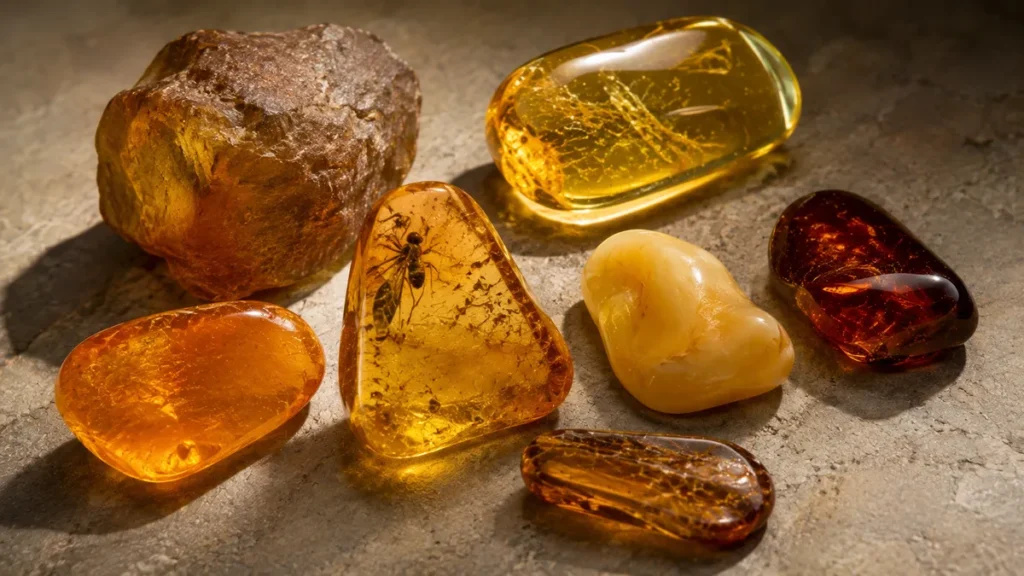
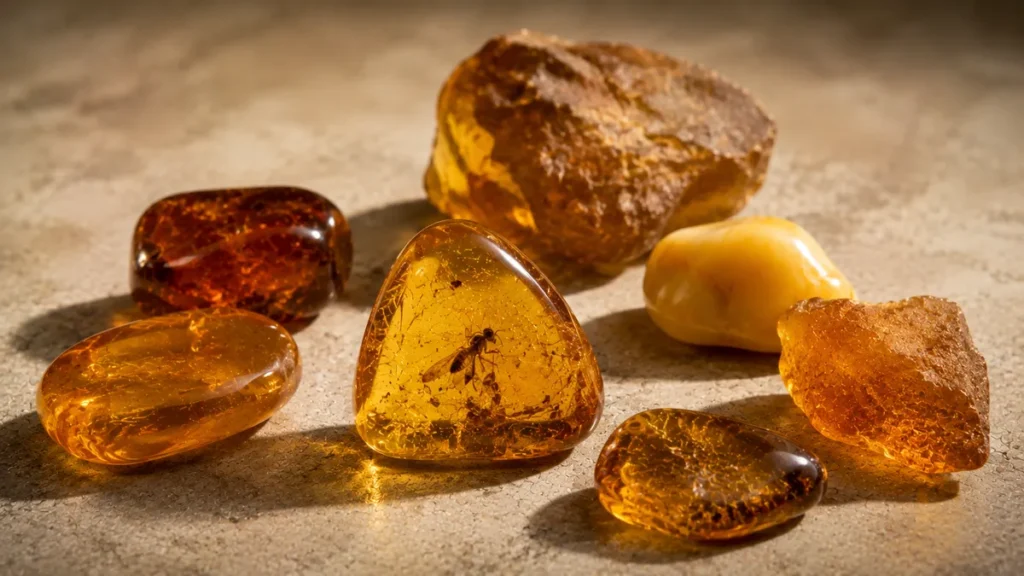
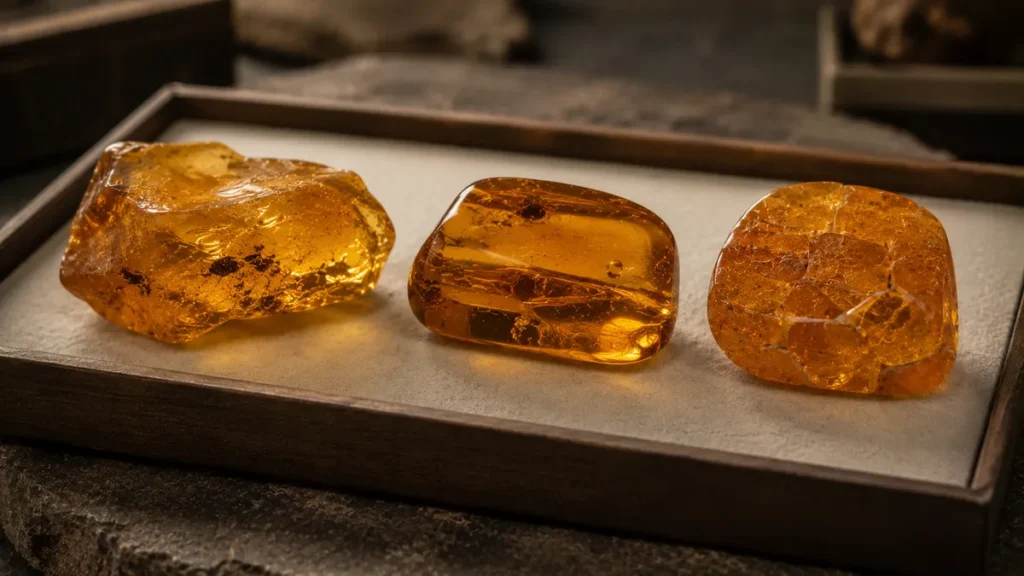
Natural amber can have a surprisingly varied appearance. It may be transparent, translucent, cloudy, milky, reddish, yellow, honey-colored, brown, or nearly opaque.
Its internal structure may also be irregular.
You may see:
- tiny bubbles
- cloudy areas
- flow structures
- internal fractures
- variations in transparency
- subtle changes in color
- small natural particles
These features are not automatically defects.
In fact, part of amber’s appeal comes from the fact that it is a natural fossil resin rather than a perfectly uniform manufactured material.
This is also why a highly uniform appearance should not automatically be treated as a sign of superior quality.
If you are unfamiliar with amber, it is useful to compare several genuine specimens before making a purchase.
3. Look at Color—but Don’t Choose by Color Alone
Color is one of the first things people notice about amber.
Common appearances include:
- pale yellow
- golden yellow
- honey
- orange
- reddish-brown
- white or milky
- brown
- dark brown
- greenish tones
- blue or blue-appearing amber in certain deposits and lighting conditions
Color can influence appearance, rarity, and sometimes value, but there is no universal rule that one color is always the best.
A darker piece is not automatically better than a lighter one.
A clear golden piece is not automatically more valuable than a cloudy piece.
And an unusual color should not be accepted as proof of authenticity.
Color can result from the resin’s original composition, internal structure, oxidation, inclusions, thickness, optical effects, geological history, and, in some cases, treatment.
If color is the main reason a seller describes a piece as “rare,” look more closely at the rest of the material before accepting the claim.
For a broader look at natural amber colors, see our guide to amber colors and what the different colors mean.
4. Examine Transparency and Clarity
Transparency is another important characteristic.
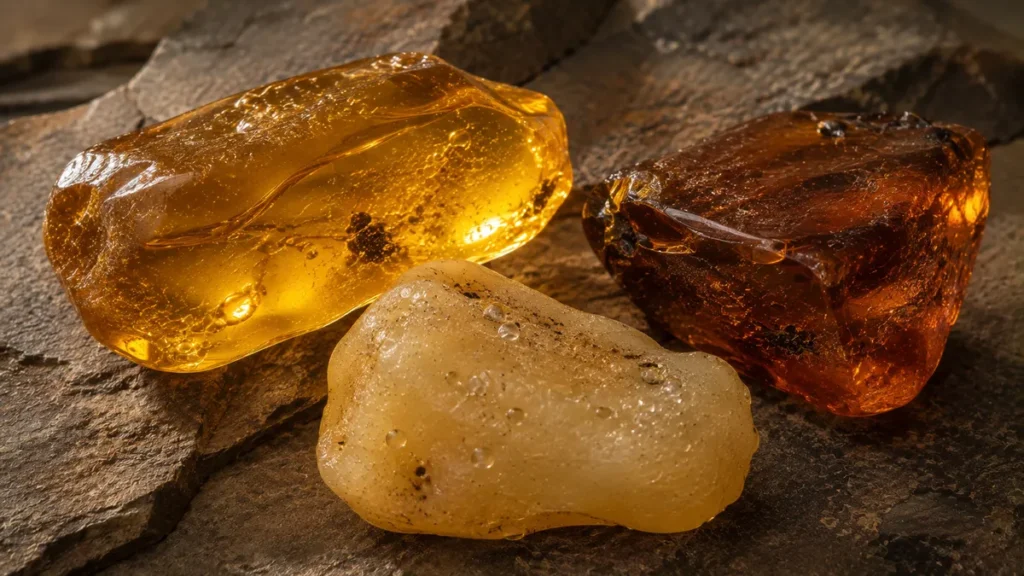
Some amber allows light to pass through easily, while other pieces appear cloudy or almost opaque.
Transparent amber can show its internal structures and inclusions particularly well. Cloudy or milky amber, however, is not necessarily inferior. Its appearance may result from microscopic bubbles, internal structures, or other natural characteristics.
The right question is not simply:
Is this amber clear?
Instead, ask:
Is the level of transparency attractive and appropriate for this particular piece?
For an inclusion specimen, transparency may be extremely important because it affects how easily the inclusion can be seen.
For jewelry, a slightly cloudy piece may still have a beautiful appearance and may be exactly what the buyer wants.
5. Look Carefully at the Inside
One of the easiest mistakes is to judge amber only from its surface.
If possible, examine the piece from different angles and under good lighting.
Look for:
- natural internal flow structures
- tiny bubbles
- cloudy zones
- fractures
- variations in transparency
- inclusions
- differences in color through the material
Natural amber often has a complex internal appearance.
This does not mean that every unusual internal feature proves authenticity. Synthetic materials can also contain bubbles, particles, or deliberately introduced features.
The goal is to look at the whole internal structure, rather than relying on one visual clue.
6. Pay Special Attention to Inclusions
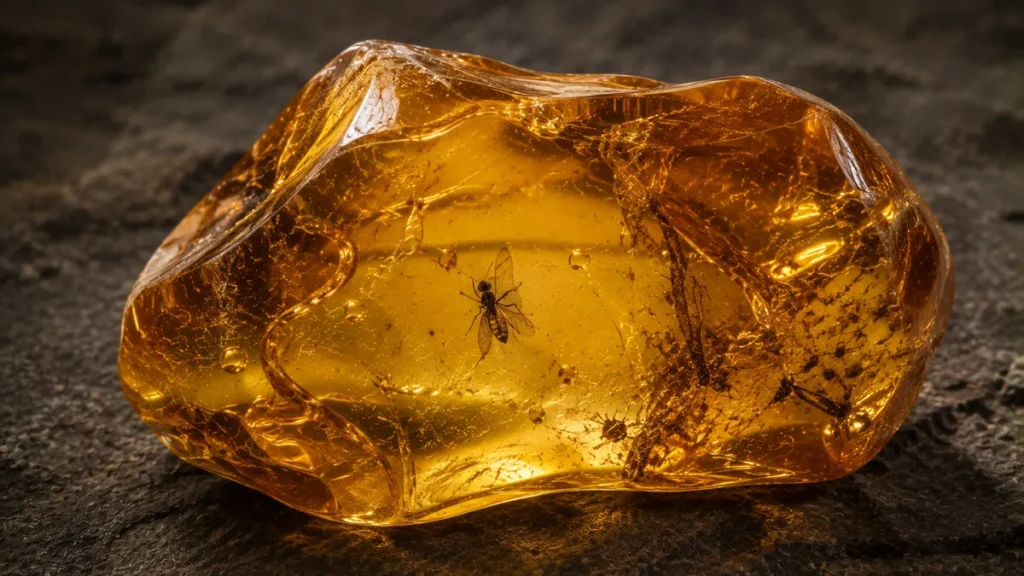
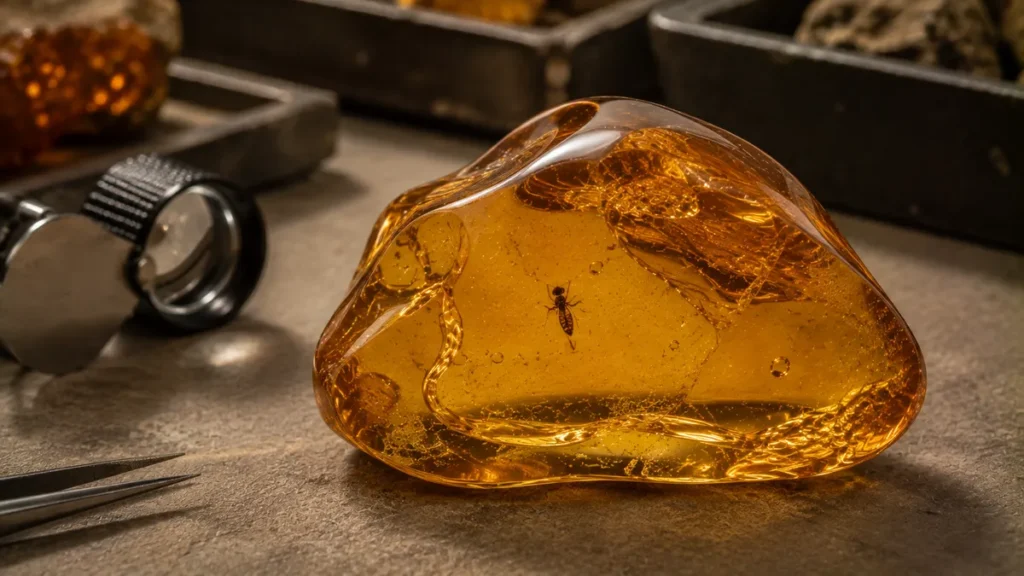
Inclusions are among the most fascinating features found in amber.
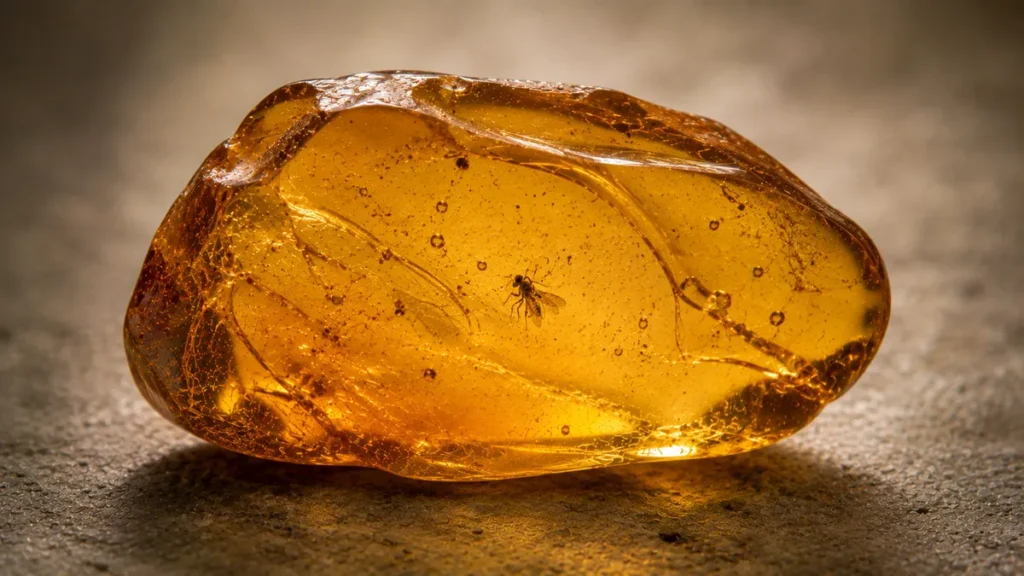
They can include insects, spiders and other arthropods, plant fragments, pollen, fungi, feathers, and other organic or inorganic material.
For collectors, an inclusion can dramatically change the character and significance of a piece.
But not every insect inclusion is automatically valuable.
Several factors matter:
- what the organism is
- how well it is preserved
- how complete it is
- how clearly it can be seen
- where it sits inside the amber
- whether the specimen has significant scientific or collecting interest
- the overall condition of the amber
An inclusion that is barely visible may be less desirable than one that is clearly preserved and easy to examine.
At the same time, a visually impressive inclusion is not necessarily rare or scientifically important.
If you are considering amber because of an inclusion, look beyond the simple statement that it “contains an insect.”
You want to know what is actually present and how well it has been preserved.
7. Don’t Assume Bigger Means Better
Size is easy to understand, which makes it tempting to use as a shortcut.
But a larger piece of amber is not automatically a better piece.
A large piece may have:
- attractive color
- good transparency
- interesting inclusions
- excellent natural form
Or it may simply be large.
A smaller specimen can sometimes be far more interesting because of its clarity, inclusion, rarity, or overall appearance.
Size should therefore be considered together with the other characteristics of the piece.
If two pieces are very different in quality, comparing them simply by weight can be misleading.
8. Check the Surface and Condition

Amber is relatively soft compared with many mineral gemstones, so surface condition deserves attention.
Look for:
- scratches
- chips
- cracks
- abrasions
- cloudy or damaged areas
- poorly finished edges
- signs of previous repair
Small imperfections are not necessarily a problem, especially in natural specimens.
What matters is whether the condition is appropriate for the piece and its intended use.
For jewelry, surface condition can be particularly important because amber may come into contact with harder materials during everyday wear.
For a natural specimen, some surface irregularity may simply be part of its character.
9. Examine the Craftsmanship if You Are Buying Jewelry
If you are purchasing amber jewelry rather than a loose specimen, you are evaluating more than the amber itself.
Pay attention to:
- the quality of the polish
- the shape and symmetry
- the smoothness of the edges
- drilling or setting work
- the quality of the metal or other materials used
- how securely the amber is mounted
- the overall finish
A beautiful piece of amber can be poorly presented, while a relatively simple piece can look excellent when it has been carefully cut and polished.
This is one reason the price of amber jewelry cannot be judged solely by the weight of the amber.
You are also paying for workmanship and the finished object.
10. Ask Whether the Amber Has Been Treated
Treatment is an important part of buying amber, particularly when color or clarity appears unusual.
Amber can be treated in different ways to modify its appearance. Some treatments affect color, while others may alter the way the material looks internally.
Treatment does not necessarily mean that the material is fake.
A treated piece can still contain genuine amber.
The important issue is disclosure.
If a seller presents treated amber as completely natural and untreated, that is a meaningful problem for a buyer.
When purchasing a more valuable piece, ask whether the amber has been:
- heated
- dyed
- clarified
- otherwise color-enhanced
- or subjected to another treatment
If the seller cannot clearly explain the treatment history of an expensive piece, be cautious.
11. Understand Pressed and Reconstructed Amber
Another distinction worth understanding is the difference between natural amber and reconstructed or pressed amber.
Pressed amber can be made from genuine amber fragments that are consolidated under controlled conditions.
That means it should not simply be treated as equivalent to ordinary plastic.
The material may contain genuine amber, but its structure and manufacturing history are different from those of a naturally formed single piece.
For a buyer, the key question is whether the material is accurately described.
If you are specifically looking for a natural, unassembled specimen, pressed or reconstructed amber is a different category and should be priced and represented accordingly.
12. Consider the Origin—but Don’t Overpay for a Name
Origin can provide useful information about amber, particularly for collectors and buyers interested in geological history.
Different amber deposits formed in different environments and geological periods, and they can have characteristic features.
But geographic origin should not become a shortcut for judging quality.
A famous geographic name does not automatically make every piece better.
Similarly, a less famous origin does not automatically make a piece uninteresting or low quality.
For most beginners, it is more useful to first understand the actual material in front of you—its appearance, condition, inclusions, treatment, and authenticity—before paying a premium simply for a geographic label.
If you are specifically interested in Baltic amber, our dedicated guide on what to look for when buying Baltic amber goes into the characteristics that matter when evaluating it.
13. Check the Seller’s Description Carefully
The seller’s description can tell you almost as much as the specimen itself.
Look for specific information rather than broad marketing language.
Useful details may include:
- whether the amber is natural
- whether it has been treated
- whether it is pressed or reconstructed
- where the seller says it comes from
- whether inclusions are natural or added
- measurements and weight
- whether repairs have been made
- whether the photographs accurately represent the actual piece
Be cautious with descriptions built almost entirely around words such as:
rare
museum quality
investment grade
100% authentic
extremely valuable
These phrases are not substitutes for evidence.
A trustworthy description should explain why a piece has particular characteristics rather than simply telling you that it is exceptional.
14. Be Careful With “Rare” and “Investment-Grade”
“Rare” is one of the most overused words in the gemstone and collectible market.
Something can be uncommon without being highly valuable.
Likewise, a piece can be beautiful and desirable without being a serious investment.
Terms such as “investment grade” should therefore be treated carefully unless they are supported by clear documentation and a credible market context.
For an ordinary buyer, it is usually more useful to ask:
- What makes this piece unusual?
- Is the feature genuinely uncommon?
- Is it natural?
- Is the condition good?
- Is the price reasonable compared with similar material?
Those questions are much more informative than relying on a marketing label.
15. Don’t Use a Single Home Test to Judge Amber
Home tests can sometimes provide useful clues, but none should be treated as a definitive authentication method on its own.
Depending on the material, buyers may hear about tests involving:
- salt water
- static electricity
- UV light
- weight
- warmth
- visual inspection
Each has limitations.
For example, a floating test depends on the density of both the amber and the liquid, while UV fluorescence can vary between specimens and should not be interpreted as a simple “glows = real” rule.
Similarly, an inclusion does not automatically prove authenticity because artificial inclusions can be introduced into imitation materials.
For valuable purchases, professional testing can provide much stronger evidence.
If you are unsure whether a piece is genuine, start with our guide on how to tell if amber is real rather than relying on a single home test.
16. Compare the Whole Piece, Not Just the Price
Price becomes much easier to understand once you stop treating it as the main quality indicator.
Two pieces may have very different prices because they differ in:
- color
- transparency
- inclusions
- rarity
- size
- condition
- treatment
- craftsmanship
- authenticity
- provenance
A higher price does not automatically mean higher quality.
Likewise, an inexpensive piece is not automatically a bargain.
Try to compare pieces with similar characteristics.
If one amber specimen costs substantially more than another, ask what explains the difference.
A convincing answer should come from the material itself, its history, its workmanship, or the market for that particular type of specimen—not simply from a seller’s claim that it is “special.”
17. Choose Amber According to Your Budget
Once you understand the characteristics that matter, set a budget before you start shopping seriously.
This can prevent an attractive piece from gradually turning into an expensive purchase simply because it has one unusual feature.
A beginner does not need to start with a rare collector specimen.
A modest piece with attractive color, good condition, and a trustworthy description can be a much better first purchase than an expensive piece whose value you cannot yet evaluate.
As your knowledge improves, you can become more selective.
The goal is not to buy the most expensive amber you can afford.
It is to buy a piece whose appearance, quality, authenticity, and price make sense together.
18. Know the Difference Between Quality and Value
Quality and value are related, but they are not identical.
A piece may have excellent transparency but little collector interest.
Another may be cloudy but contain an unusual and scientifically significant inclusion.
A large specimen may attract attention because of its size, while a smaller one may command more interest because of its rarity.
Value depends on what the market and buyers consider desirable, while quality describes the characteristics of the material and workmanship.
This distinction is important because it prevents you from searching for one universal definition of “high-quality amber.”
For a broader explanation of how different characteristics influence amber’s market value, see our guide to what makes amber valuable.
A Simple Amber Buying Checklist
Before buying, ask yourself:
About the amber
- Is the material clearly described?
- Do I understand its color and transparency?
- Have I looked at the internal structure?
- Are there visible inclusions?
- Is the surface in good condition?
- Does the piece show signs of treatment?
About the construction
- Is it natural amber or pressed/reconstructed material?
- If it is jewelry, is the craftsmanship good?
- Are the edges and polish well finished?
About authenticity
- Is the seller’s description specific?
- Are the claims supported by evidence?
- Am I relying on one home test?
- Would professional testing make sense for this purchase?
About the price
- Do I understand why this piece costs what it does?
- Am I paying for a real characteristic or simply a marketing label?
- Have I compared similar pieces?
- Does the purchase fit my budget?
If you can answer these questions comfortably, you are already in a much stronger position than someone choosing amber based only on color or price.
What Should a Beginner Avoid When Buying Amber?
There are a few common mistakes worth avoiding.
Buying only because the color looks unusual
Unusual color can be attractive, but appearance alone does not establish rarity, authenticity, or value.
Assuming an insect automatically means high value
The type, condition, visibility, completeness, and significance of the inclusion all matter.
Assuming heavier means better
Weight and size are only part of the picture.
Treating “natural” as a guarantee of high quality
Natural amber can vary enormously in appearance and condition.
Assuming pressed amber is the same as plastic
Pressed amber may be made from genuine amber fragments, but it is still different from naturally formed single-piece amber.
Trusting a single home test
No simple test should carry the entire burden of authentication.
Paying a premium for vague claims
Words such as “rare,” “museum quality,” or “investment grade” should be supported by specific information.
What Is the Best Amber for a Beginner?
There is no single type of amber that is best for everyone.
For a first purchase, however, it is usually sensible to choose a piece that is:
- clearly described
- reasonably priced
- in good condition
- visually attractive to you
- easy to examine
- sold by a seller who provides useful information
You do not need a rare inclusion or an expensive collector specimen to have a meaningful first piece of amber.
A straightforward, well-documented specimen can actually be a better learning experience.
Once you understand how amber varies in color, clarity, structure, inclusions, treatment, and value, you can make more specialized choices with greater confidence.
Final Thoughts
Choosing amber is less about finding a single “best” piece and more about understanding what you are actually buying.
Look beyond color.
Examine the internal structure. Pay attention to inclusions. Consider the condition and craftsmanship. Ask about treatment and whether the material is natural or reconstructed. Read the seller’s description carefully, and think about whether the price is supported by characteristics you can actually identify.
Most importantly, decide what matters to you before you start comparing pieces.
A collector may want an unusual inclusion. Someone buying jewelry may care more about color and craftsmanship. A beginner may simply want an attractive, genuine piece at a sensible price.
There is no universal answer.
The best amber is the piece whose material, characteristics, authenticity, purpose, and price all make sense together.
And once you learn how to evaluate those factors, choosing amber becomes much less about guessing—and much more about making an informed decision.
FAQ
What is the most important thing to look for when buying amber?
Authenticity should come first, followed by the characteristics that matter for your purpose. Color, transparency, inclusions, condition, treatment, craftsmanship, and price should then be considered together.
Is darker amber better than lighter amber?
Not necessarily. Amber color is largely a matter of appearance and preference, although certain colors or appearances may be more desirable in particular markets. Color alone does not determine quality or authenticity.
Does an insect inside amber make it more valuable?
Not automatically. The type of organism, its preservation, visibility, completeness, position, and potential scientific or collecting significance all influence its desirability.
Is pressed amber fake?
Pressed or reconstructed amber is different from a naturally formed single piece, but it may contain genuine amber. It should be accurately disclosed rather than automatically described as plastic.
Can I test amber at home?
You can use some home tests as supporting clues, but no single home test can reliably establish authenticity in every case. Valuable pieces may warrant professional examination.
Is Baltic amber always better?
No. Geographic origin can be important, but it does not automatically determine quality or value. The actual characteristics of the individual piece still matter.
Should I buy expensive amber as an investment?
Not simply because someone calls it an investment. Amber prices depend on many factors, and ordinary buyers should focus first on authenticity, quality, desirability, and whether the price is justified.
What is the best amber for a beginner?
A clearly described, authentic piece in good condition and within your budget is usually a sensible starting point. You do not need to begin with a rare or expensive collector specimen.