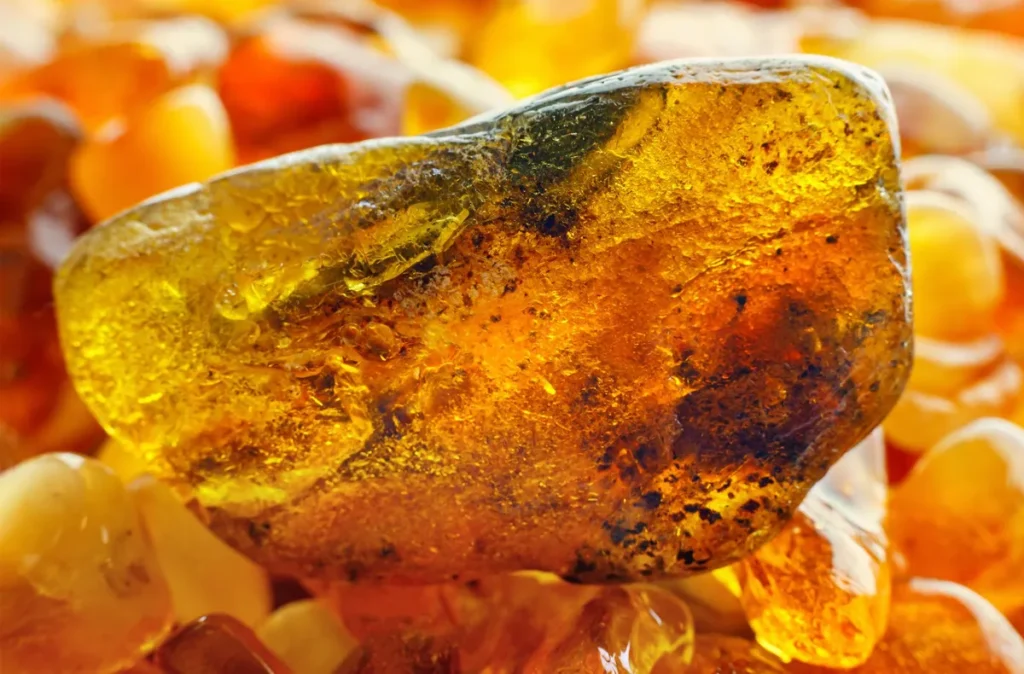
Amber is often admired for its color, clarity, and beauty. But to paleontologists, some pieces are valuable for an entirely different reason: they preserve evidence of life.
An insect trapped in amber is not simply an insect sealed inside a piece of fossilized resin. In the right circumstances, it can preserve anatomical details, biological interactions, plant material, fungi, microorganisms, and even clues about the environment in which it lived.
Taken together, these inclusions can help scientists reconstruct ancient forests, understand extinct species, trace evolutionary changes, and investigate how organisms interacted millions of years ago. Amber deposits can therefore serve as remarkably detailed windows into ecosystems that disappeared long before humans existed.
But amber fossils also need to be interpreted carefully. A single inclusion rarely tells an entire story. Scientists combine the fossil itself with the age and geological setting of the amber, other inclusions from the same deposit, and evidence from rocks and fossils found nearby.
That is what makes amber so scientifically fascinating: it does not merely preserve individual organisms. In exceptional deposits, it preserves fragments of entire ancient worlds.
What Is an Amber Fossil?
Amber is fossilized natural resin, and the organisms or biological materials preserved inside it are commonly called amber inclusions or fossil inclusions.
These can include:
- insects
- spiders and other arthropods
- plant fragments
- pollen
- flowers
- fungi
- microorganisms
- feathers
- hair
- bark and wood
- small pieces of organic debris
Not everything preserved inside amber is necessarily a fossil in the strictest sense. Some inclusions may be mineral particles, air bubbles, resin structures, or other non-biological material.
The important distinction is that amber can preserve both organisms and evidence of their surroundings.
This makes it different from many other fossil types. Conventional fossils often preserve hard structures such as bones, teeth, shells, or mineralized plant material. Amber can sometimes preserve much more delicate structures in three dimensions, including tiny anatomical features that would normally disappear during decomposition.
Why Is Amber So Important to Paleontology?
Amber occupies a special place in the fossil record because of its exceptional preservation potential.
When an organism becomes trapped in fresh resin, the sticky material can surround and isolate it. If the resin is subsequently buried and preserved, the inclusion may survive through geological time.
In exceptional cases, the result is a three-dimensional fossil with remarkably fine detail.
The preservation process itself is part of what makes these fossils so valuable. For a closer look at how resin can preserve insects in such remarkable detail, see our guide to why insects are preserved so well in amber.
Scientists can sometimes study features such as:
- body shape
- legs and antennae
- wings
- hairs
- surface textures
- mouthparts
- reproductive structures
- plant tissues
- fungal structures
This level of preservation can provide information that is difficult or impossible to obtain from flattened or fragmented fossils.
Amber deposits are therefore considered important fossil archives for terrestrial ecosystems, particularly for small organisms that are poorly represented elsewhere in the fossil record.
What Can Amber Fossils Tell Us About Ancient Life?
The scientific value of amber goes far beyond identifying individual insects.
By studying collections of inclusions, researchers can begin to ask much larger questions:
What lived in these ancient forests?
What did those ecosystems look like?
How did organisms interact?
Where did particular species live?
How have certain groups changed through evolution?
What was the environment like millions of years ago?
These questions make amber particularly valuable in paleobiology.
1. Amber Can Reveal Ancient Biodiversity
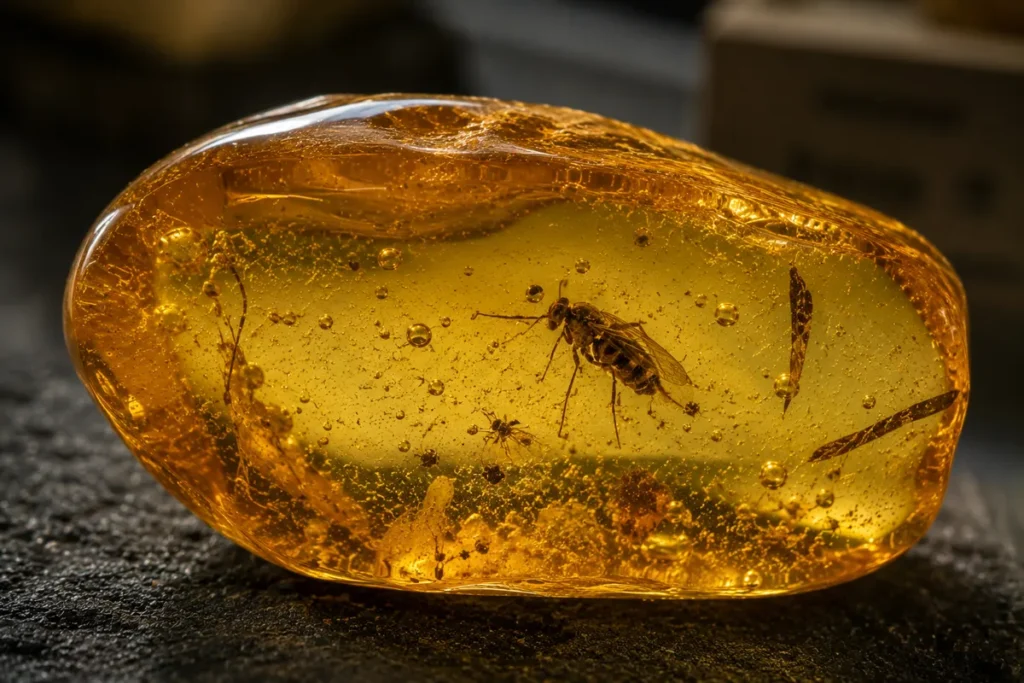
One of the simplest things amber can tell us is what kinds of organisms existed in a particular place and time.
A single amber deposit may contain numerous kinds of insects and other arthropods, along with plants, fungi, microorganisms, and other organic material.
When scientists study many inclusions from the same deposit, they can begin to reconstruct the biological community represented there.
This is much more informative than studying one isolated fossil.
For example, a deposit containing predators, herbivorous insects, decomposers, fungi, and plant material may provide evidence for a functioning terrestrial ecosystem rather than merely a collection of unrelated fossils.
Amber therefore preserves not only individual species, but sometimes a sample of the biological diversity of an ancient environment.
2. Amber Can Help Scientists Reconstruct Ancient Forests
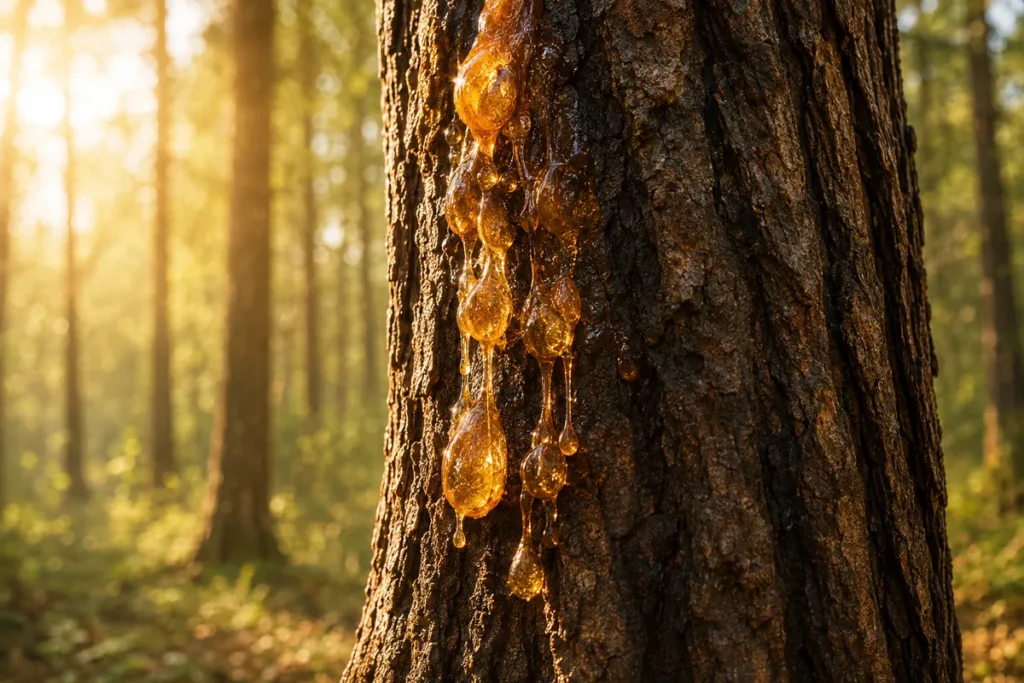
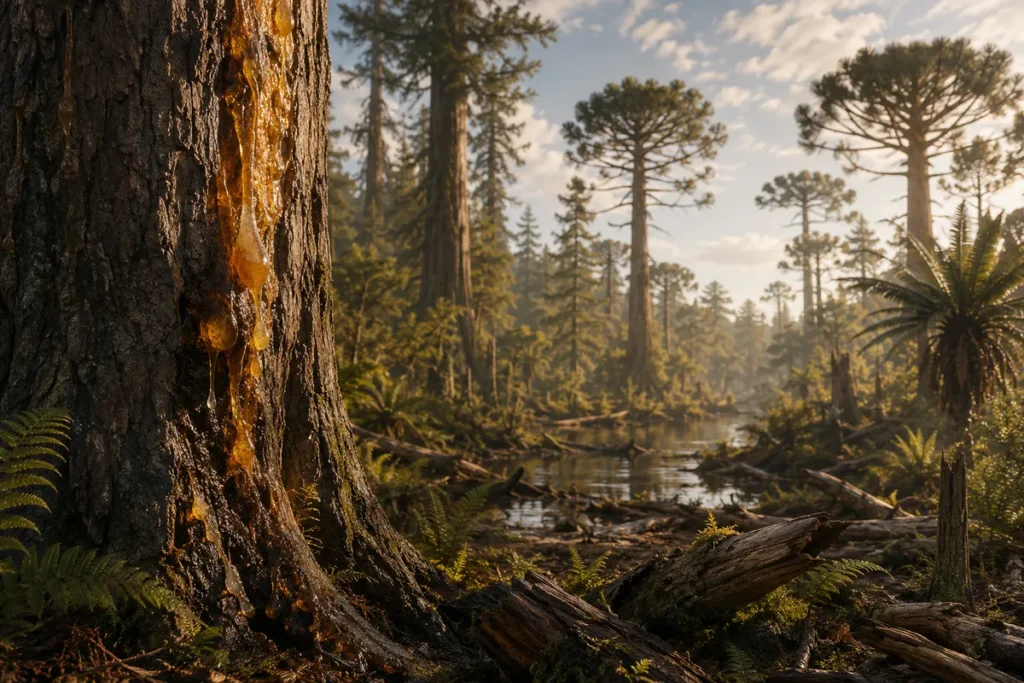
Amber originates from plant resin, so its presence already tells us something about the environment: resin-producing vegetation was growing somewhere nearby.
The inclusions can add considerably more information.
Plant fragments, pollen, fungi, insects, and other organisms can collectively provide clues about the vegetation and ecological conditions surrounding the resin-producing trees.
For instance, researchers have used amber inclusions to reconstruct ancient forest communities and terrestrial habitats in different parts of the world.
The combination of resin chemistry, geological setting, and fossil inclusions can be particularly useful because the fossils preserved in amber often represent organisms living close to the resin-producing vegetation.
That does not mean every organism found in amber lived directly on the tree.
Some organisms could have fallen, crawled, flown, or been transported into the resin before burial. Scientists therefore have to consider the entire depositional environment rather than assuming that every inclusion represents life immediately beside the resin source.
3. Amber Can Preserve Evidence of Evolution
Amber fossils can also contribute to our understanding of evolution.
A fossil does not have to be millions of years old simply to be interesting. Its real scientific value may come from a particular anatomical feature that helps connect extinct organisms with living groups.
Detailed amber fossils can preserve morphological characters that are difficult to see in other types of fossils.
Scientists can compare these structures with those of living and extinct relatives to investigate:
- evolutionary relationships
- anatomical changes
- extinct lineages
- the appearance of particular adaptations
- the persistence of ancient body forms
Some amber inclusions have provided important evidence about evolutionary traits that would otherwise be poorly represented in the fossil record.
In this sense, amber can act almost like a detailed snapshot of evolutionary history.
4. Amber Can Reveal Ancient Behavior
Perhaps one of the most remarkable features of amber fossils is that they can sometimes preserve behavior.
Most fossils tell us what an organism looked like.
Amber can occasionally provide clues about what an organism was doing.
For example, scientists have studied amber inclusions showing evidence consistent with:
- mating behavior
- predation
- feeding
- interactions between organisms
- insects visiting plants
- social or ecological relationships
Such evidence is extremely unusual in the fossil record because behavior normally disappears almost immediately after an organism dies.
Amber can occasionally capture a moment before the interaction is interrupted.
Researchers have reported examples of mating behavior and other behavioral indicators preserved in amber, including evidence that has helped illuminate the ecology of extinct organisms.
These fossils are sometimes described informally as “frozen behavior.”
The phrase is memorable, but scientists still need to interpret such evidence cautiously. A fossil captures a physical arrangement, and reconstructing the behavior that produced it requires comparison with living organisms and careful taphonomic analysis.
5. Amber Can Reveal Ancient Food Webs
Ancient ecosystems were not made up of isolated species.
Plants, herbivores, predators, decomposers, fungi, and microorganisms interacted with one another.
Amber can preserve representatives of several of these groups.
When researchers find predators alongside potential prey, plant-feeding insects alongside plant material, or fungi associated with organic remains, they may be able to reconstruct pieces of these ancient ecological relationships.
This is particularly useful because food webs are rarely preserved directly in the fossil record.
A single insect tells us about one organism.
A diverse assemblage of insects, plants, fungi, and other organisms can tell us something about how an ecosystem functioned.
Amber Can Preserve More Than Insects
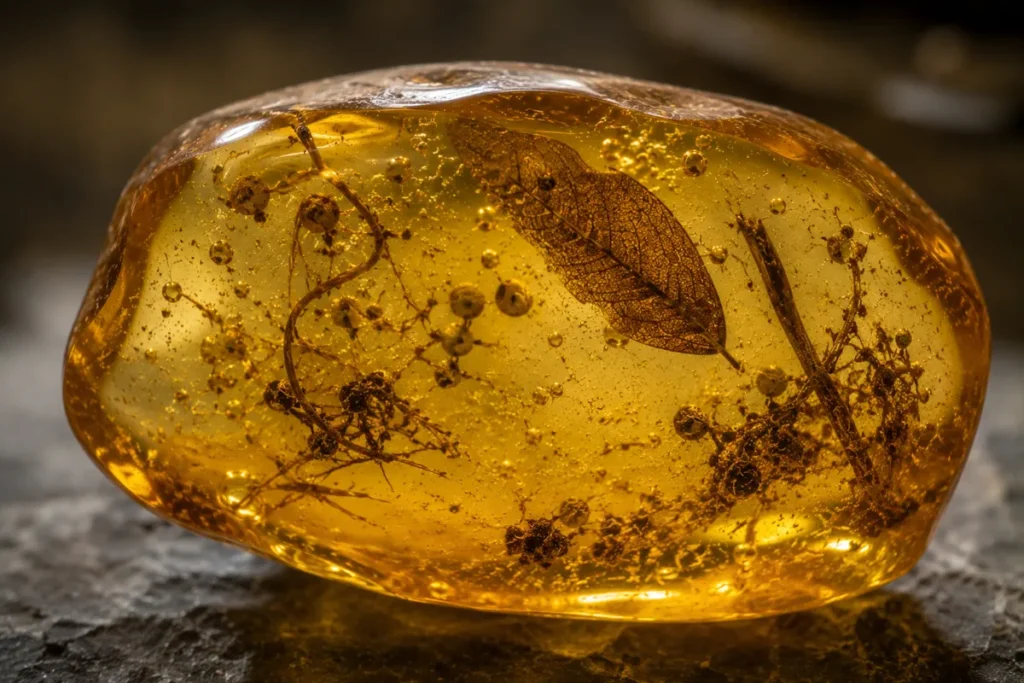
Insects receive much of the attention because they are relatively common in amber and can be spectacularly preserved.
But insects are only part of the story.
Amber can contain a surprisingly wide range of biological and non-biological material, from plant fragments and pollen to fungi, feathers, and tiny mineral particles. See our guide to what can be found inside amber for a closer look at the range of materials preserved in fossil resin.
Amber fossils can also include:
Spiders and other arthropods
Spiders, mites, crustaceans, springtails, and other arthropods occur in various amber deposits.
These fossils can reveal ecological relationships and help scientists understand the diversity of ancient terrestrial communities.
Plants
Leaves, flowers, pollen, seeds, bark, and other plant material can sometimes be preserved.
Plant inclusions can provide clues about vegetation and the environments in which resin-producing forests developed.
Fungi
Fungal structures can be preserved in amber and provide evidence of organisms that played important roles in ancient ecosystems.
Microorganisms
Some amber deposits contain exceptionally small biological inclusions.
One famous example is Triassic amber from the Dolomites that preserved microorganisms including bacteria, fungi, algae, and protozoans approximately 220 million years ago.
Feathers and hair
Rare amber fossils can preserve delicate structures such as feather fragments and hair.
These discoveries are especially valuable because such structures are difficult to preserve in many other fossil environments.
What Can Amber Tell Us About Ancient Climate?
Amber cannot simply be treated as a thermometer from the past.
However, amber deposits can contribute to paleoclimate research when their geological setting and biological contents are studied together.
The organisms preserved in amber had particular environmental requirements. Their presence can therefore provide clues about the habitats in which they lived.
Researchers can combine:
- fossil inclusions
- plant remains
- pollen
- sedimentology
- geological age
- resin chemistry
- other fossils from the same deposits
to build a broader picture of ancient environmental conditions.
For example, fossil-rich amber deposits from different periods and geographic regions have helped researchers investigate ancient forests and terrestrial environments, including ecosystems that existed under climatic conditions very different from those of today.
The key is that amber is one line of evidence among several, not a standalone climate record.
Amber Can Help Trace Ancient Geography
Amber fossils can also tell us where organisms lived in the distant past.
This field is known as paleobiogeography.
When a fossil group appears in one region millions of years ago and related organisms appear elsewhere, scientists can compare their ages, anatomy, and geological settings to investigate how distributions changed through time.
Amber is especially useful because its inclusions can be identified in considerable anatomical detail.
This has helped researchers investigate the historical distributions of insects and other organisms and reconstruct how ancient biological communities differed from those found today.
In other words, amber can provide clues not only about what lived, but also about where it lived.
Why Is the Geological Age of Amber So Important?
An amber fossil becomes much more scientifically meaningful when its geological age is well constrained.
Knowing that an insect existed is useful.
Knowing that it existed 100 million years ago, in a particular environment, alongside particular plants and other organisms, is much more informative.
Age allows scientists to place the fossil into an evolutionary and geological timeline.
This is one reason the question of how old amber is matters so much to paleontologists.
As discussed in our guide to how old amber is, scientists usually determine the age of amber deposits from their geological context rather than simply dating the amber itself.
Age estimates can involve stratigraphy, associated fossils, and radiometric dating of suitable rocks surrounding amber-bearing layers.
Once the age is established, the biological information preserved inside the amber becomes much easier to place into the broader history of life.
Different Amber Deposits Record Different Ancient Worlds
Amber is found in deposits ranging from the Mesozoic to the Cenozoic, and different deposits represent very different environments and moments in Earth’s history.
Amber deposits occur in many parts of the world, and each one can preserve evidence from a different period and environment. Our guide to where amber is found around the world provides a broader overview of the major amber-producing regions and deposits.
Burmese Amber
Burmese amber from Myanmar is famous for its exceptionally diverse Cretaceous inclusions.
It has yielded insects, arachnids, plants, microorganisms, and other organisms from an ecosystem that existed roughly 99 million years ago.
Because of its age and exceptional preservation, Burmese amber has become an important source of information about Cretaceous terrestrial life.
Baltic Amber
Baltic amber is much younger than Burmese amber, generally associated with the Eocene.
Its inclusions provide a detailed record of ancient ecosystems from a very different period in Earth’s history.
The enormous amount of Baltic amber available has also made it one of the most important amber deposits for studying fossil insects and other organisms.
Dominican Amber
Dominican amber is younger again, generally associated with the Miocene.
Its inclusions have provided important information about tropical ecosystems and the organisms that lived in them.
Other Amber Deposits
Important amber-bearing deposits also occur in places such as Lebanon, China, Mexico, Australia, New Zealand, and elsewhere.
Recent discoveries from Australia and New Zealand have expanded our understanding of ancient southern ecosystems and demonstrated that amber can preserve important terrestrial communities far beyond the classic Northern Hemisphere deposits.
Amber Can Preserve Entire Ecological Snapshots
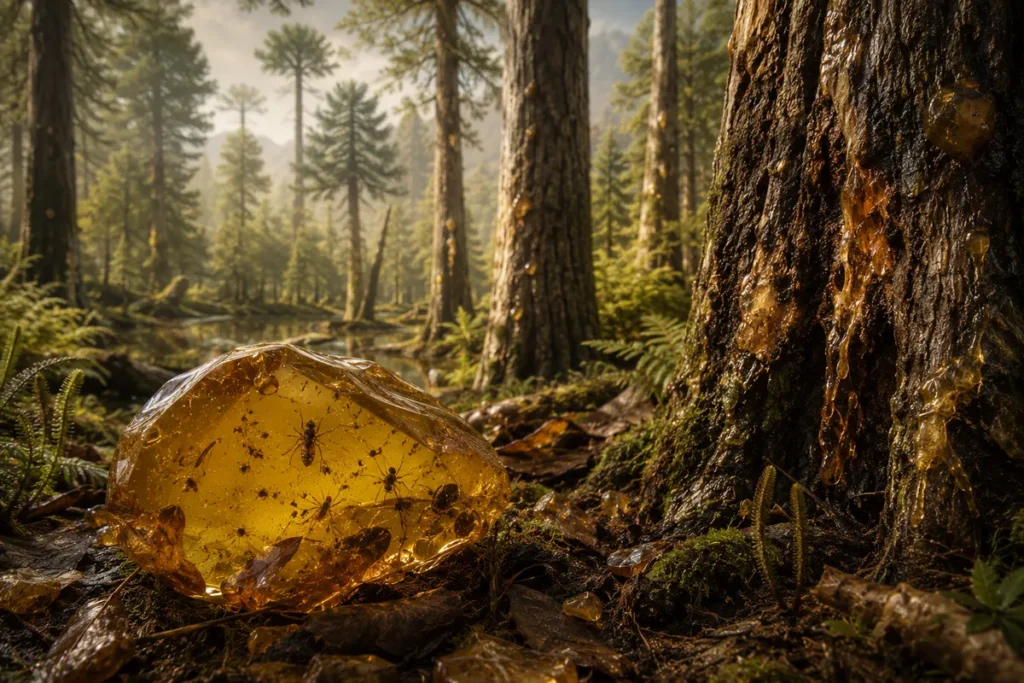
One of the most powerful ideas in amber research is that a deposit can contain many different pieces of the same ecosystem.
Imagine finding:
- a plant fragment
- pollen
- a fungus
- several insect species
- a spider
- a mite
- traces of other organisms
in amber associated with the same geological environment.
Each fossil provides one piece of information.
Together, they can reveal something much larger.
Researchers can investigate questions such as:
What plants were growing there?
Which insects lived among them?
What predators were present?
What organisms decomposed organic material?
Which species may have interacted?
What kind of forest or habitat existed?
This is why amber deposits are sometimes described as windows into ancient ecosystems rather than simply collections of fossil insects.
What Amber Fossils Cannot Tell Us
Amber is remarkable, but it is not a perfect record of the past.
There are important limitations.
Amber Does Not Preserve Everything
Only organisms that encountered resin and became trapped under favorable conditions had a chance of being preserved.
That means the organisms found in an amber deposit are not necessarily a complete representation of the ecosystem.
Some animals may have been too large.
Others may never have encountered resin.
Some may have decomposed before becoming preserved.
The fossil assemblage is therefore biased toward organisms and materials that could interact with resin and survive the preservation process.
An Amber Inclusion Does Not Automatically Prove Authenticity
A beautiful insect inside a piece of amber may look convincing, but the inclusion itself is not absolute proof that the material is natural amber.
Artificially created or manipulated specimens can contain introduced inclusions.
That is why an inclusion should be considered alongside the amber’s internal structure, surface characteristics, fluorescence, provenance, and other evidence.
For practical identification, see our guide on how to tell if amber is real.
Amber Is Not a Perfect Record of Ancient DNA
The idea that amber might preserve ancient DNA became famous through popular culture, particularly Jurassic Park.
The scientific reality is much less dramatic.
Amber can preserve extraordinary anatomical detail, but spectacular physical preservation does not mean that usable ancient DNA survives for tens of millions of years.
Amber’s scientific value comes primarily from its preservation of morphology, biological relationships, behavior, and ecological information—not from a reliable supply of recoverable dinosaur DNA.
The distinction is important.
Amber can preserve the evidence of ancient life without preserving its genetic material in a usable form.
Why Are Some Amber Fossils So Scientifically Valuable?
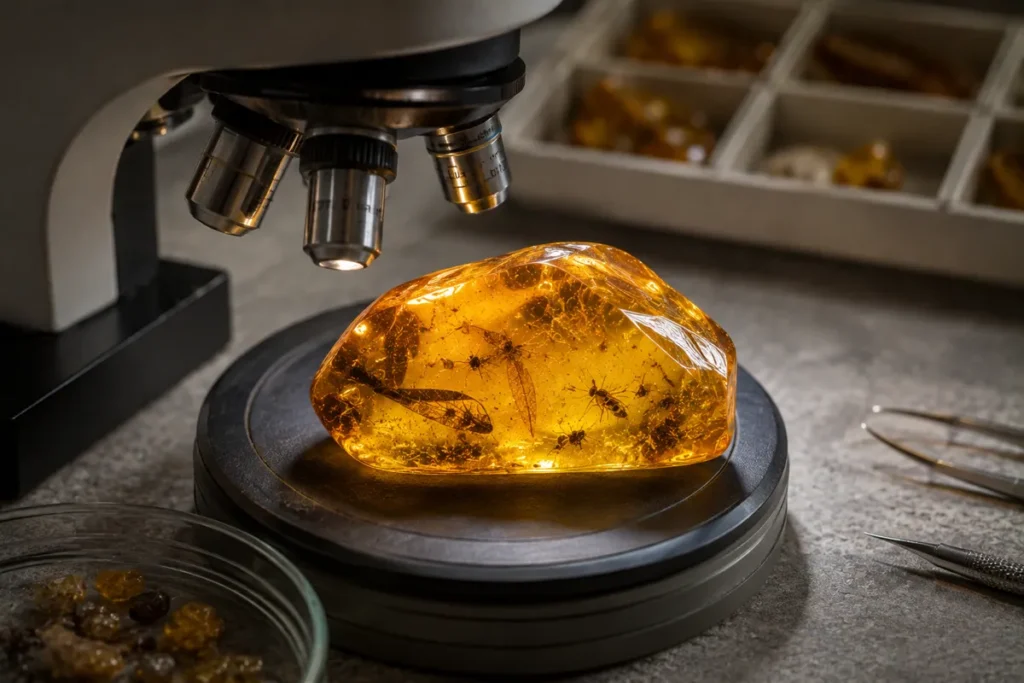
Not every insect trapped in amber is equally important to science.
Researchers may pay particular attention to specimens that are:
- exceptionally well preserved
- taxonomically unusual
- from a poorly known geological period
- from a poorly understood geographic region
- associated with rare plant or animal groups
- informative about behavior
- useful for evolutionary comparisons
- preserved alongside other organisms from the same ecosystem
Sometimes the most scientifically important specimen is not the largest or most visually impressive one.
A tiny organism with a previously unknown anatomical feature may tell scientists more about evolution than a spectacular-looking inclusion.
This is an important distinction between collector value and scientific value.
Can Amber Fossils Show Ancient Behavior?
In exceptional cases, yes—but interpretation must be cautious.
Some amber fossils preserve organisms in positions that strongly suggest interactions such as mating, predation, or feeding.
Other specimens preserve biological structures that provide clues about how an organism behaved.
Researchers can compare these fossil arrangements with living species and known biological behavior to develop hypotheses about the ancient event.
However, a fossil is still a snapshot.
Scientists must distinguish between:
what the fossil directly preserves
and
what scientists infer from it.
That distinction is essential in paleontology.
Why Amber Is Sometimes Called a Geological Time Capsule
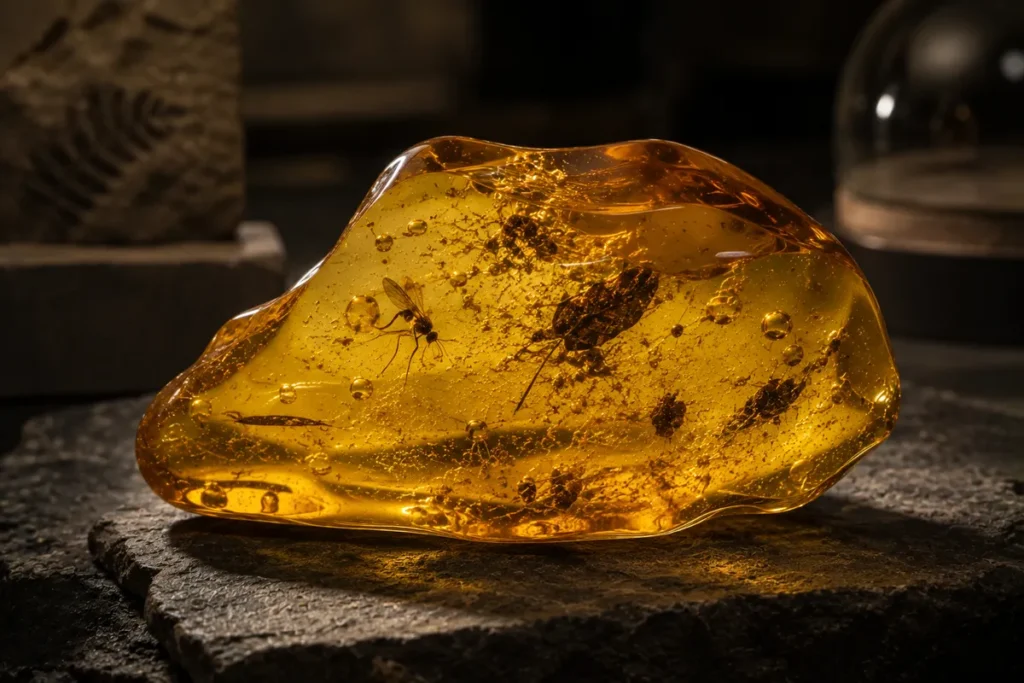
The phrase “time capsule” is especially appropriate when discussing amber.
A piece of amber can preserve:
- an organism
- a plant fragment
- a fungal structure
- a moment of interaction
- traces of an ancient environment
and carry that information across millions of years.
But amber is more than a container.
It is part of the geological story itself.
The resin came from ancient vegetation. It entered a particular environment. It trapped organisms under particular circumstances. It was buried, chemically altered, and preserved. The surrounding rocks then recorded the geological history of the deposit.
Studying all of these elements together allows scientists to reconstruct fragments of worlds that disappeared millions of years ago.
That is what makes amber extraordinary.
Amber and the History of Life
When we look at a piece of amber with the naked eye, it is easy to see only its surface beauty.
Its golden color.
Its transparency.
Its bubbles and internal patterns.
Perhaps a tiny insect suspended inside.
But to a paleontologist, that same piece may represent something much larger.
It can provide evidence about an extinct species.
It can reveal an ancient forest.
It can preserve a biological interaction.
It can help establish where an organism once lived.
It can provide evidence for evolutionary change.
And when many specimens from the same deposit are studied together, they can help reconstruct an ecosystem that existed long before the modern world took shape.
This is why amber has become such an important fossil material.
Its greatest scientific value is not simply that it preserves things beautifully.
It is that, in exceptional cases, it preserves relationships between organisms and their environment.
Final Thoughts
Amber fossils offer one of the clearest glimpses we have into certain ancient terrestrial ecosystems.
They can preserve insects, plants, fungi, microorganisms, feathers, and other delicate biological material in remarkable detail. When these fossils are studied together with their geological surroundings, they can help scientists reconstruct biodiversity, ancient habitats, evolutionary history, behavior, and biogeography.
But amber should not be treated as a perfect snapshot of the past.
Its fossil record is selective, its age can sometimes be difficult to establish precisely, and interpretations must be supported by geological and biological evidence.
Perhaps the most remarkable thing about amber is therefore not any single insect trapped inside it.
It is the possibility that one small piece of fossil resin can preserve a moment from an ecosystem that vanished millions of years ago.
And when scientists put many of those moments together, amber becomes something much more than a beautiful fossil.
It becomes a record of ancient life.
Frequently Asked Questions
What can amber tell us about ancient life?
Amber can provide information about ancient biodiversity, ecosystems, evolution, behavior, biogeography, and environmental conditions. Its inclusions can preserve organisms in three dimensions with exceptional anatomical detail.
Are insects in amber considered fossils?
Yes. Insects and other organisms preserved in ancient amber are generally regarded as fossil inclusions. However, not every inclusion inside amber is necessarily a fossil; some may be mineral particles, air bubbles, resin structures, or other non-biological material.
What kinds of fossils are found in amber?
Amber can contain insects, spiders, mites, other arthropods, plants, pollen, flowers, fungi, microorganisms, feathers, hair, bark, and other organic material.
Can amber preserve ancient behavior?
In rare cases, yes. Some amber inclusions preserve physical arrangements that provide evidence of mating, feeding, predation, or other biological interactions. Such interpretations require careful scientific analysis.
Can amber preserve DNA?
Amber can preserve exceptional physical detail, but that does not mean usable DNA survives for tens of millions of years. The scientific importance of amber primarily comes from its preservation of morphology and ecological information rather than recoverable ancient DNA.
Does an insect inside amber prove that the amber is real?
No. An inclusion can be an important clue, but it is not conclusive proof of authenticity. Artificially introduced inclusions are possible, so valuable specimens should be evaluated using multiple lines of evidence.
Which amber is most important for studying ancient life?
There is no single most important amber deposit. Burmese amber is especially important for Cretaceous life, Baltic amber provides a rich record of Eocene ecosystems, and Dominican amber preserves younger tropical ecosystems. Other deposits around the world contribute important evidence from different periods and environments.