
Amber is often pictured as warm golden yellow, but natural amber comes in a surprisingly wide range of colors.
Depending on the specimen, you may encounter pale yellow, honey, orange, reddish brown, deep brown, creamy white, greenish tones, and, more rarely, blue. Some pieces are almost transparent, while others are cloudy or opaque.
These differences are not simply a matter of appearance. Amber’s color can be influenced by its internal structure, tiny bubbles and inclusions, oxidation, geological history, and, in some cases, later treatment.
So what do the different amber colors actually mean? Is one color more natural than another? Does red amber mean better quality? And what about the unusual blue and green varieties?
This guide explains the major colors found in amber, what causes them, and what color can—and cannot—tell you about an amber specimen.
Why Does Amber Have Different Colors?
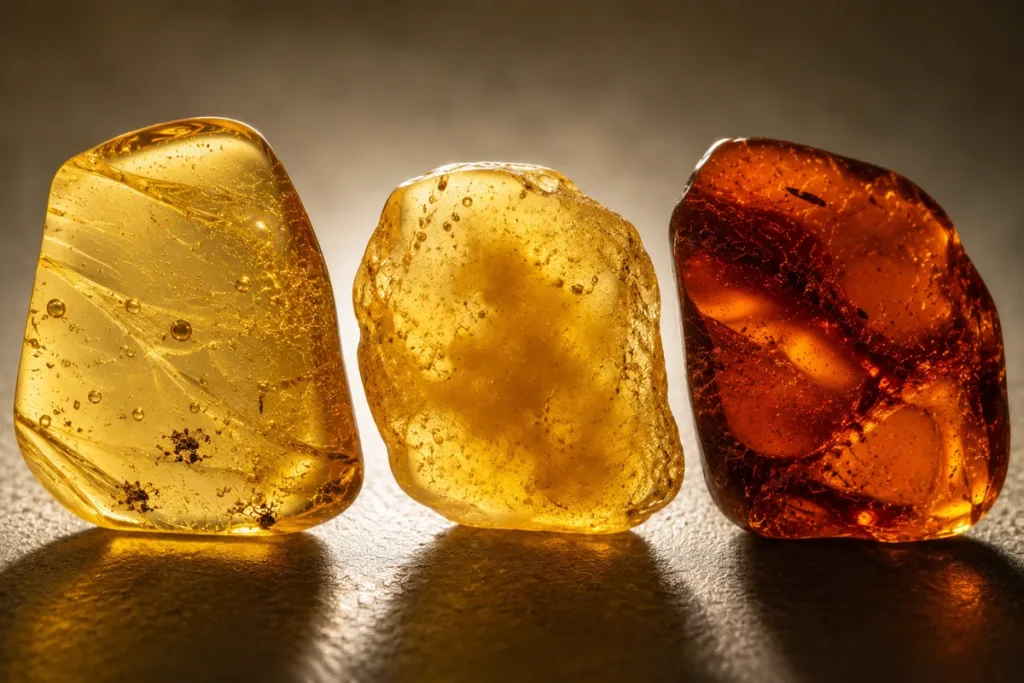
Amber formed from ancient tree resin, but not all resin followed exactly the same geological path.
Over millions of years, changes in the resin’s chemical composition, exposure to oxygen, internal bubbles, microscopic particles, and other structural features can influence the way light travels through the material.
The result is a broad range of appearances, from clear golden yellow to opaque white and deep reddish brown.
Amber can also change color over time. Oxidation may gradually darken yellow or orange amber, particularly when the surface has been exposed to air, light, or wear. GIA notes that cutting and polishing can make amber more susceptible to oxidation because the harder outer surface may be removed or thinned.
This is one reason two pieces of amber from the same broad region can look noticeably different.
Color, therefore, is part of the story—but it is not the whole story.
The Most Common Amber Colors
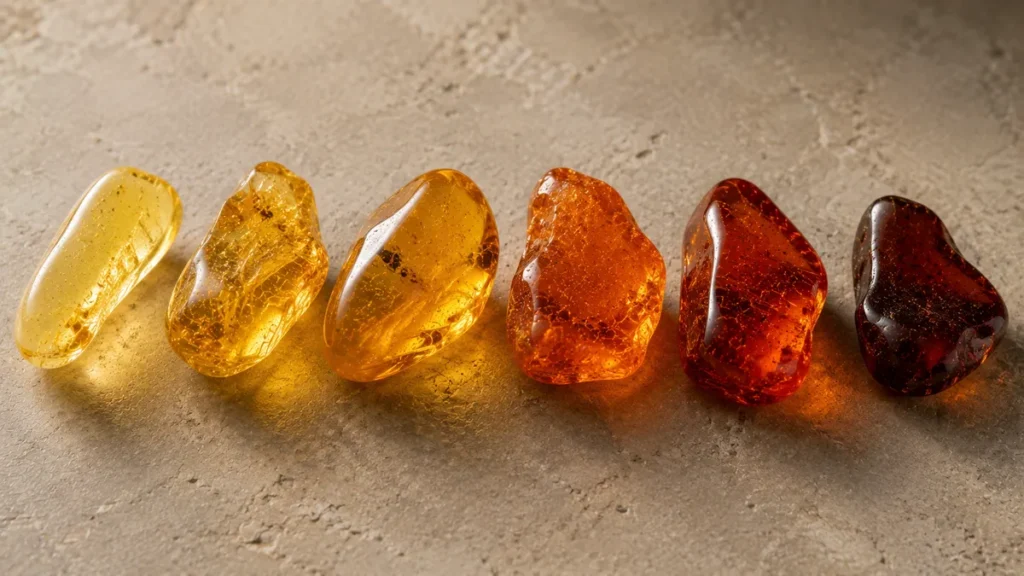
1. Yellow Amber
Yellow is one of the colors most people associate with amber.
It can range from very pale yellow to a richer, warmer golden tone. Some yellow amber is transparent or translucent, while other pieces have enough microscopic bubbles or internal structure to appear cloudy.
Clear yellow amber can have a particularly bright appearance because light passes through the material more easily.
Yellow amber is common enough that the word amber itself is often used to describe a warm yellow-brown color.
However, yellow does not automatically mean that a piece is natural, high quality, or Baltic in origin. Color alone cannot establish authenticity or geographic origin.
2. Golden Amber
Golden amber is perhaps the classic amber appearance: warm, honey-like, and translucent to transparent.
The color can range from a soft honey yellow to a deeper golden orange.
Golden amber is particularly attractive when it has good transparency and a relatively clean interior. When light passes through the material, natural variations in color and internal structure can give the piece a depth that is difficult to reproduce perfectly.
That said, golden color is not a guarantee of quality.
When assessing amber, color should be considered alongside transparency, surface condition, inclusions, craftsmanship, and whether the material has been treated.
For a broader explanation of what actually determines amber’s value, see our guide to what makes amber valuable.
3. Orange Amber
Orange amber sits between golden yellow and deeper reddish tones.
Some specimens have a bright orange appearance, while others are closer to honey or amber-orange. The color can become especially noticeable when a piece is viewed against a dark background or under transmitted light.
Orange amber is a natural part of the amber color spectrum and should not automatically be regarded as unusual or treated.
However, unusually intense or uneven coloration can sometimes warrant closer examination, particularly when buying a valuable piece.
Color enhancement and dyeing are known in the amber trade, and gemological examination can sometimes reveal evidence of treatment. GIA has documented treated amber in which coloration was modified through processes such as heating or dyeing.
4. Red and Reddish-Brown Amber
Red amber is less common than the familiar yellow and golden varieties.
Natural amber can develop reddish to reddish-brown tones, and oxidation is one factor that can contribute to darkening over time. GIA notes that fine translucent yellow or orange amber can gradually darken toward reddish brown and eventually black as oxidation progresses.
Reddish amber can therefore have a particularly rich appearance, ranging from warm orange-red to deep reddish brown.
In the marketplace, redder amber is sometimes considered more desirable than ordinary yellow amber. But it is important not to confuse color preference with proof of quality or authenticity.
A red appearance by itself does not prove that an amber specimen is natural.
In fact, amber can be artificially darkened through treatment. Heat treatment is used commercially to deepen the color of lighter amber, sometimes producing brownish yellow or brownish red material.
For this reason, unusually strong color should be evaluated together with the rest of the specimen rather than judged on color alone.
5. White or Milky Amber
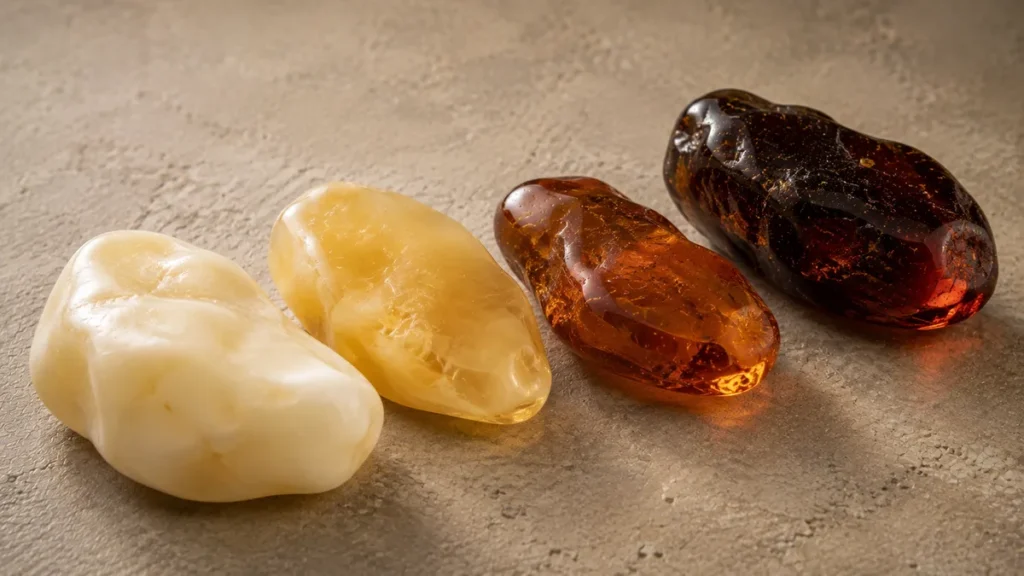
White amber is one of the most distinctive amber varieties.
Rather than being transparent, it can appear creamy, pale yellow, ivory, or almost opaque. Some pieces have a soft, cloud-like appearance that is very different from the clear golden amber most people picture.
The cloudy appearance can be related to microscopic gas bubbles and internal structures. GIA notes that gas bubbles are very common in amber and, when present in large numbers, can give it a cloudy appearance.
This is why white or milky amber should not automatically be regarded as a different material.
It is still amber; its appearance simply reflects a different internal structure and optical response.
White amber is also sometimes described using trade terms such as butterscotch amber, particularly when the material has a creamy, opaque yellow appearance.
These names describe appearance rather than establishing a separate geological species of amber.
6. Brown and Dark Amber
Amber can range from light brown to deep brown and, in some cases, almost black.
Darker amber may result from natural aging and oxidation, as well as differences in internal composition and structure.
A dark specimen can be transparent, translucent, or opaque. Some pieces reveal warm red or orange tones when held against strong light even though they appear very dark under ordinary lighting.
This is an important reminder when judging amber by eye:
the color you see on the surface is not always the full color of the material.
Thickness also matters. A thin edge may look golden or orange, while the thicker central part of the same piece can appear much darker.
7. Green Amber
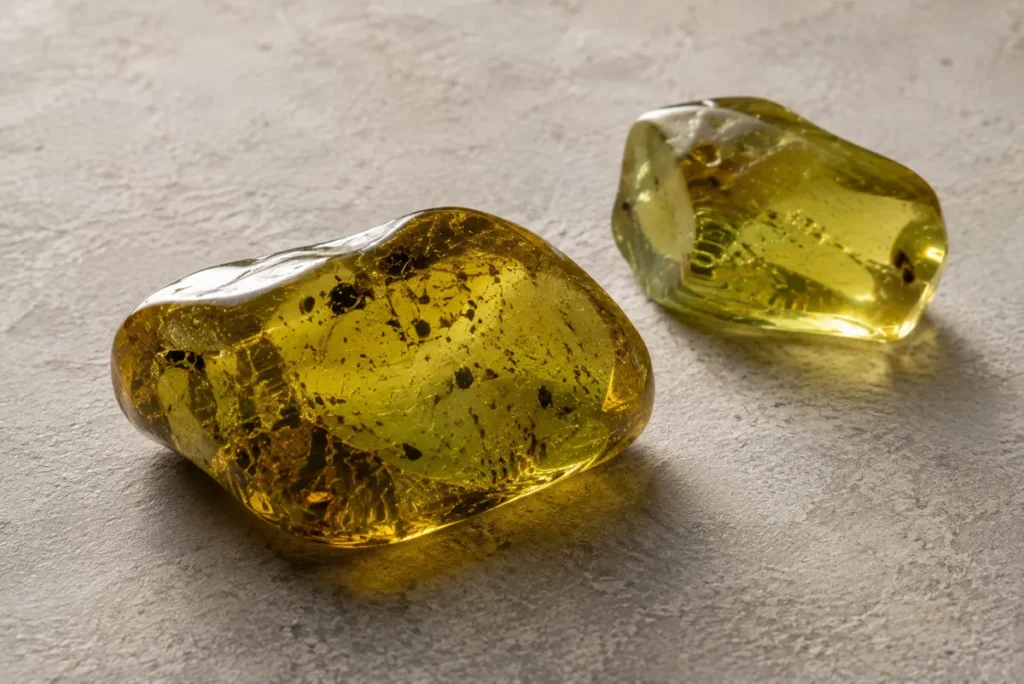
Green amber is one of the more complicated categories because the term can refer to materials with very different appearances and histories.
Some amber can show greenish tones, but bright green material deserves particular caution.
GIA specifically notes that bright yellow-green “green amber” can be the result of heat and pressure treatment.
That does not mean every amber specimen with a greenish appearance is treated. Rather, it means that color alone cannot tell you whether the material is natural or enhanced.
When a seller describes a piece simply as “natural green amber,” it is reasonable to ask whether the color is untreated and whether any treatment has been disclosed.
For valuable material, laboratory testing is a much better way to investigate treatment than relying on color alone.
8. Blue Amber
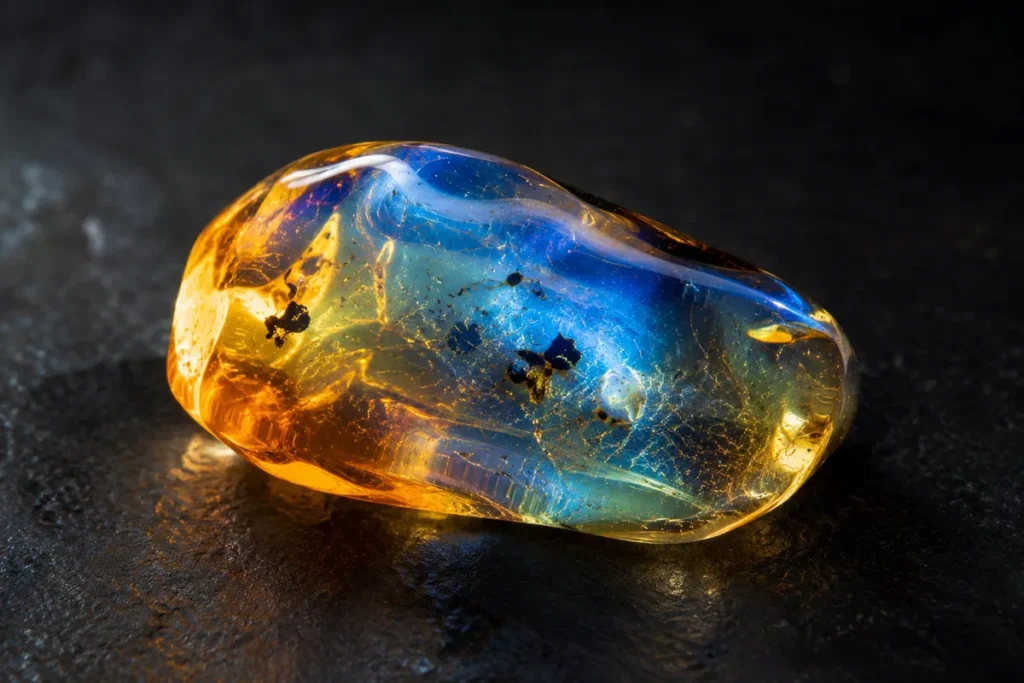
Blue amber is one of the most fascinating—and misunderstood—amber varieties.
It is particularly associated with amber from the Dominican Republic, although blue-appearing material has also been documented from Mexico and Myanmar.
What makes blue amber unusual is that its apparent blue color is not always a simple blue body color.
Some blue amber can appear yellow, orange, or reddish when viewed under ordinary conditions, yet show a striking blue or blue-green appearance under particular lighting and against a dark background.
Research published by GIA found that the blue appearance in Dominican and Indonesian amber is related to UV-stimulated fluorescence, rather than ordinary surface color or iridescence.
More recent GIA research also examined blue amber from the Dominican Republic, Mexico, and Myanmar and found differences in their fluorescence characteristics.
This makes blue amber a good example of why amber color can be more complicated than it first appears.
Is blue amber actually blue?
Sometimes—but not necessarily in the way a blue gemstone such as sapphire is blue.
The apparent blue can be strongly influenced by lighting, background, fluorescence, and the thickness of the material.
That is why a piece of blue amber may look surprisingly different when viewed under different lighting conditions.
Does Amber Color Tell You Where It Came From?
Not reliably on its own.
Certain colors are more strongly associated with particular amber-producing regions, and experienced specialists may use color as one piece of evidence when evaluating a specimen.
For example, blue amber is particularly associated with the Dominican Republic, while reddish amber is known from Myanmar.
But this does not mean:
yellow = Baltic
red = Myanmar
blue = Dominican Republic
Real amber identification is more complicated than that.
Geographic origin can involve a combination of physical characteristics, inclusions, geological context, spectroscopy, and other analytical methods.
If you’re interested in the major amber-producing regions, see our guide to where amber is found around the world.
Does Amber Color Affect Its Value?
Yes—but color is only one factor.
GIA identifies color as an important amber quality factor, while also considering clarity, inclusions, cut, and other characteristics.
Certain colors can command higher prices because they are relatively rare or especially attractive to collectors.
Reddish amber, for example, is generally considered more valuable than ordinary golden or yellow amber in GIA’s discussion of amber quality factors. Rare amber with attractive blue or green fluorescence can also be highly valued.
But rarity alone does not determine the price of an individual piece.
A transparent golden amber specimen with an exceptionally well-preserved insect may be considerably more interesting to a collector than a rare-looking piece with poor clarity or an unremarkable appearance.
In other words:
There is no single “most valuable amber color.”
Value depends on the combination of characteristics.
Does Darker Amber Mean Better Amber?
Not necessarily.
This is a common misconception.
Dark amber can be beautiful and collectible, but darker color does not automatically mean greater age, higher quality, or greater authenticity.
Natural oxidation can darken amber over time, while heat treatment can also change its color.
Similarly, a pale or almost colorless piece is not necessarily inferior.
In amber, transparency, clarity, inclusions, condition, treatment, origin, size, and craftsmanship can all matter alongside color.
Can You Tell if Amber Is Real by Its Color?
No.
Color can provide useful clues, but it is not a reliable authenticity test by itself.
Natural amber exists in many colors, and synthetic materials can be manufactured in colors that imitate natural amber.Amber occurs in many varieties, and color is only one of the characteristics used to describe them. You can also explore our guide to the different types of amber.
At the same time, genuine amber can be treated, polished, heated, dyed, or otherwise modified, meaning that color alone cannot tell you whether a specimen is natural and untreated.
If you’re trying to determine whether a piece is genuine, it is better to consider several characteristics together, including internal structure, inclusions, weight, surface characteristics, fluorescence, and other identification methods.
For a broader introduction to amber identification, see how to tell if amber is real.
What Is the Most Common Amber Color?
Yellow and golden amber are among the most familiar and widely recognized colors.
However, “amber” is not limited to a single shade.
Natural specimens can range from pale yellow and honey to orange, reddish brown, white, and dark brown, with rarer blue or green appearances also known.
This variety is part of what makes amber so interesting.
Two pieces can come from broadly similar geological environments yet look completely different once cut, polished, or viewed under different lighting conditions.
Amber Color Chart: A Quick Guide
| Amber color | Typical appearance | What to know |
| Yellow | Pale to warm yellow | One of the most familiar natural colors |
| Golden | Honey to rich golden yellow | Classic amber appearance |
| Red / reddish brown | Warm red to deep reddish brown | Can result partly from oxidation; treatments also exist |
| White / milky | Creamy, cloudy, opaque | Often associated with abundant microscopic bubbles |
| Brown | Light to deep brown | Can become darker through oxidation |
| Dark / black | Very dark brown to nearly black | May appear lighter when viewed in transmitted light |
| Green | Greenish to yellow-green | Bright green material may be treated |
| Blue | Blue or blue-green appearance under certain conditions | Rare; often related to fluorescence rather than simple body color |
| Orange | Yellow-orange to deeper orange | Common natural color range |
The chart is useful as a starting point, but it should not be used as an identification chart. Color alone cannot establish whether a piece is natural, treated, synthetic, or from a particular geographic origin.
Final Thoughts
Amber’s colors are one of the easiest things to notice—and one of the easiest things to misunderstand.
The familiar golden yellow is only the beginning. Natural amber can appear pale, honey-colored, orange, reddish brown, creamy white, dark brown, and, in rare cases, blue or green.
Some colors are related to the way the resin changed during geological time. Others can be influenced by oxidation, internal bubbles, inclusions, thickness, or the way light interacts with the material. And in the marketplace, treatment can further alter amber’s appearance.
Most importantly, color should be treated as one characteristic, not a verdict.
A beautiful red piece is not automatically better than a yellow one. A blue-looking specimen is not automatically more valuable. And a particular color cannot, by itself, prove that amber is genuine.
The more you learn to look beyond color—to transparency, internal structure, inclusions, treatment, and origin—the easier it becomes to understand what you’re actually looking at.
That is where amber becomes especially interesting: its color is not just decoration. It is part of the geological and visual history recorded inside the material.
FAQ
What is the most common color of amber?
Yellow and golden amber are among the most familiar colors. Amber can also occur in orange, reddish brown, white, brown, and darker shades, with rarer blue and green appearances.
What does red amber mean?
Red or reddish-brown amber is a natural color range that can be associated with oxidation and other changes in the material. However, red color alone does not prove that amber is natural or untreated.
Is white amber real?
Yes. Natural amber can be white, creamy, cloudy, or almost opaque. Microscopic gas bubbles and internal structures can contribute to its milky appearance.
Is blue amber naturally blue?
Blue amber is unusual and can show a blue or blue-green appearance under particular lighting conditions. In some important blue amber varieties, the apparent blue color is strongly related to fluorescence rather than a simple blue body color.
Is green amber natural?
Greenish amber exists, but bright yellow-green material may have been treated. Color alone cannot determine whether a green-looking amber specimen is natural or enhanced.
Which amber color is the most valuable?
There is no single universally most valuable color. Rarity, attractiveness, transparency, inclusions, treatment, origin, size, and condition can all affect value. Some reddish amber and rare blue or green fluorescent material can command higher prices, but color is only one factor.
Can amber become darker with age?
Yes. Oxidation can gradually darken amber, sometimes changing yellow or orange material toward reddish brown or darker shades. Heat and light can accelerate this process.
Can you identify real amber by its color?
No. Color can provide clues, but it is not a standalone authenticity test. A reliable assessment should consider multiple characteristics and, for valuable specimens, professional testing.