
Amber can be surprisingly difficult to price.
Two pieces may look similar at first glance, yet one can be worth considerably more than the other. A small piece containing a beautifully preserved insect may attract far more interest than a much larger piece of clean amber. A transparent golden specimen may command a premium over cloudy material, while a rare color or unusual inclusion can change the value again.
So what actually makes amber valuable?
The answer is not simply color, size, or age.
Amber value comes from a combination of characteristics, including color, transparency, inclusions, origin, treatment, size, condition, craftsmanship, and rarity. The relative importance of each factor also depends on what kind of amber is being evaluated and whether it is being sold as jewelry, a collector’s specimen, or simply as decorative material.
This guide explains the main factors that influence amber quality and price, how collectors and buyers look at amber, and why there is no single price per gram that applies to every piece.
What Determines the Value of Amber?
There is no universal formula for pricing amber.
Unlike diamonds, which are commonly discussed using a standardized set of grading criteria, amber is a much more varied organic gem material. A piece may be valuable because of its color, exceptional clarity, an unusual fossil inclusion, its geographic origin, its size, or simply because it is an especially attractive and well-crafted specimen.
GIA identifies several important quality factors for amber, including color, clarity, cut, and carat weight, while also noting the importance of inclusions, treatments, and origin.
For a buyer, this means one important thing:
Never judge the value of amber from a single characteristic.
A large piece is not automatically valuable. A dark piece is not automatically better. And a piece with an insect inside is not automatically rare or genuine.
The overall combination is what matters.
1. Color
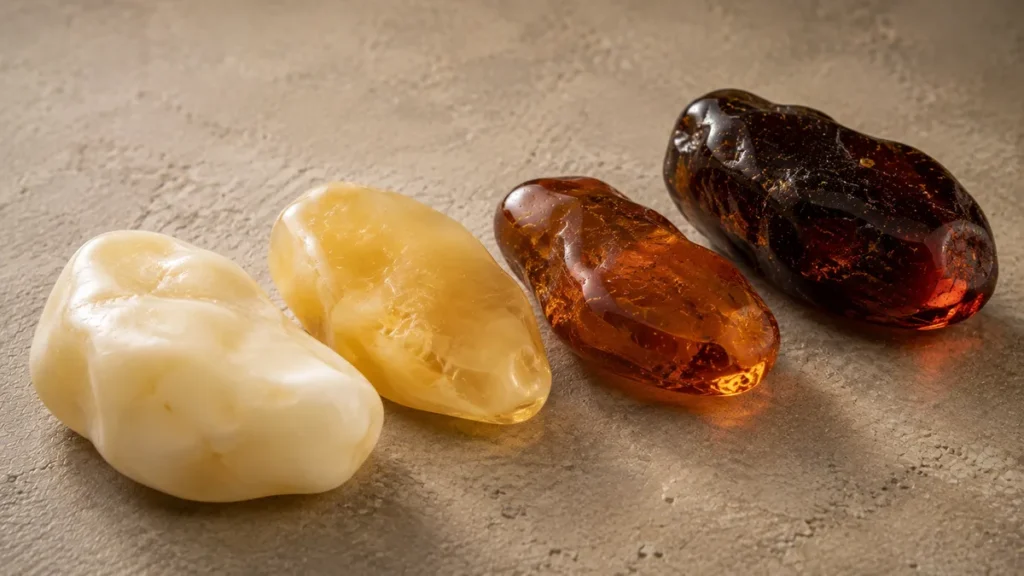
Color is one of the first things people notice when looking at amber, and it can have a significant influence on value.
Natural amber can occur in a broad range of colors, including:
- pale yellow
- golden yellow
- honey
- orange
- reddish brown
- white or milky
- brown
- dark brown
- greenish tones
- rare blue-appearing material
GIA notes that reddish amber generally commands more value than golden amber, while golden amber is generally more valuable than ordinary yellow amber. Rare amber showing attractive bluish or greenish fluorescence can also be highly valued.
But this does not mean that one color is always worth more than another.
Color preference varies among buyers, collectors, and markets. A transparent golden specimen with an exceptional inclusion may be much more desirable than a rare-colored piece with poor clarity or unattractive treatment.
Color can also be modified through treatment. GIA notes that amber may be altered through heat treatment or dyeing, so unusually strong or vivid color should not be treated as proof of natural quality.
If you want to explore amber colors in more detail, see our guide to amber colors and what the different colors mean.
2. Transparency and Clarity
Transparency is another important factor.
In general, transparent amber tends to be more valuable than cloudy material. Clear amber allows light to travel through the specimen, revealing its depth of color and internal structure.
However, amber is different from many gemstones because clarity is not always about being completely free of inclusions.
A clean piece of transparent amber may be beautiful, but a specimen containing a rare or interesting fossil can be considerably more valuable.
GIA specifically notes that transparent amber is generally more valuable than cloudy amber, while interesting plant or animal inclusions can add substantial value to a specimen.
This creates an important distinction:
Clarity can increase value, but an interesting inclusion can be even more important.
In other words, the “best” amber is not necessarily the amber with nothing inside it.
3. Inclusions
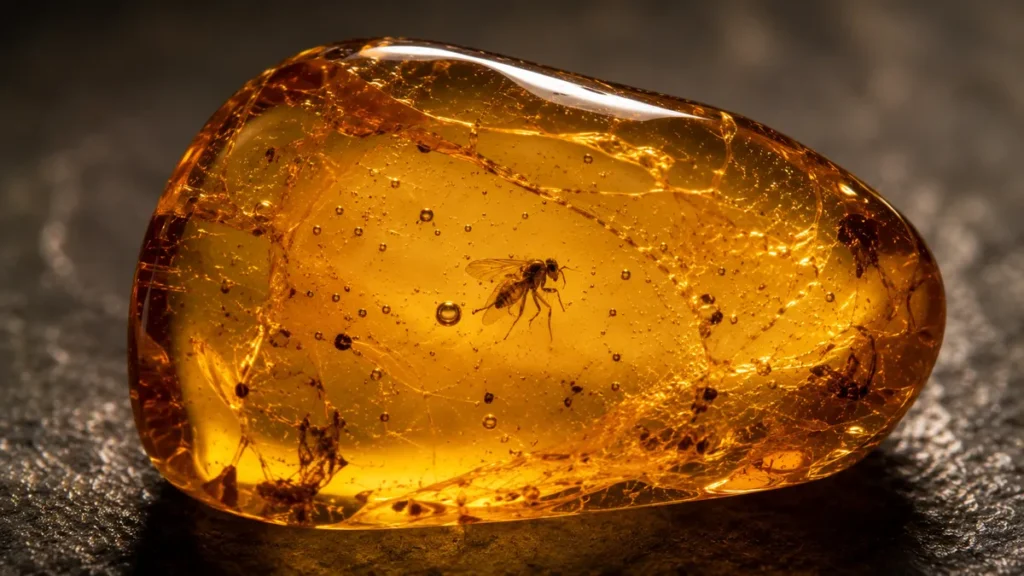
For collectors, inclusions can be among the most important features in amber.
An inclusion is something naturally trapped within the resin before it became fossilized. These can include:
- insects
- spiders
- other arthropods
- plant fragments
- flowers
- leaves
- seeds
- pollen
- fungi
- small pieces of organic material
But simply having an insect inside amber does not automatically make a specimen valuable.
What matters is what the inclusion is, how well it is preserved, how clearly it can be seen, and whether the inclusion is scientifically or aesthetically interesting.
A complete and well-preserved specimen can be far more desirable than a common insect that is only partially visible.
GIA notes that rare inclusions such as lizards, scorpions, snails, frogs, and complete flowers can be particularly valuable. Inclusions that capture a distinctive moment, such as an insect caught in a web or evidence of predator-prey interaction, can also be highly prized.
This is one reason amber with an interesting inclusion can be worth dramatically more than ordinary jewelry-grade amber.
Does an insect automatically make amber expensive?
No.
This is an important point for buyers.
An insect inclusion should be evaluated for:
- species or type
- completeness
- visibility
- preservation
- position within the amber
- scientific interest
- rarity
- condition of the surrounding amber
A tiny, poorly preserved inclusion that is difficult to identify is not equivalent to a complete and exceptionally preserved specimen.
And because artificial inclusions exist, the presence of an insect should never be treated as proof of authenticity by itself.
4. Rarity
Rarity is one of the simplest concepts behind value.
If something is difficult to find and desirable to collectors, its price can rise.
This applies to amber in several ways.
A specimen may be rare because of:
- an unusual color
- an uncommon inclusion
- an exceptionally complete fossil
- an unusual biological interaction
- an unusual geological origin
- an unusually large size
- an exceptional combination of several characteristics
The important point is that rarity and desirability have to work together.
Something can be rare without being especially valuable if collectors do not find it attractive or interesting.
Conversely, a relatively common type of amber can still command a good price when it has excellent transparency, attractive color, beautiful craftsmanship, or a particularly appealing inclusion.
5. Geographic Origin
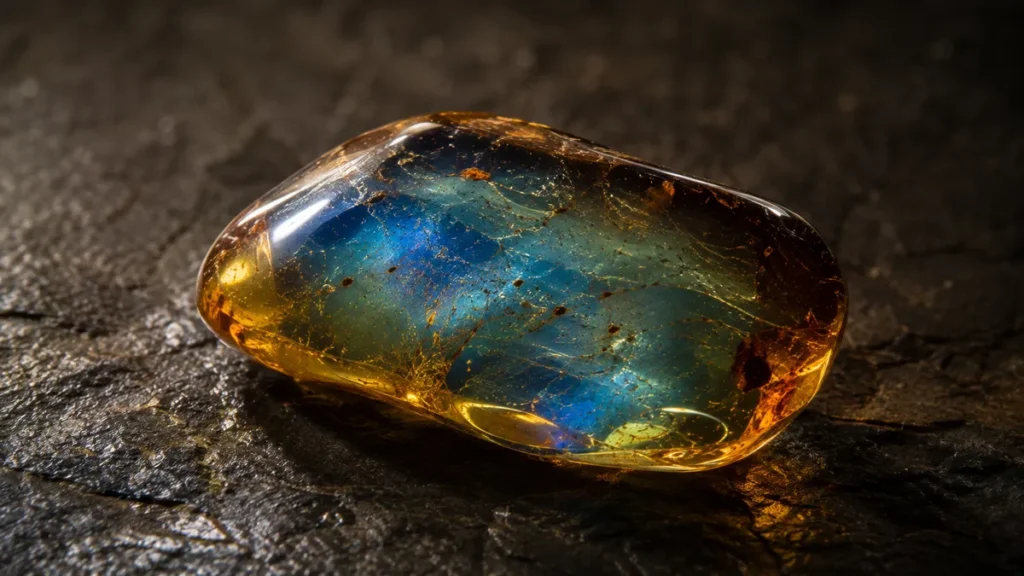
Where amber comes from can also influence its value.
Amber occurs in many parts of the world, including the Baltic region, the Dominican Republic, Myanmar, Mexico, and other areas.
Some origins have developed strong reputations among collectors because of their characteristic material, geological history, or inclusions.
Baltic amber, for example, is particularly well known in the jewelry and collector markets. GIA notes that Baltic amber is generally more expensive than Dominican amber, although this does not mean that every piece of Baltic amber is more valuable than every piece from the Dominican Republic.
This distinction is important.
Origin is a value factor, not a guarantee of value.
A mediocre piece from a famous locality may be less desirable than an exceptional specimen from somewhere else.
Origin also needs to be established carefully. A seller’s geographic description should not automatically be accepted as proof of provenance.
For more background, see our guide to where amber is found around the world.
6. Treatment
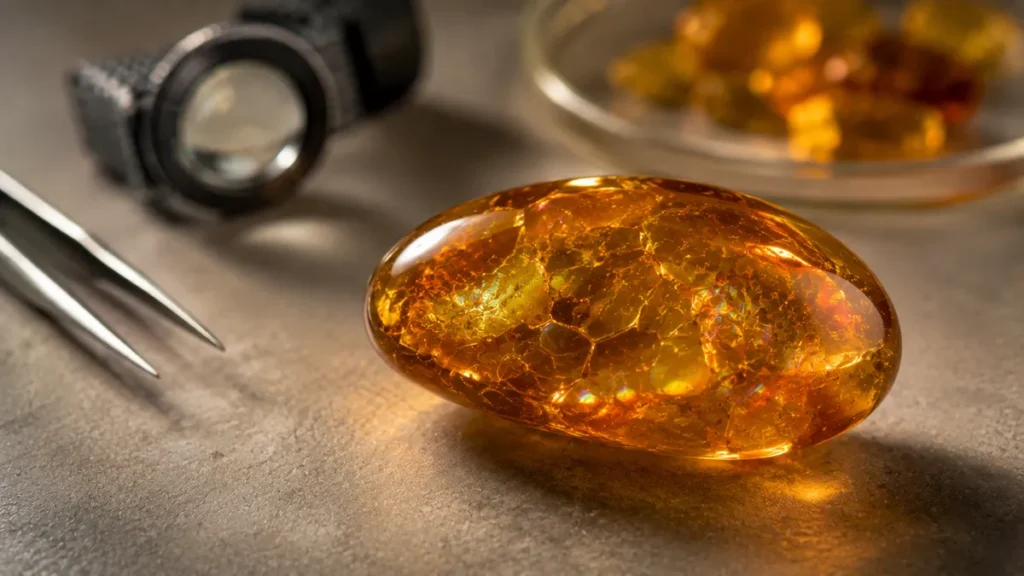
Treatment can have a significant effect on how amber looks—and therefore how buyers perceive its value.
Amber can be treated to change characteristics such as:
- color
- transparency
- appearance
- surface characteristics
GIA notes that amber can be modified through heat treatment and dyeing. Cloudy amber can also be treated in ways that improve apparent clarity, sometimes producing characteristic circular crack-like patterns known as sun spangles.
Treatment does not necessarily mean that the underlying material is fake.
This distinction is important.
A piece of amber can be genuine amber and still have been treated.
The real question is:
What material is it, and what has been done to it?
For valuable purchases, buyers should ask whether treatment has been disclosed and, when necessary, seek professional testing.
This is particularly important when a piece has an unusually vivid color, exceptional clarity, or an appearance that seems too perfect for its price.
7. Size and Weight
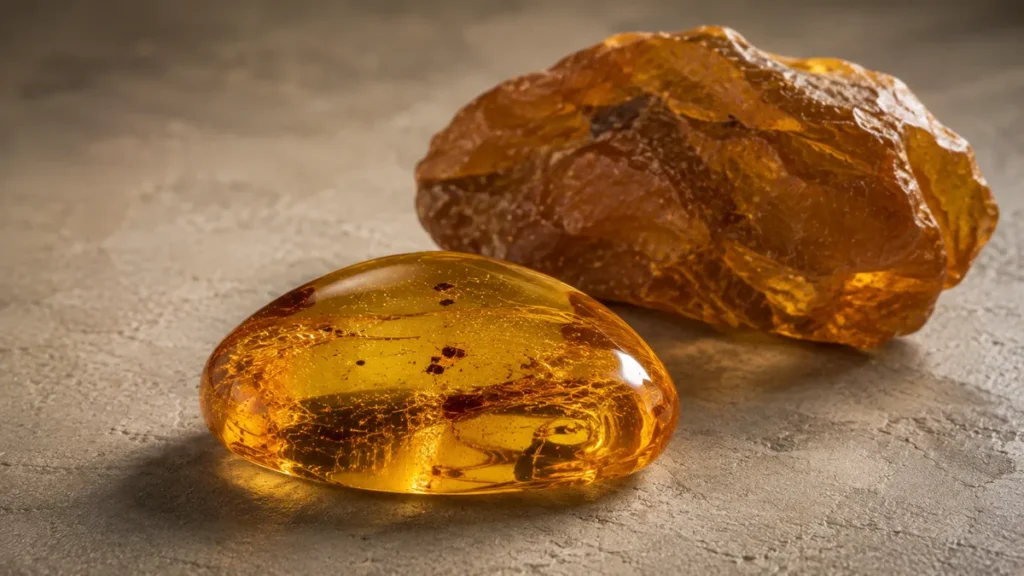
Size matters, but it is easy to overestimate its importance.
A larger piece of amber generally uses more material, and unusually large natural specimens can be desirable. But amber is unusually light compared with many mineral gemstones.
GIA notes that amber has a low density, which allows relatively large beads and jewelry pieces to remain surprisingly light.
This means that price should not be reduced to:
price per gram × weight
That approach can be misleading.
A large, cloudy piece of ordinary amber may be worth less than a much smaller specimen with an exceptional inclusion.
For collector material, the characteristics of the specimen can matter much more than its raw weight.
8. Cut and Craftsmanship
Amber is usually not cut in the same way as diamonds or many other transparent gemstones.
Common forms include:
- free-form polished pieces
- cabochons
- beads
- carved objects
- pendants
- polished rough specimens
Faceting is possible but relatively uncommon.
GIA notes that amber is often fashioned into free-form shapes, cabochons, beads, or carved pieces, while faceting is relatively rare.
For jewelry, craftsmanship can make a major difference.
A well-polished piece with attractive proportions, a good surface finish, and a design that makes the most of the material can be more appealing than a poorly finished piece of similar amber.
The value of the finished jewelry therefore includes more than the raw amber itself.
It may also reflect:
- workmanship
- design
- setting
- labor
- brand
- retail positioning
This is why the price of an amber necklace or ring cannot be compared directly with the value of the loose amber inside it.
9. Condition
Condition is another factor that is easy to overlook.
Amber is relatively soft. GIA gives amber a Mohs hardness of approximately 2 to 2.5, and notes that it has poor toughness compared with many gemstones.
As a result, amber can develop:
- scratches
- abrasions
- chips
- surface wear
- cracks
- dullness
A valuable specimen with a major chip or significant damage may be worth substantially less than a similar piece in excellent condition.
Older amber jewelry can be especially difficult to evaluate because wear may be part of its history, while excessive damage can reduce both its beauty and structural integrity.
10. Authenticity
Before discussing price, there is an even more basic question:
Is it actually amber?
This sounds obvious, but it is one of the most important points in the entire buying process.
Materials that can resemble amber include:
- plastic
- synthetic resin
- copal
- reconstructed or pressed amber
- other imitations
And even genuine amber may have been treated or reconstructed from smaller pieces.
That means “real amber” is not always a simple yes-or-no question.
For a general introduction to authentication, see our guide on how to tell if amber is real.
And if the specific concern is whether a piece may be plastic, see our guide on how to tell amber from plastic.
For inexpensive decorative pieces, a laboratory report may not be necessary. For an expensive collector’s specimen or a major purchase, professional testing can provide much greater confidence.
Natural Amber vs. Pressed or Reconstructed Amber
This distinction deserves special attention.
Pressed or reconstructed amber can contain genuine amber material that has been processed and consolidated into a larger piece.
That is different from plastic.
So a buyer should not automatically classify every reconstructed piece as “fake amber.”
Instead, ask:
- Is the material natural amber?
- Has it been pressed or reconstructed?
- Has it been dyed or otherwise treated?
- Was the treatment disclosed?
- Is the asking price appropriate for the material?
This is one reason terminology matters when comparing amber prices.
A natural, untreated specimen and a reconstructed amber product should not necessarily command the same price, even if they look similar from a distance.
Does Older Amber Cost More?
Not necessarily.
Amber can be millions of years old, but age alone does not determine its market value.
A specimen’s age can be scientifically fascinating, particularly when it is associated with a well-understood geological formation or contains important fossils. But buyers should not assume:
older = more expensive
A younger amber specimen with an exceptional inclusion may be more desirable than an older piece with little visual or scientific interest.
Age becomes more meaningful when considered together with:
- geological origin
- rarity
- preservation
- inclusions
- provenance
- scientific significance
This is another example of why amber value cannot be reduced to one number.
Why Are Amber Inclusions Sometimes Worth More Than the Amber Itself?
This is one of the most interesting aspects of amber collecting.
The amber acts as a natural time capsule.
When an organism is preserved inside it, the material can become more than a gemstone or decorative object. It can become a record of ancient life.
A small piece of amber with an extraordinary inclusion may therefore have two kinds of value:
material value and specimen value.
The second can be much more significant.
For example, an inclusion that is rare, complete, scientifically useful, or captures an unusual interaction between organisms may attract collectors and researchers for reasons that have little to do with the weight of the amber itself.
This is why two pieces of identical size can have dramatically different values.
Is Baltic Amber More Valuable Than Other Amber?
Baltic amber is highly recognized in the international market and can command strong prices, but it would be misleading to say that Baltic amber is automatically the most valuable amber.
GIA notes that Baltic amber is generally more expensive than Dominican amber, while also emphasizing that amber value depends on characteristics such as color and inclusions.
A particularly rare Dominican specimen, for example, can be much more interesting to a collector than an ordinary piece of Baltic amber.
So the better question is not:
“Is Baltic amber the most expensive?”
but:
“What makes this particular piece desirable?”
How Much Does Amber Cost?
There is no single reliable price range that applies to all amber.
You may find inexpensive amber jewelry and decorative pieces for relatively modest prices, while rare collector specimens can sell for much more.
GIA gives a useful illustration of this difference: ordinary amber cabochons without insect inclusions may sell for only a few dollars per piece, while specimens containing easily visible or complete plant or animal inclusions can reach prices in the thousands of dollars.
These figures should not be interpreted as a universal price list.
The actual market price of a piece depends on factors such as:
- authenticity
- treatment
- color
- transparency
- inclusion
- rarity
- origin
- size
- condition
- craftsmanship
- provenance
- buyer demand
The same type of amber can also be priced differently depending on whether it is being sold as rough material, jewelry, a collector specimen, or a scientifically interesting fossil.
Why Can Two Pieces of Amber Have Such Different Prices?
Imagine two pieces of amber that are both roughly the same size.
Piece A
- ordinary golden-yellow color
- cloudy interior
- no visible inclusions
- minor surface wear
- commercially polished
Piece B
- excellent transparency
- attractive reddish color
- unusually clear internal structure
- well-preserved insect inclusion
- excellent condition
- documented provenance
Although the two pieces may contain a similar amount of amber, they are not equivalent products.
Piece B has several characteristics that can make it much more desirable to collectors.
This is the key principle behind amber pricing:
Value comes from the combination of characteristics, not simply from how much amber there is.
What Makes Amber “High Quality”?
There is no single definition of high-quality amber that applies to every purpose.
For jewelry, buyers may prioritize:
- attractive color
- transparency
- clean surface
- durability
- craftsmanship
- comfortable size and shape
For collectors, the priorities may be very different:
- rare inclusions
- scientific significance
- exceptional preservation
- unusual color
- provenance
- geological origin
For someone buying a decorative piece, appearance and craftsmanship may matter most.
So instead of asking:
“Is this high-quality amber?”
it can be more useful to ask:
“High quality for what purpose?”
That question leads to a much more meaningful assessment.
How to Judge Amber Quality Before Buying
If you’re evaluating a piece of amber, work through the following questions.
1. Is it genuine amber?
Don’t begin with price until you’ve established what the material actually is.
2. Is it natural, treated, pressed, or reconstructed?
The material history matters.
3. What is the color?
Look for natural variation rather than assuming that darker or brighter automatically means better.
4. How transparent is it?
Transparent amber is often more valuable, but an exceptional inclusion can change the equation.
5. Are there inclusions?
If so, what are they?
A visible insect is not enough. Consider its completeness, preservation, rarity, and position.
6. What is the origin?
If geographic origin is part of the price claim, ask how that origin was established.
7. What condition is it in?
Check carefully for cracks, chips, scratches, repairs, and excessive wear.
8. Has it been treated?
Ask the seller directly.
9. Is the price consistent with the material?
An unusually low price may deserve closer examination, while a very high price should come with a convincing explanation.
10. Does the seller provide meaningful documentation?
For expensive material, documentation and independent testing can be much more useful than a seller’s description alone.
Does a Higher Price Always Mean Better Amber?
No.
This is perhaps the most important lesson for buyers.
Price is influenced not only by the physical characteristics of the amber but also by:
- craftsmanship
- branding
- retail margins
- market demand
- seller reputation
- jewelry design
- provenance
- collector interest
A high retail price does not automatically prove that a piece is rare or exceptional.
Likewise, a low price does not automatically mean that the material is fake.
The right approach is to understand what you are actually paying for.
If a seller asks a premium for a particular color, inclusion, origin, or treatment-free status, that claim should be supported by evidence rather than accepted simply because the price is high.
Amber Value: The Factors That Matter Most
There is no universal ranking, because different types of amber appeal to different buyers.
But as a general framework, you can think about value through these categories:
| Factor | Why it matters |
| Authenticity | Determines whether the material is actually amber |
| Color | Attractive or rare colors can increase desirability |
| Transparency | Clear amber is generally more valuable than cloudy material |
| Inclusions | Rare, complete, and interesting inclusions can dramatically increase value |
| Rarity | Unusual characteristics can attract collectors |
| Origin | Some geographic origins have stronger market demand |
| Treatment | Treatments can affect desirability and price |
| Size | Larger specimens can be desirable, but size alone is not enough |
| Condition | Damage and wear can reduce value |
| Cut & Craftsmanship | Important especially for finished jewelry |
| Provenance | Documentation can support origin and collector significance |
The most valuable specimens are often those where several desirable characteristics come together.
Final Thoughts
Amber is a good reminder that value is rarely as simple as appearance.
A piece may be beautiful because of its color. Another may be valuable because it is unusually transparent. A third may be far more important because it contains a rare and exceptionally preserved organism from the distant past.
There is no single “best” amber.
There is no universal price per gram.
And there is no single characteristic that can tell you what a piece is worth.
Instead, look at the whole specimen.
Color, transparency, inclusions, rarity, origin, treatment, size, condition, craftsmanship, and authenticity all contribute to the picture.
For buyers, the most useful habit is to stop asking only:
“How much does amber cost?”
and start asking:
“What makes this particular piece worth its price?”
Once you learn to ask that question, amber becomes much easier to evaluate—and much harder to oversell.
Frequently Asked Questions
What makes amber valuable?
Amber value depends on a combination of factors, including color, transparency, inclusions, rarity, origin, treatment, size, condition, craftsmanship, and authenticity. Rare and well-preserved inclusions can have a particularly strong effect on collector value.
What color amber is the most valuable?
There is no universally most valuable color. GIA notes that reddish amber generally commands more value than golden amber, while rare amber with attractive blue or green fluorescence can also be highly valuable.
Is amber with insects inside worth more?
It can be. Rare, complete, clearly visible, and scientifically or aesthetically interesting inclusions can significantly increase the value of an amber specimen. However, not every insect inclusion is rare or valuable.
Is clear amber more valuable than cloudy amber?
Generally, transparent amber is more valuable than cloudy amber. However, an interesting plant or animal inclusion can make a cloudy or less transparent specimen much more desirable.
Is Baltic amber more valuable?
Baltic amber generally commands higher prices than Dominican amber, according to GIA, but origin is only one factor. An exceptional specimen from another locality can still be much more valuable than ordinary Baltic amber.
Does older amber cost more?
Not necessarily. Geological age can be scientifically significant, but market value also depends on rarity, inclusions, appearance, origin, condition, and collector demand.
How much does amber cost?
Amber prices vary enormously. Ordinary jewelry-grade pieces can be relatively inexpensive, while rare specimens with exceptional inclusions can reach much higher prices. There is no universal price per gram that applies to all amber.
Does treated amber have value?
Yes. Treated amber can still be genuine amber, but the treatment should be disclosed because it can affect how the material is evaluated and priced. Amber may be treated to modify color or apparent clarity.
Is bigger amber always more valuable?
No. Size matters, but it is only one factor. A smaller piece with a rare inclusion or exceptional clarity can be much more valuable than a larger piece of ordinary amber.
How can I tell if an expensive piece of amber is genuine?
For valuable purchases, use multiple identification clues rather than relying on a single home test. When the financial value is significant, an independent gemological or laboratory assessment can provide much greater confidence.