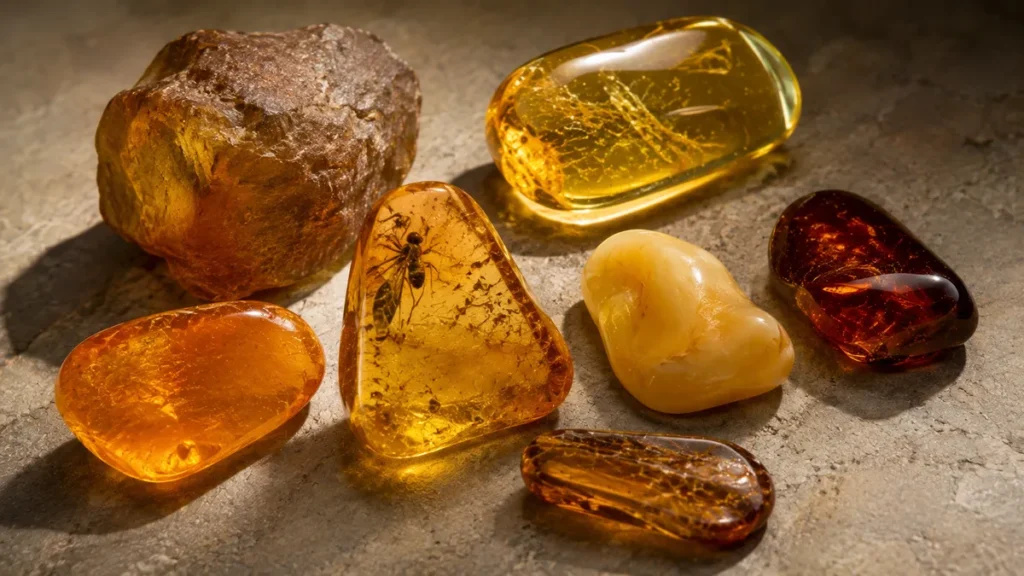
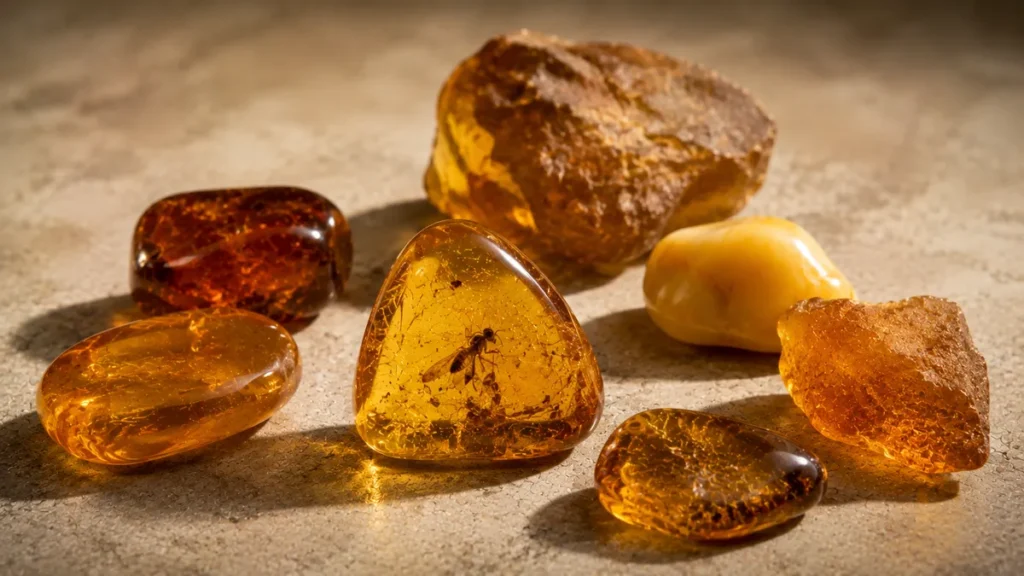
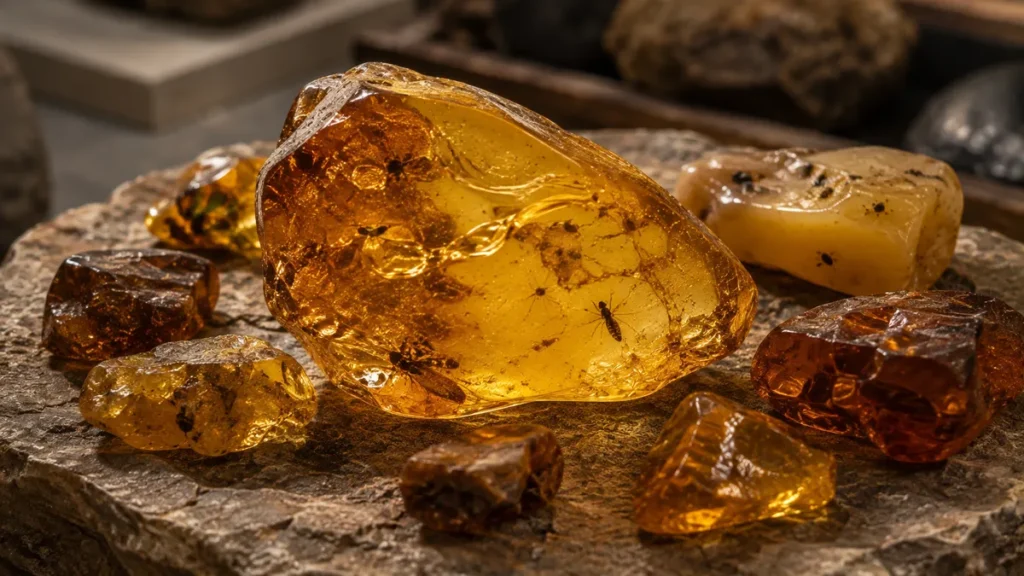
Amber is famous for something few other gemstones can offer: a glimpse of life from the distant past.
Inside some pieces of amber are tiny insects, spiders, plant fragments, pollen, feathers, and other traces of ancient environments. These materials became trapped in sticky tree resin and, under the right conditions, remained enclosed as the resin matured and was preserved over geological time.
These preserved materials are known as amber inclusions.
For collectors, inclusions can transform an ordinary-looking piece of amber into a remarkable natural specimen. For scientists, they can be even more important. An inclusion may provide evidence about organisms, ecosystems, and environments that existed millions of years ago.
But amber inclusions are often misunderstood. The presence of an insect does not automatically prove that a piece is genuine, and not every inclusion makes amber more valuable.
So what exactly counts as an amber inclusion? How are they preserved, and what makes one specimen more significant than another?
Let’s take a closer look.
What Is an Amber Inclusion?
An amber inclusion is a piece of material that became naturally trapped and preserved inside resin before the resin eventually became amber.
The term can refer to both organic and inorganic material.
Organic inclusions may include:
- insects
- spiders and other arthropods
- plant fragments
- pollen
- seeds
- flowers
- fungi
- feathers
- microscopic organisms
Inorganic inclusions can include:
- mineral particles
- dust
- sand
- small crystals
- air bubbles
Some inclusions are easily visible to the naked eye. Others are so small that they require magnification to study.
In paleontology, these inclusions can be particularly valuable because amber sometimes preserves delicate structures that are unlikely to survive in ordinary sedimentary fossilization.
How Do Inclusions Get Trapped in Amber?
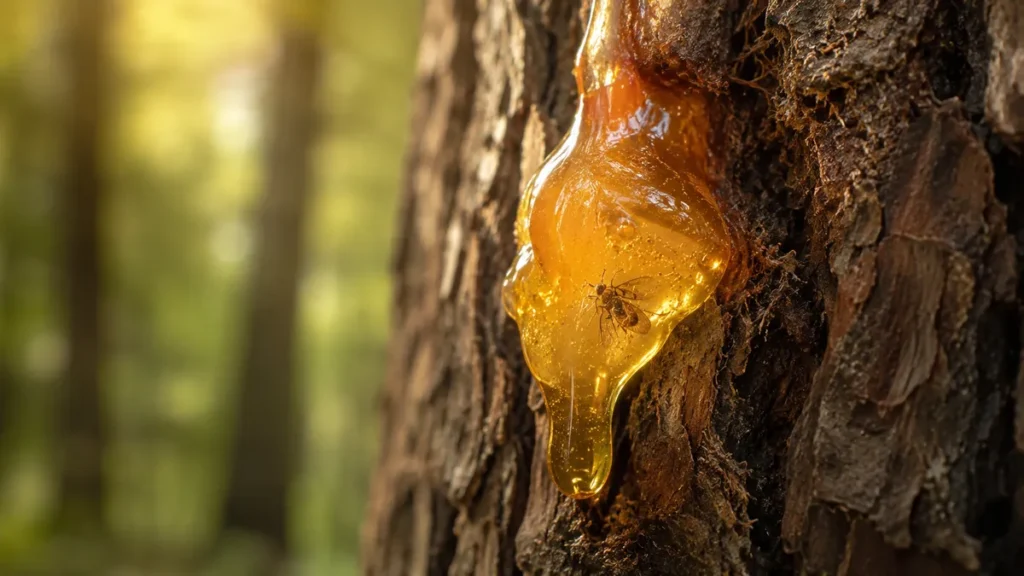
The process begins long before amber becomes a gemstone.
Ancient trees and other resin-producing plants released sticky resin when branches or bark were damaged. Resin may also have been produced as part of the plant’s natural defense against insects, fungi, and other threats.
While the resin was still sticky, small organisms could become trapped on its surface.
An insect might land on the resin while searching for food. A spider could become caught while moving across it. Plant material, pollen, or other particles could also become embedded.
Fresh resin could then flow over the trapped material, enclosing it within additional layers.
Over time, the resin became buried and underwent chemical and physical changes. Volatile components were lost, the material polymerized and matured, and geological processes eventually produced amber.
The result can be a remarkably detailed natural time capsule.
Why Does Amber Preserve Insects So Well?
This is one of the most fascinating properties of amber.
When a small organism becomes trapped in sticky resin, the resin can rapidly cover and isolate it from the surrounding environment.
That can protect delicate structures from physical disturbance and, in favorable circumstances, from ordinary decomposition.
The resin may preserve remarkably fine details, including:
- wings
- legs
- antennae
- hairs
- body segments
- surface textures
In exceptional specimens, structures that would normally be extremely fragile can remain visible millions of years later.
However, preservation is not always perfect.
Some organisms are distorted, partially decomposed, damaged, or obscured by the surrounding amber. The quality of preservation depends on what happened to the organism before and after it became trapped, as well as the chemistry and physical history of the resin.
What Types of Inclusions Can Be Found in Amber?

Amber inclusions are much more diverse than the familiar image of an insect trapped inside golden resin.
Insects
Insects are among the most recognizable amber inclusions.
Depending on the deposit and geological age, specimens may include:
- flies
- ants
- termites
- beetles
- wasps
- mosquitoes and mosquito-like flies
- other small insects
Some are common in the fossil record, while others are exceptionally rare.
A well-preserved insect with clearly visible anatomical details can be an impressive specimen even when the insect itself is tiny.
Spiders and Other Arthropods
Amber can also preserve spiders and a wide range of other arthropods.
Examples include:
- spiders
- mites
- ticks
- centipedes
- millipedes
- crustaceans in certain deposits
- other small arthropods
These specimens can be especially interesting because they reveal interactions between organisms in ancient ecosystems.
A spider, for example, may preserve clues about its body structure, while an arthropod caught alongside another organism may provide evidence of behavior or ecological relationships.
Plant Inclusions
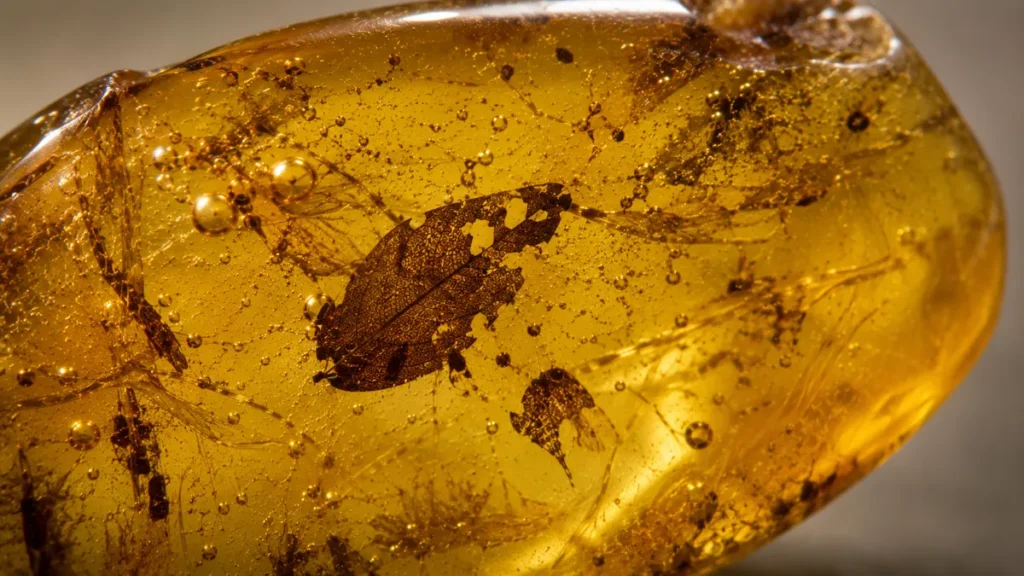
Plants are another important category.
Amber may contain:
- leaves
- flowers
- seeds
- stems
- bark fragments
- pollen
- spores
- pieces of wood
Plant inclusions can help researchers reconstruct ancient vegetation and understand the environments in which the resin-producing plants lived.
In some cases, a tiny fragment can be scientifically significant even if it would have little visual appeal to a jewelry buyer.
Fungi and Microorganisms
Some amber specimens contain fungi or microscopic biological material.
These inclusions are easy to overlook because they may require magnification or specialized imaging to study.
Yet they can provide useful information about ancient ecological relationships, including interactions between plants, fungi, and other organisms.
Feathers and Other Delicate Material
Rare amber specimens can preserve exceptionally delicate organic material, including feathers.
These are particularly fascinating because soft, fragile structures generally have a much lower chance of surviving ordinary fossilization.
When such material is preserved in amber, scientists may be able to study details that would otherwise have disappeared.
What Can Amber Inclusions Tell Us About Ancient Life?
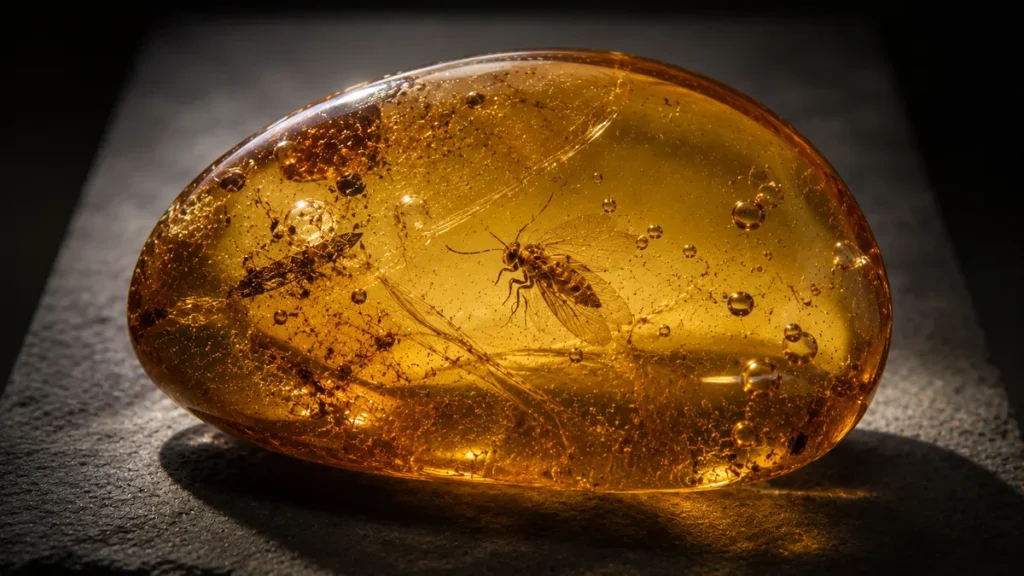
Amber is valuable scientifically because it can preserve more than isolated objects.
It can preserve evidence of ancient ecosystems.
An insect trapped in amber tells us something about the organism itself. A plant fragment can provide clues about vegetation. Multiple organisms within the same deposit can help researchers reconstruct the environment in which they lived.
Inclusions may reveal information about:
- ancient biodiversity
- insect evolution
- plant evolution
- predator-prey relationships
- pollination
- parasitism
- ancient forests
- ecological interactions
- geographic distribution of organisms
This is why some amber specimens are regarded as scientific specimens rather than simply decorative gemstones.
A tiny inclusion can sometimes tell a much larger story.
Are All Amber Inclusions Fossils?
Not exactly.
This distinction is worth understanding.
The term inclusion describes material preserved inside amber. The term fossil is broader and relates to preserved evidence of ancient life.
An insect trapped in genuinely ancient amber can reasonably be described as a fossilized organism or a fossil inclusion, but not every material inside amber is biological.
An air bubble is an inclusion, but it is not a fossil.
A mineral particle is an inclusion, but it is not a fossil either.
So amber inclusion is the broader and more precise term when discussing everything preserved within amber.
What Makes an Amber Inclusion Valuable?
Not every insect-containing piece of amber is automatically valuable.
The significance of an inclusion depends on several factors.
Rarity
Rare organisms can attract considerable interest from collectors and researchers.
An unusual species or an uncommon type of organism may be far more significant than a common inclusion.
Preservation
Condition matters enormously.
A complete insect with clearly visible anatomical details is generally more desirable than a fragmented or badly obscured specimen.
Visibility
The inclusion needs to be visible enough to study or appreciate.
A remarkable organism hidden behind heavy cloudiness may be less desirable than a similar specimen that can be seen clearly.
Position
The position of an inclusion within the amber can affect how easily it can be viewed.
A specimen positioned near a natural fracture or an unsuitable angle may be difficult to examine.
Scientific importance
Some inclusions are valuable because they provide meaningful information about ancient life.
This can matter independently of their appearance.
Overall quality of the amber
The amber surrounding the inclusion matters too.
Color, transparency, internal structure, condition, and size can all influence the appeal of the complete specimen.
The value of an inclusion is only one part of the larger question of what makes amber valuable.
Does an Insect Automatically Make Amber More Valuable?
No.
This is one of the most common misconceptions about amber.
The simple presence of an insect does not guarantee a high price.
A common insect with poor preservation inside heavily cloudy amber may have limited collector appeal.
On the other hand, a rare and exceptionally well-preserved organism can make a specimen highly desirable.
There is also another issue that buyers should understand:
An inclusion does not automatically prove that the amber is genuine.
Artificial inclusions have been produced, and material can be manipulated or reconstructed.
For valuable specimens, authenticity should therefore be evaluated independently of the inclusion itself.
Can Inclusions Prove That Amber Is Real?
No single inclusion can provide absolute proof of authenticity.
Natural amber often contains convincing internal features, but artificial materials can also be manufactured or modified to imitate some of them.
An insect trapped inside a transparent material may look impressive, but visual appearance alone is not enough to establish whether the surrounding material is natural amber.
If authenticity is important—particularly for a high-value specimen—professional gemological or laboratory testing is a better approach.
For a practical introduction to identification, see our guide on [how to tell if amber is real].
Natural Inclusions vs. Artificially Added Inclusions
This distinction is especially important for collectors.
A natural inclusion became trapped during the original formation of the resin.
An artificial inclusion is introduced by a person after the material already exists.
The two can look surprisingly similar in photographs.
Some artificial inclusions are created by placing insects or other objects inside synthetic or modified materials. Because of this, the phrase “contains an insect” should never be treated as equivalent to “contains a naturally preserved insect.”
For expensive amber, provenance, examination, and professional testing become increasingly important.
What Is the Difference Between an Inclusion and an Internal Feature?
Not everything you see inside amber is an inclusion.
This distinction can be useful when examining a specimen.
Inclusions
These are foreign materials trapped within the resin, such as:
- insects
- plant fragments
- mineral particles
- pollen
- feathers
Internal features
These are structures created within the amber itself, such as:
- bubbles
- flow lines
- fractures
- cloudy zones
- color variations
Both can make amber visually fascinating, but they are not the same thing.
Understanding the difference also helps when evaluating amber for authenticity and quality.
Why Are Some Inclusions So Clear?
The transparency of the surrounding amber can have a major effect on how an inclusion appears.
Clear amber allows light to pass through the material with relatively little scattering. This can make an insect or plant fragment much easier to see.
Cloudy amber scatters light more strongly, which can partially obscure what is inside.
This is one reason transparent amber with a well-preserved inclusion can be particularly attractive to collectors.
But again, clarity alone does not determine the importance of an inclusion.
A rare organism in less transparent amber can still be scientifically significant.
Can Amber Preserve DNA?
This is a subject surrounded by popular myths.
Amber’s ability to preserve detailed physical structures has sometimes led to the idea that ancient DNA could routinely survive inside amber for millions of years.
That idea became famous through popular culture, but real-world evidence is much more complicated.
Although biological molecules can sometimes survive under favorable conditions, there is no scientific basis for assuming that usable dinosaur DNA can simply be extracted from amber because an insect is visibly preserved inside it.
The physical preservation of an organism and the survival of recoverable ancient DNA are two different questions.
Amber can preserve extraordinary anatomy without functioning as a reliable “DNA vault.”
Which Amber Deposits Are Famous for Inclusions?
Several amber deposits around the world are scientifically important.
Baltic Amber
Baltic amber from the Baltic region is particularly well known for its fossil inclusions and has been studied extensively.
Dominican Amber
Dominican amber is also famous for its diversity of inclusions and is especially well known for insect and other arthropod fossils.
Burmese Amber
Amber from Myanmar, commonly referred to as Burmese amber, is much older than Baltic and Dominican amber and has produced exceptionally diverse Cretaceous inclusions.
Other deposits around the world also contain fossil inclusions, each with its own geological history and scientific significance.
This is one reason the origin of an amber specimen can matter to collectors and researchers.
Why Are Some Amber Inclusions Scientifically More Important Than Others?
Scientific importance does not always correspond to visual beauty.
A tiny, unattractive fragment may contain information that helps researchers identify a previously unknown species or understand an ancient ecological relationship.
A spectacular-looking insect may be less scientifically significant if similar specimens are already well documented.
Researchers may therefore consider:
- taxonomic rarity
- preservation
- geological age
- evolutionary significance
- ecological information
- association with other organisms
- quality of anatomical detail
This is why museum collections may contain amber specimens that look quite ordinary to a casual observer.
Their real importance may only become apparent under a microscope or through scientific study.
How Should You Examine an Amber Inclusion?
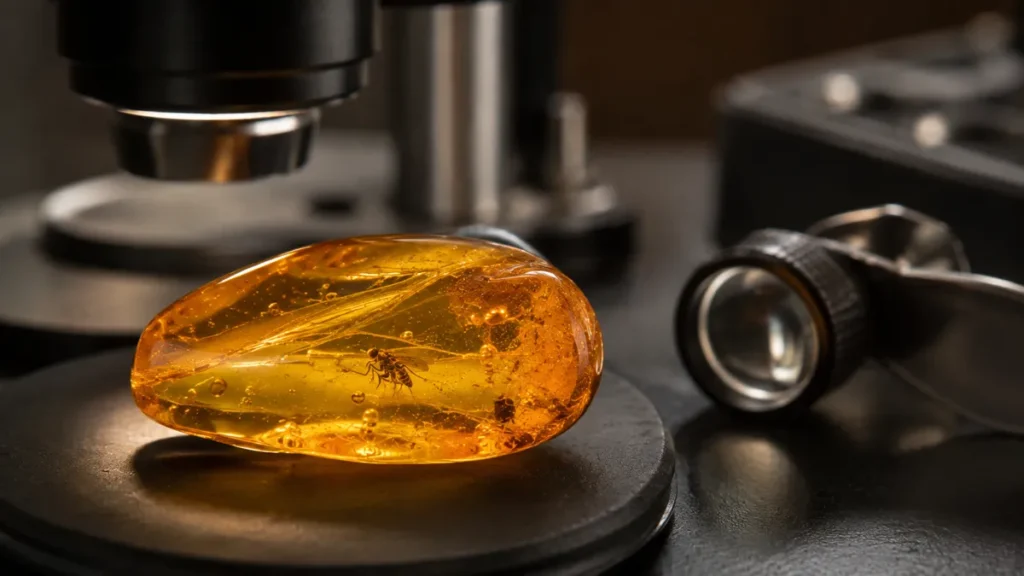
If you’re looking at an inclusion-bearing piece of amber, don’t immediately focus on the insect itself.
Start with the amber surrounding it.
Look at the color
Does the amber have a natural, attractive appearance?
Examine transparency
Can you see the inclusion clearly?
Study the internal structure
Look for natural flow patterns, bubbles, cloudy areas, and fractures.
Examine the inclusion
Is it complete? Are anatomical details visible? Does its position appear natural?
Look for signs of manipulation
Be cautious if the inclusion appears strangely positioned, unnaturally perfect, or inconsistent with the surrounding material.
None of these observations can independently prove authenticity.
They are simply clues.
For an expensive specimen, professional examination is the appropriate next step.
Are Amber Inclusions Always Visible to the Naked Eye?
No.
Some inclusions are large enough to be seen easily, while others are microscopic.
Magnification can reveal details that are impossible to see with the naked eye, including:
- tiny insects
- mites
- pollen
- fungal structures
- delicate plant fragments
This is one reason serious amber research often involves microscopy and other imaging techniques.
What appears to be an ordinary piece of amber may contain a surprisingly complex microscopic world.
Amber Inclusions and Collecting
For collectors, amber inclusions offer something that few other gemstones can provide.
A conventional gemstone is generally valued for qualities such as color, clarity, cut, and rarity.
An inclusion-bearing amber specimen adds another dimension:
history.
The inclusion may represent an organism that lived in an ancient forest millions of years ago. Its position, preservation, and surrounding resin can turn a small piece of amber into a natural record of a vanished environment.
That does not mean every inclusion-bearing piece is rare or expensive.
It means that the appeal of amber can extend far beyond its appearance as a gemstone.
What Should You Look for When Buying Amber With Inclusions?
If you’re considering buying an inclusion specimen, evaluate the whole piece rather than focusing only on the word “inclusion.”
Ask:
- Is the amber itself authentic?
- Is the inclusion naturally preserved?
- What type of organism is it?
- How complete is the specimen?
- How clearly can it be seen?
- Is the surrounding amber transparent enough to examine it?
- Does the piece show signs of treatment or reconstruction?
- Is the stated origin supported by credible information?
- Is the price reasonable for the characteristics of the specimen?
For a valuable collector’s piece, independent verification can be worth far more than a seller’s description.
If you’re evaluating the overall quality of a piece rather than the inclusion alone, our guide on how to tell good quality amber covers color, clarity, condition, craftsmanship, and other factors.
Final Thoughts
Amber inclusions are among the most remarkable natural records of ancient life.
A tiny insect, plant fragment, or other organism preserved inside amber can provide a direct connection to an ecosystem that existed millions of years ago. For scientists, these specimens can reveal information about evolution, biodiversity, and ancient environments. For collectors, they can add rarity, character, and a sense of history to an already unusual gemstone.
But an inclusion should never be judged in isolation.
Its importance depends on what it is, how well it has been preserved, how clearly it can be seen, and whether the surrounding amber is natural and properly identified.
The most fascinating piece is not necessarily the one with the largest insect or the highest price.
Sometimes the most valuable thing inside amber is simply the story it allows us to see.
Frequently Asked Questions
What are amber inclusions?
Amber inclusions are materials naturally trapped and preserved inside resin as it became amber. They can include insects, spiders, plants, pollen, fungi, feathers, mineral particles, and air bubbles.
What is the most common inclusion in amber?
Insects and other small arthropods are among the most familiar and frequently encountered biological inclusions, although the exact types and abundance vary between amber deposits.
Are amber inclusions real fossils?
Biological organisms preserved in ancient amber can be considered fossilized remains or fossil inclusions. However, not everything inside amber is a fossil. Air bubbles and mineral particles, for example, are inclusions but are not fossils.
Does an insect make amber more valuable?
It can, but not automatically. Rarity, preservation, visibility, scientific significance, the quality of the surrounding amber, and authenticity all influence the importance and potential value of an inclusion specimen.
Can you tell if amber is real because it contains an insect?
No. An insect inside a transparent material is not conclusive proof of authenticity. Artificial inclusions and manipulated materials exist, so valuable specimens may require professional examination.
Can amber preserve DNA?
Amber can preserve remarkably detailed physical structures, but that does not mean usable ancient DNA can routinely be recovered from organisms trapped inside it. Claims about extracting dinosaur DNA from amber are not supported by established scientific evidence.
Where is amber with inclusions found?
Important deposits containing fossil inclusions include the Baltic region, the Dominican Republic, Myanmar, and other locations around the world. Each deposit has its own geological history and characteristic fossil record.
Are amber inclusions visible without a microscope?
Some are, particularly larger insects and plant fragments. Others are microscopic and require magnification or specialized imaging to study properly.