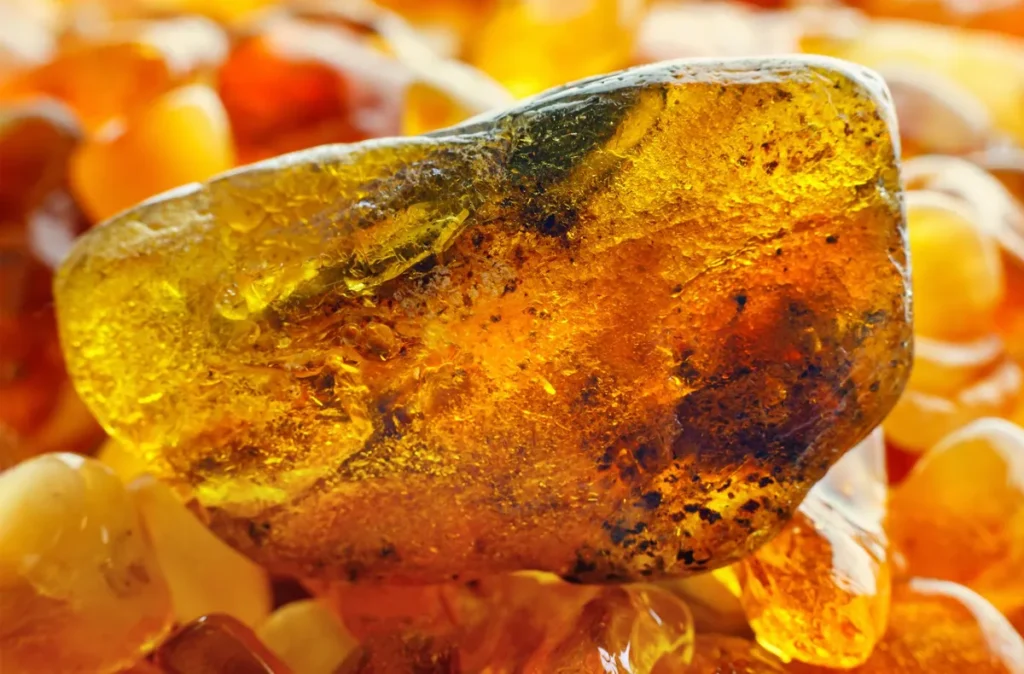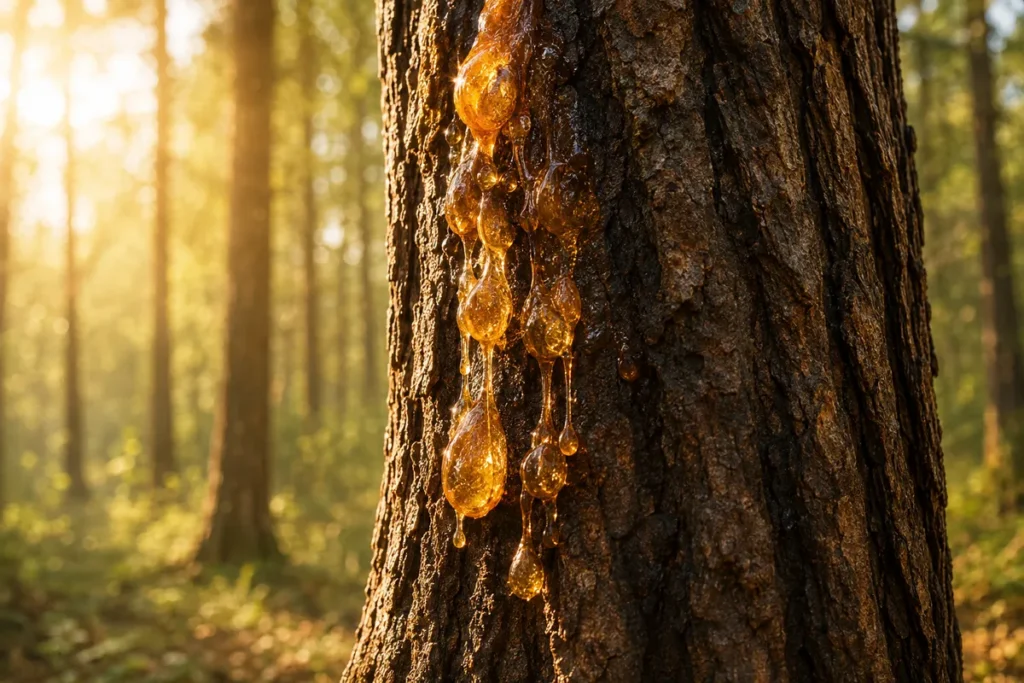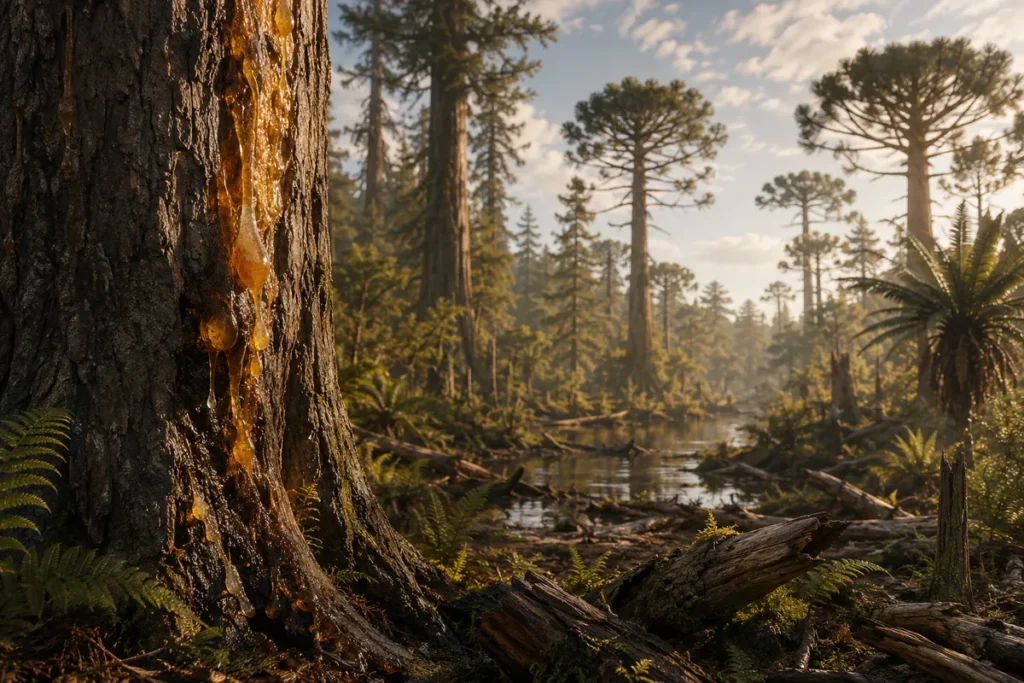
Amber is often pictured as a warm golden stone glowing in the light.
If you’re new to amber, start with our [complete beginner’s guide to amber] to learn what amber is and why it is so unusual among gem materials.
That image is not wrong, but it only represents one small part of the amber world.
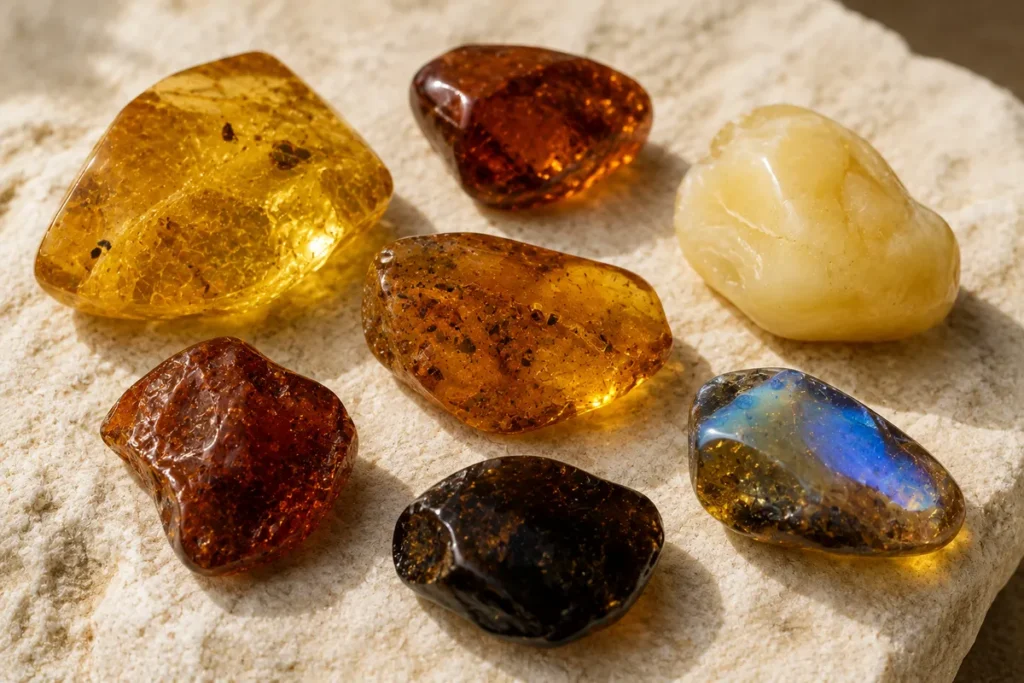
Natural amber comes in many different colors, levels of transparency, geological ages, and geographic origins. Some pieces are clear and honey-colored. Others are cloudy white, deep red, almost black, or even show unusual blue fluorescence or coloration.
There are also major differences between amber from different parts of the world.
Baltic amber, Dominican amber, Burmese amber, and Mexican amber, for example, do not have identical geological histories. They formed at different times, came from different plant sources, and can contain very different types of inclusions.
So when someone asks, “What are the different types of amber?”, there isn’t just one answer.
Amber can be grouped by geographic origin, color, transparency, geological age, and sometimes chemical or botanical characteristics.
In this guide, we’ll look at the major types of amber you are likely to encounter, what makes them different, and why the origin of a piece can be just as interesting as its appearance.
How Is Amber Classified?
These differences begin with the formation and geological history of amber. See [How Is Amber Formed?] for a closer look at that process.
Before looking at individual types, it helps to understand what the word “type” actually means.
Amber is not divided into a single universally accepted list of types in the same way that diamonds are commonly discussed by cut, color, clarity, and carat weight.
Instead, amber can be described in several different ways.
By geographic origin
Examples include:
- Baltic amber
- Dominican amber
- Mexican amber
- Burmese amber
- Lebanese amber
By color
Amber can occur in:
- Yellow
- Golden
- Honey
- Orange
- Red
- Brown
- White
- Greenish
- Very dark shades
- Unusual blue or bluish varieties
By transparency
A piece may be:
- Transparent
- Translucent
- Opaque
- Cloudy
By geological age
Some amber deposits are tens of millions of years old, while other fossil resins are considerably younger.
These categories can overlap.
For example, Baltic amber can be yellow, honey-colored, white, cloudy, transparent, or reddish. So “Baltic amber” describes its origin, while “honey amber” describes its appearance.
That distinction becomes important when buying or researching amber.
1.Baltic Amber
Baltic amber is probably the best-known type of amber in the world.
It is associated with amber-bearing deposits around the Baltic region of northern Europe and is particularly famous for its warm yellow, honey, orange, and creamy colors.
Much Baltic amber originated from resin produced by ancient forests during the Eocene Epoch, roughly 34–56 million years ago.
Over geological time, the resin became buried and transformed into amber.
The Baltic region is especially important because it contains some of the world’s most extensive and well-known amber deposits.
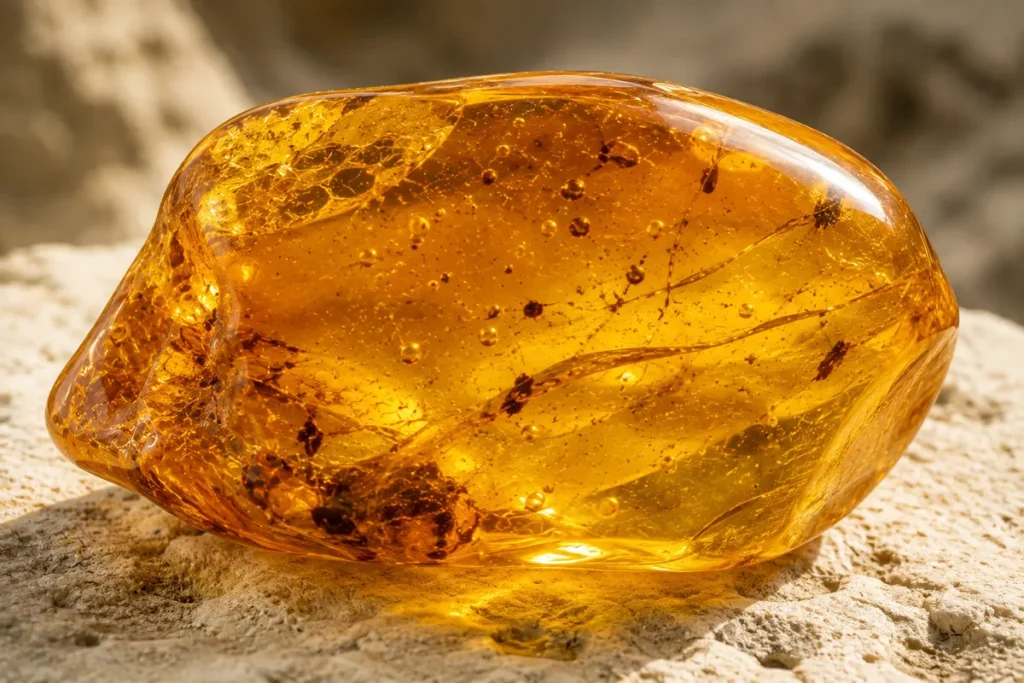
Baltic amber can appear in many forms:
- Clear yellow
- Honey-colored
- Cognac
- Orange
- Reddish
- Creamy white
- Cloudy
- Almost opaque
It can also contain inclusions such as insects, plant fragments, pollen, and other organic material.
If you’re interested in the geological story behind it, see our guide to [Where Does Baltic Amber Come From?].
2.Dominican Amber
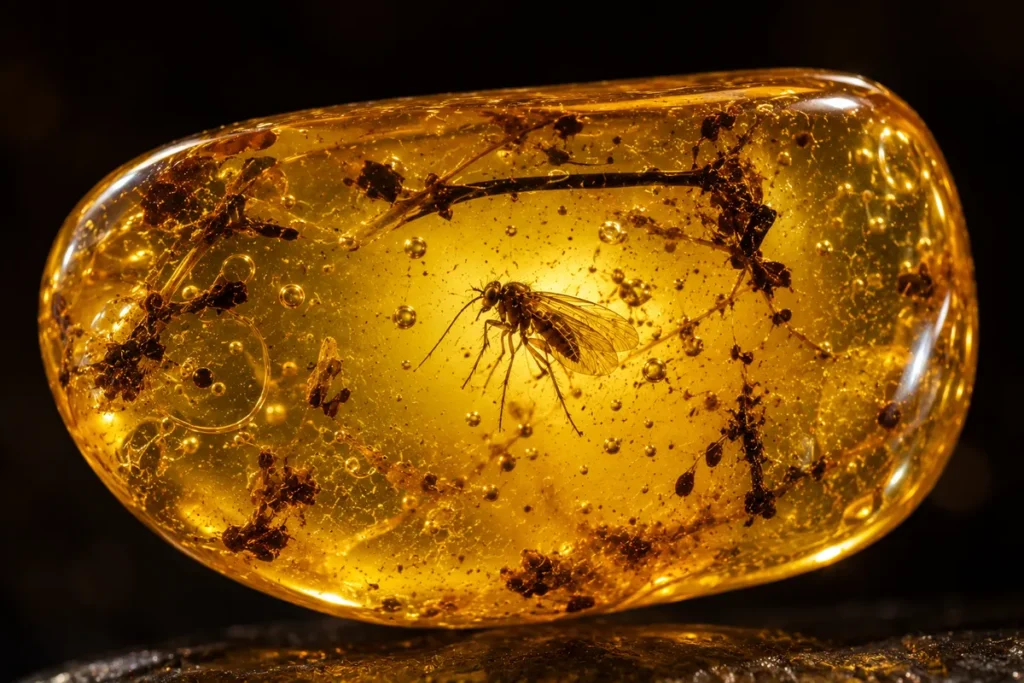
Dominican amber comes primarily from the Dominican Republic in the Caribbean.
It is particularly well known among collectors because of its remarkable inclusions.
Dominican amber can contain insects, spiders, plants, and other organisms that provide valuable information about ancient tropical ecosystems.
Its geological age is generally younger than Baltic amber, with important Dominican deposits dating mainly to the Miocene and Oligocene periods.
One of the most interesting characteristics of Dominican amber is its diversity of inclusions.
Researchers have found exceptionally detailed specimens containing organisms that would otherwise be extremely difficult to study.
Dominican amber can range from pale yellow to orange, reddish, and darker shades. Some specimens are highly transparent, making their inclusions especially easy to see.
For collectors, a Dominican amber specimen with an unusual and well-preserved inclusion can be much more interesting than an ordinary piece of clear amber.
3.Mexican Amber
Mexico is another important source of natural amber.
The most famous Mexican deposits are located in the state of Chiapas in southern Mexico.
Mexican amber is generally associated with ancient tropical forests and is well known for its warm yellow, orange, reddish, and occasionally unusual colors.
Like Dominican amber, Mexican amber can contain impressive biological inclusions.
Insects and plant material preserved inside the resin can provide a window into ancient ecosystems.
Mexican amber is also interesting because its appearance can vary considerably from one specimen to another.
Some pieces are clear and golden, while others have deeper orange or reddish tones.
When discussing Mexican amber, it is therefore useful to consider both its geographic origin and individual characteristics rather than assuming that every piece looks the same.
4.Burmese Amber
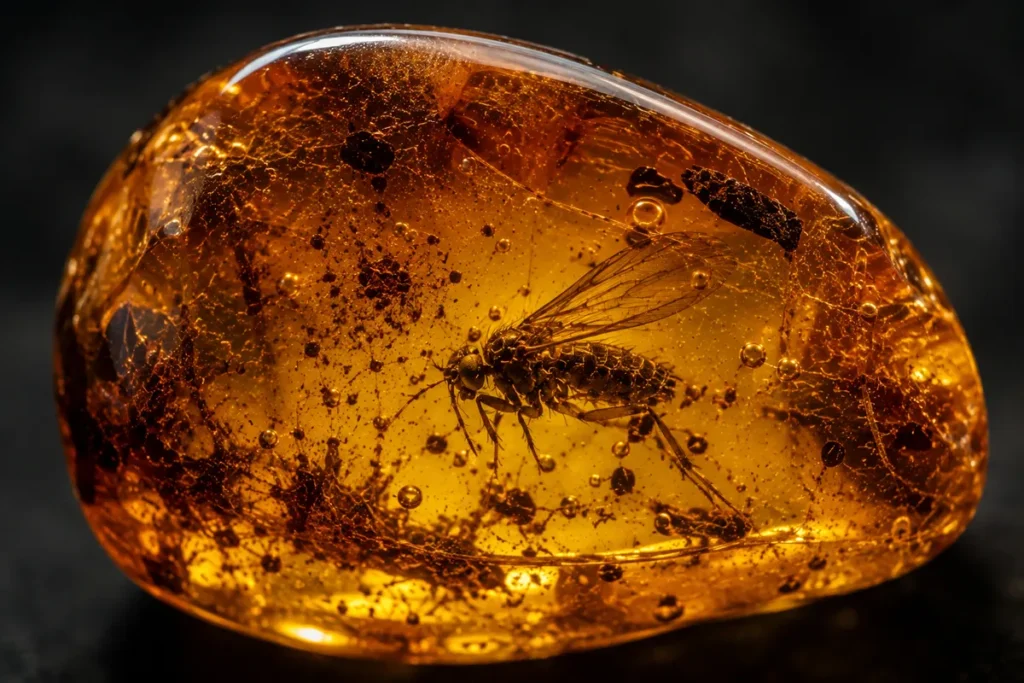
Burmese amber, commonly known as Burmite, is one of the most scientifically important amber deposits.
It comes primarily from northern Myanmar and is famous for its extraordinary geological age.
Much Burmese amber dates to the mid-Cretaceous, around 99 million years ago.
That means some specimens are considerably older than Baltic amber.
This enormous age is one of the reasons Burmese amber has attracted so much scientific attention.
Its inclusions can preserve organisms from a world that existed when dinosaurs were still alive.
Researchers have studied insects, spiders, plants, feathers, and other biological material preserved in Burmese amber.
For paleontology, these specimens can be incredibly valuable because amber can preserve delicate structures that are rarely found in ordinary fossil deposits.
Burmese amber can also display a wide range of colors and degrees of transparency.
However, its scientific and commercial history is complicated, and provenance can be particularly important when dealing with valuable specimens.
5.Lebanese Amber
Lebanese amber is much less common in the jewelry market than Baltic amber, but it is scientifically fascinating.
Some Lebanese amber deposits date back to the Early Cretaceous, making them extremely old.
Inclusions preserved in Lebanese amber provide evidence of ancient terrestrial ecosystems that existed roughly 130 million years ago.
This is especially interesting because the Early Cretaceous was a period of major ecological change.
Flowering plants were beginning to diversify, while many familiar modern ecosystems had not yet developed.
Amber from this period can therefore provide an unusually detailed look at ancient life.
Lebanese amber is not usually encountered as everyday jewelry material, but for researchers and collectors, its geological age makes it an important type of fossil resin.
6.Indonesian Amber
Indonesia is associated with several natural resin deposits, and amber-like fossil resins from the region have attracted interest among collectors.
However, this is one area where terminology needs to be handled carefully.
Not every piece sold commercially as “Indonesian amber” necessarily has the same geological history or degree of maturation.
Some materials may be younger fossil resin or other natural resin rather than mature amber in the strictest scientific sense.
This is a good example of why geographic labels alone are not enough.
If you are buying a specimen described as Indonesian amber, it is worth asking about:
- Exact locality
- Geological age
- Whether the material has been tested
- Whether it is natural or treated
- Whether it is mature amber or younger resin
The name used by a seller and the scientific classification of a specimen are not always identical.
7.Yellow and Golden Amber
Yellow and golden amber are probably the colors most people associate with the word “amber.”
The color can range from very pale yellow to rich golden honey.
Transparent yellow amber can have a particularly bright appearance because light passes through the material and illuminates its internal structure.
Golden amber may also contain small bubbles, flow patterns, or other internal features.
These characteristics are part of the natural appearance of the material.
Yellow amber is found in several geographic deposits, so yellow amber does not automatically mean Baltic amber.
Color tells you what a piece looks like.
It does not, by itself, tell you where it came from.
8.Honey Amber
Honey amber has a warmer, deeper appearance than pale yellow amber.
It can range from translucent golden yellow to rich orange-gold.
The term “honey amber” is primarily a descriptive or commercial color term rather than a separate geological species.
This is an important distinction.
When a seller describes a piece as honey amber, they are usually describing its appearance rather than identifying a specific geographic origin.
Honey-colored material can occur in different amber deposits.
Its value will depend on factors such as transparency, size, quality, origin, craftsmanship, and market demand.
9.White Amber
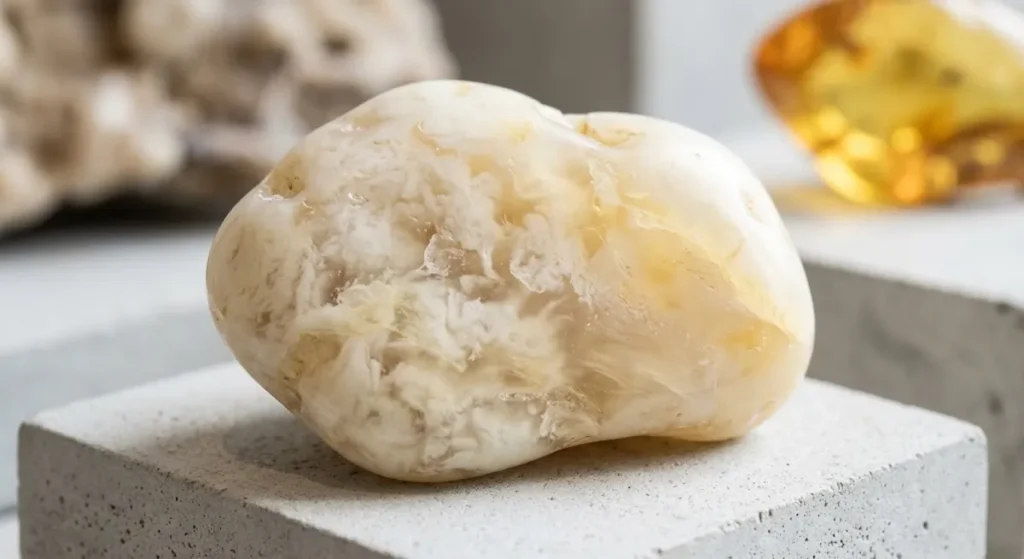
White amber is one of the most distinctive forms of amber.
Instead of appearing transparent and golden, it can have a creamy, milky, or almost ivory-like appearance.
Some white amber is completely opaque, while other pieces have varying degrees of translucency.
Its unusual appearance makes it popular in jewelry and decorative work.
White amber is sometimes described using terms such as:
- Bone amber
- Milky amber
- Cream amber
These names generally refer to appearance rather than separate species.
The internal structure responsible for its cloudy appearance can scatter light, producing the characteristic creamy effect.
10.Red Amber
Red or reddish amber is another popular color variety.
It can range from warm orange-red to deeper reddish-brown tones.
Some red-looking amber is naturally colored, while other pieces may have been heated or otherwise treated.
This distinction matters.
Heat treatment can change the appearance of amber, sometimes making the surface darker or altering its internal appearance.
Therefore, a seller’s description should make it clear whether a particular color is natural or the result of treatment.
A naturally occurring red specimen can be particularly attractive, but color alone should not be used to determine authenticity or origin.
11.Green Amber
Greenish amber exists, although the color can vary significantly.
Some specimens have a naturally green or greenish appearance, while others may appear green because of optical effects, inclusions, weathering, or treatment.
As with red amber, the term “green amber” is primarily descriptive.
It does not automatically indicate a specific geographic source.
If a piece is being sold as rare natural green amber, especially at a premium price, provenance and testing become much more important.
12.Blue Amber
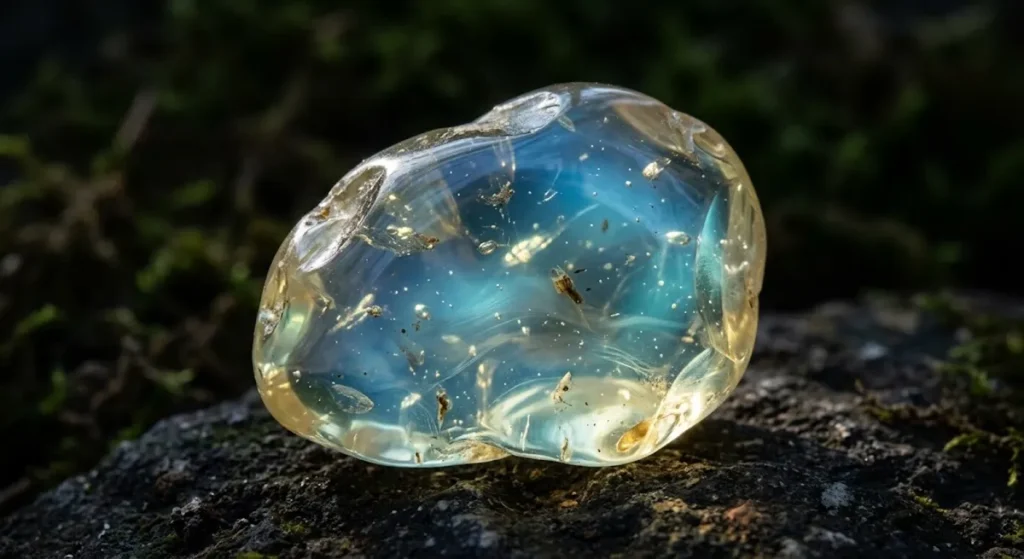
Blue amber is one of the most unusual and visually striking varieties.
It is particularly associated with the Dominican Republic.
Unlike ordinary yellow amber, some blue amber can display a bluish appearance under certain lighting conditions, especially when illuminated from particular angles or with ultraviolet light.
The phenomenon is related to the way light interacts with the material and its internal composition.
In ordinary daylight, some specimens may look relatively normal or only slightly bluish. Under the right lighting, however, the blue effect can become much more noticeable.
This is one reason blue amber has become highly desirable among collectors.
It is also a good example of why amber cannot always be understood simply by looking at its surface color.
13.Black and Very Dark Amber
Very dark amber can appear brown, reddish-brown, or almost black.
The darkness may result from the material’s internal structure, organic content, coloration, or other factors.
Opaque dark amber can have a very different visual character from transparent golden amber.
It is sometimes used in carved objects and jewelry because its deeper color provides a strong contrast with polished surfaces.
However, “black amber” should be treated as a descriptive term rather than proof of a particular geographic origin.
Transparent, Translucent, and Opaque Amber
Color isn’t the only characteristic that changes the appearance of amber.
Transparency can make an equally dramatic difference.
Transparent amber
Light passes through relatively easily.
This type is particularly useful when the goal is to display an inclusion.
Translucent amber
Light passes through, but the material remains cloudy or partially obscured.
It can have a soft, glowing appearance.
Opaque amber
Very little light passes through.
White and highly cloudy amber are examples of material that can appear opaque.
None of these categories automatically means that one type is “better.”
Collectors have different preferences, and value depends on the entire specimen rather than transparency alone.
Why Does Amber Have So Many Colors?
Amber’s color can be influenced by several factors.
These may include:
- Original resin chemistry
- Plant source
- Geological conditions
- Oxidation
- Weathering
- Internal structure
- Bubbles and microscopic features
- Heat treatment
- Other forms of processing
This is why amber from the same broad geographic region can still look very different.
Two pieces may come from the same deposit but have completely different appearances.
One might be clear and pale yellow.
Another might be cloudy white.
Another might be deep orange or reddish brown.
The natural variation is part of what makes amber interesting to collectors.
If you’d like to understand amber colors in more detail, this is a good subject for a future dedicated article.
Which Type of Amber Is the Oldest?
This depends on the specific deposit being discussed, but some of the oldest well-known amber deposits are from the Cretaceous Period.
Burmese amber, for example, is approximately 99 million years old.
Lebanese amber is also extremely old, with important deposits dating to the Early Cretaceous.
Baltic amber is much younger by comparison, with major deposits associated with the Eocene Epoch.
This is a useful reminder that Baltic amber is famous not simply because it is old, but because of its abundance, history, quality, and geological significance.
Age alone does not determine whether a piece is valuable.
Which Type of Amber Is Best?
There isn’t one universal answer.
It depends on what you are looking for.
For jewelry
Baltic amber is a popular choice because of its availability, range of colors, and long history of use.
For fossil inclusions
Dominican, Burmese, and Mexican amber can be especially interesting because of their biological inclusions.
For geological research
Older deposits such as Burmese and Lebanese amber can provide important information about ancient ecosystems.
For unusual color
Blue amber, white amber, red amber, and other uncommon appearances can attract collectors looking for something different.
So rather than asking:
“Which amber is the best?”
A better question is:
“Which amber is best for what I want?”
Does Amber Type Affect Value?
Yes, but not in a simple way.
Geographic origin can influence desirability, but it is only one factor.
Other factors include:
- Color
- Transparency
- Size
- Inclusions
- Rarity
- Condition
- Naturalness
- Treatment
- Provenance
- Craftsmanship
A small piece of common amber may have little collector value, while a rare specimen containing an exceptionally preserved insect may be worth considerably more.
Likewise, a beautifully crafted piece of Baltic amber jewelry can have value because of its design and workmanship rather than simply because the raw material is rare.
This is why it is difficult to assign a universal “price per gram” to amber.
Are All Amber Types Natural?
No.
This is an important consideration when buying amber.
The market can include:
- Natural amber
- Heated amber
- Pressed or reconstructed amber
- Amber composites
- Copal
- Synthetic resin
- Plastic imitations
These materials can sometimes look surprisingly similar.
Copal deserves particular attention because it is natural plant resin but is generally younger and less geologically mature than amber.
We explored that distinction in our article [Amber vs. Copal: What’s the Difference?].
For valuable purchases, knowing the material is just as important as knowing its color.
How Can You Tell Which Type of Amber You Have?
The first clue is usually provenance.
Where was the specimen collected?
What geological deposit did it come from?
Who collected it?
Has the material been tested?
Physical characteristics can provide additional clues, but appearance alone is not enough to establish geographic origin.
For valuable specimens, identification may involve:
- Microscopic examination
- Physical measurements
- Chemical analysis
- Infrared spectroscopy
- Geological information
- Comparison with known reference material
This is particularly important when a specimen is being sold as rare amber from a specific geographic location.
A beautiful color doesn’t prove an origin.
And an unusual inclusion doesn’t automatically prove geological age.
A Simple Guide to the Main Types of Amber
| Type | Main Region | Notable Characteristics |
| Baltic amber | Baltic region | Famous, abundant, many colors and forms |
| Dominican amber | Dominican Republic | Excellent biological inclusions, occasional blue amber |
| Mexican amber | Chiapas, Mexico | Tropical origin, varied colors and inclusions |
| Burmese amber | Myanmar | Extremely old, important Cretaceous inclusions |
| Lebanese amber | Lebanon | Very old, Early Cretaceous |
| Indonesian amber | Indonesia | Varied materials; provenance is particularly important |
| White amber | Various deposits | Creamy, milky, often opaque |
| Red amber | Various deposits | Orange-red to reddish-brown |
| Green amber | Various deposits | Greenish appearance, sometimes treatment-related |
| Blue amber | Mainly Dominican Republic | Unusual blue optical appearance |
Remember that these categories overlap.
Baltic amber can be white. Dominican amber can be blue. Mexican amber can be red.
Geographic type and visual type are two different ways of describing the same material.
Frequently Asked Questions
What are the main types of amber?
The best-known geographic types include Baltic amber, Dominican amber, Mexican amber, Burmese amber, and Lebanese amber. Amber can also be described by color and transparency.
Which type of amber is the most common?
Baltic amber is one of the most abundant and commercially important types of amber and is widely used in jewelry.
Which amber is the oldest?
Some Cretaceous amber deposits, including Burmese and Lebanese amber, are among the oldest well-known amber deposits. Burmese amber is approximately 99 million years old.
What is the rarest color of amber?
There is no single universally accepted “rarest” amber color because rarity depends on the deposit and how the material is classified. Blue amber is particularly unusual and highly sought after.
Is blue amber real?
Yes. Natural blue amber is particularly associated with the Dominican Republic and can display a blue appearance under certain lighting conditions.
Is white amber real?
Yes. White or milky amber is a natural form of amber with a cloudy, creamy, or opaque appearance.
Is Baltic amber the best amber?
Not necessarily. Baltic amber is extremely important and popular, but the “best” type depends on whether you value jewelry, inclusions, geological age, rarity, or unusual color.
Are all amber colors natural?
No. Some amber can be heated or otherwise treated to change its appearance. When buying valuable amber, ask whether the color is natural or treated.
Can different types of amber contain insects?
Yes. Biological inclusions occur in several amber deposits, including Dominican, Mexican, Burmese, Baltic, and other fossil resin deposits.
Is copal a type of amber?
Not exactly. Copal is generally younger, less geologically mature natural plant resin. It can resemble amber and can also contain insects, but the two materials should not automatically be treated as the same.
Final Thoughts
Amber is much more diverse than the classic image of a small golden stone might suggest.
If you’re wondering why amber is considered an organic gemstone rather than a mineral, see [Is Amber a Real Stone or Resin?].
There are amber deposits associated with different continents, geological periods, ancient forests, and plant sources. Some specimens are relatively young compared with others, while certain deposits preserve organisms from ecosystems that existed nearly 100 million years ago.
And then there are the colors.
Golden yellow.
Honey.
Orange.
White.
Red.
Green.
Dark brown.
And, in unusual cases, blue.
But perhaps the most useful thing to remember is that color alone does not tell the whole story.
When you look at a piece of amber, you’re seeing only its surface appearance. Its real identity may depend on where it came from, when it formed, what kind of resin produced it, and what happened to it during millions of years of geological history.
That’s what makes amber so interesting.
Two pieces can look completely different and still belong to the same broad family of fossilized plant resins.
And two pieces that look almost identical can have completely different geological histories.
The more you learn about amber, the less it looks like a simple golden gemstone—and the more it starts to look like what it really is:
a piece of ancient natural history.