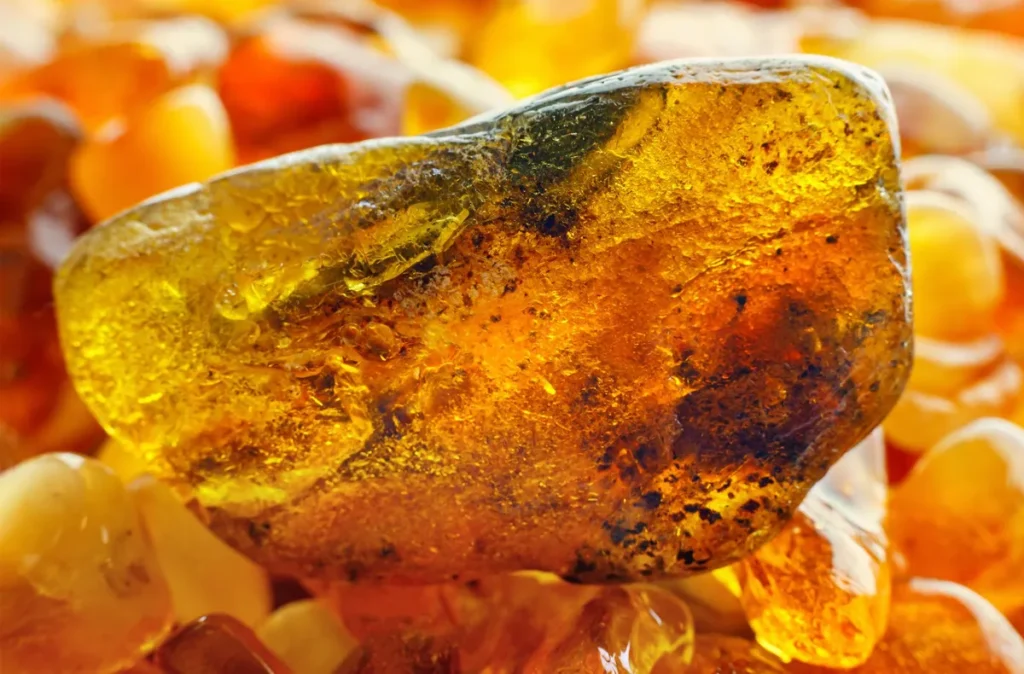
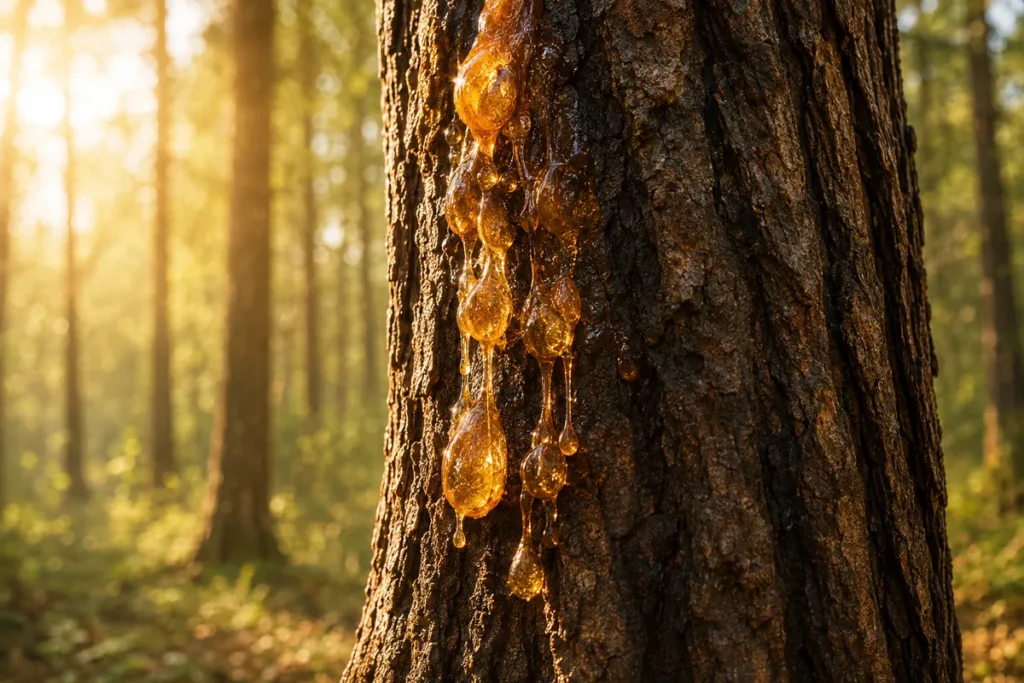
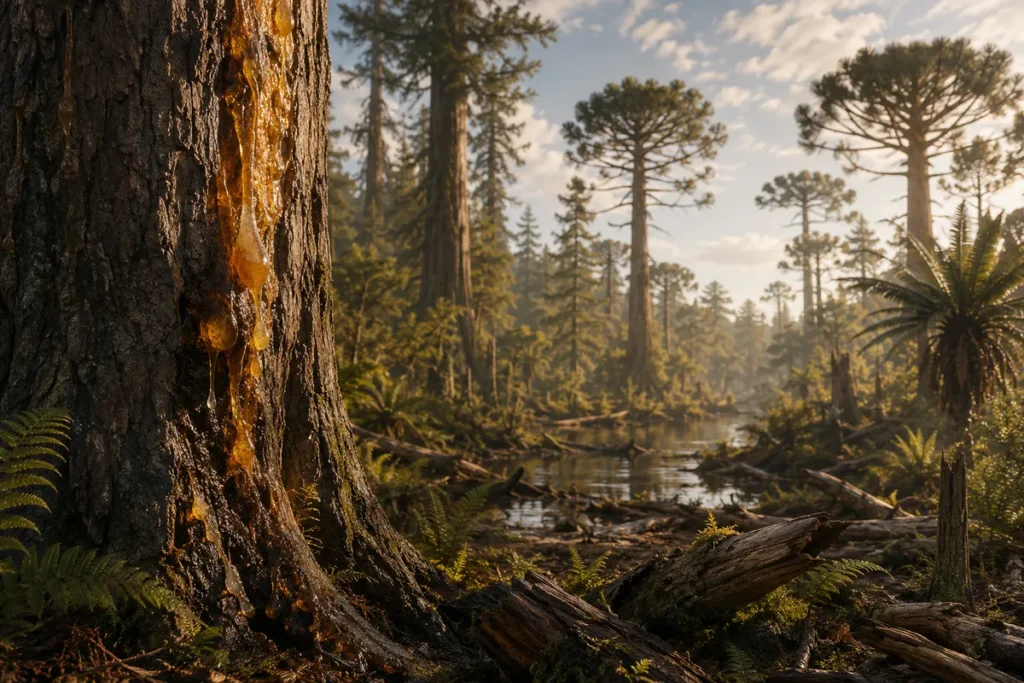
Amber looks ancient.
Its warm golden color, preserved insects, plant fragments, and unusual internal structures can make it feel like a direct piece of Earth’s distant past.
And in a geological sense, it is.
But how old is amber actually?
The answer is more complicated than a single number.
Amber occurs in deposits ranging from the Mesozoic to the Cenozoic, and different amber deposits formed at very different times in Earth’s history. Some are more than 100 million years old, while others are considerably younger.
Even within a single famous amber-producing region, the age may not be represented by one exact date.
Baltic amber is a particularly good example.
It is commonly described as being around 40 million years old, but modern research shows that the geological history is more complicated. The main Baltic amber-bearing deposits are associated with the Eocene, and recent work places the Upper Blue Earth Member of the Prussian Formation at roughly 36–35 million years old, while broader studies have proposed wider age ranges for Baltic amber-bearing sediments.
So when we ask, “How old is amber?”, we are really asking several different questions:
- When did the original tree resin form?
- When was that resin buried?
- When did it become chemically transformed into amber?
- How old are the sediments containing it?
- How do scientists determine its age?
Understanding those distinctions makes the age of amber much more interesting.
Amber Does Not Have One Universal Age
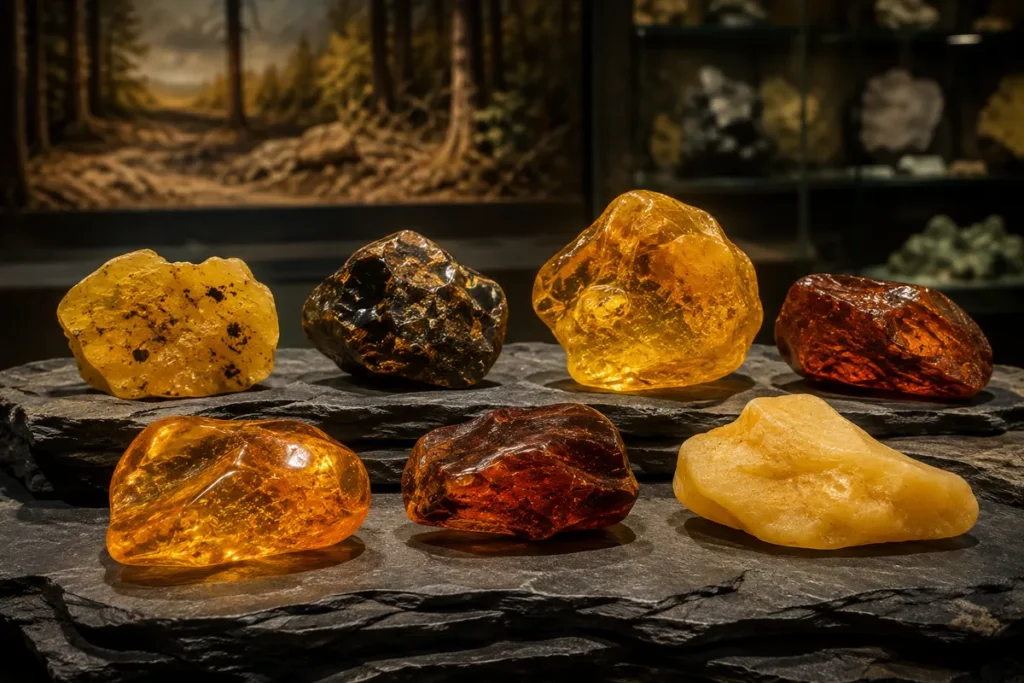
The first thing to understand is that amber is not one geological material from one particular period.
Amber is fossilized plant resin, and fossil resins have formed throughout different periods of Earth’s history.
Researchers have documented amber ranging from the Mesozoic to the Cenozoic, with deposits distributed across many parts of the world. A 2023 review notes that amber occurs globally and spans a very broad geological age range, from the Carboniferous to the Cenozoic, although the exact dating of individual deposits can be difficult.
This means that asking for the age of “amber” without specifying its origin is a little like asking:
How old is a fossil?
The answer depends on which fossil you mean.
A piece of Burmese amber and a piece of Baltic amber can be separated by tens of millions of years.
A piece of Canadian amber can have yet another geological age.
Dominican amber is younger still.
The location matters because it tells us which geological history we are dealing with.
How Old Is Baltic Amber?
Baltic amber is generally associated with the Eocene Epoch, particularly the later part of the Eocene.
The Eocene lasted from approximately 56 to 33.9 million years ago under the current geological timescale.
For the main amber-bearing deposits of the Samland Peninsula, recent stratigraphic research has placed the Upper Blue Earth Member of the Prussian Formation in the mid-Priabonian, around 36–35 million years ago.
This is more precise than simply saying “Baltic amber is 40 million years old.”
At the same time, scientists continue to discuss the broader age of Baltic amber because amber occurs in multiple geological settings and some material may have been transported and redeposited.
Earlier studies have proposed considerably wider age ranges, including amber-bearing sediments dating into the middle Eocene and younger Paleogene deposits.
So a careful description would be:
Most Baltic amber is associated with Eocene deposits, with the principal Upper Blue Earth amber-bearing layer generally placed at around 36–35 million years old.
That is much more accurate than assigning every Baltic amber specimen one exact age.
Understanding the age of Baltic amber also requires understanding how the region’s ancient forests, sediments, rivers, and later geological processes shaped the deposits ,see our guide to why so much amber is found in the Baltic region.
Why Do You Sometimes See “44 Million Years Old” for Baltic Amber?
If you have researched Baltic amber before, you may have seen claims that it is approximately 44 million years old.
There is a scientific reason for that number.
Earlier geological studies used radiometric dating of minerals associated with amber-bearing sediments and obtained ages around 44–47 million years. These results contributed to the long-running debate over the age of Baltic amber.
However, later research raised questions about whether those minerals accurately recorded the age of the amber-bearing sediments.
The problem is that a mineral in a sedimentary deposit can sometimes have an older history than the sediment in which it is eventually deposited. Reworking and contamination can therefore complicate the interpretation of radiometric ages.
This is one reason scientists increasingly rely on stratigraphic evidence and fossil assemblages when determining the age of amber-bearing deposits.
A recent review concluded that dinoflagellate cyst biostratigraphy provides a particularly useful framework for dating the principal Baltic amber-bearing beds, placing the Upper Blue Earth Member around 36–35 million years old.
So the difference between “44 million years” and “36 million years” is not simply a matter of someone making a mistake.
It reflects a long-standing scientific question about what exactly is being dated and how reliable each dating method is in that geological setting.
Does Amber Itself Get Directly Dated?
This is one of the most important questions in understanding amber’s age.
The short answer is:
Not usually in the simple way people imagine.
Scientists often determine the age of amber by dating the geological context in which the amber occurs.
That may include:
- the sediment surrounding the amber
- fossils found in the same layer
- microfossils
- volcanic minerals or ash layers
- geological relationships between rock units
- radiometric ages of associated minerals
A major review of amber dating notes that directly dating amber and its inclusions remains difficult, and that age estimates commonly rely on stratigraphic correlations and index fossils.
This distinction is extremely important.
If an amber specimen is found in a sedimentary layer known to be about 36 million years old, scientists can use that geological context to estimate the age of the amber.
But that does not necessarily mean the amber itself has been directly measured and shown to be exactly 36,000,000 years old.
How Do Scientists Determine the Age of Amber?
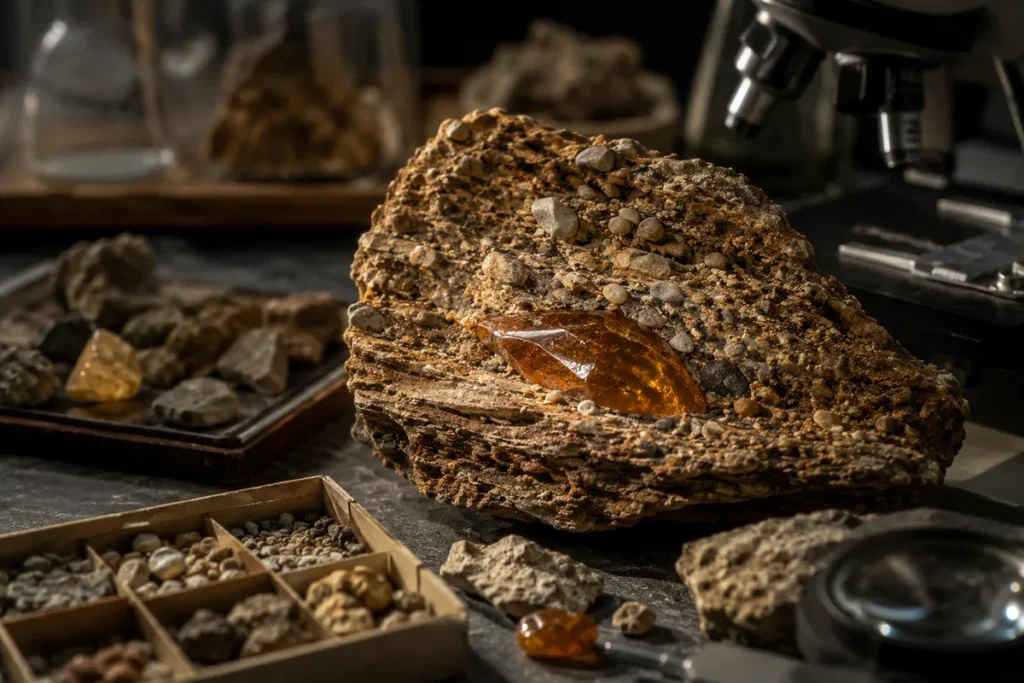
There is no single universal method.
Instead, scientists combine several lines of evidence.
1. Stratigraphy
Stratigraphy is the study of rock layers and their relationships.
If amber occurs within a geological formation whose age can be established, researchers can use that information to estimate the age of the amber.
This is particularly important for Baltic amber.
Scientists study the sequence of sedimentary layers and compare them with established geological timescales.
The relative position of a layer can provide important information about when it formed.
2. Fossil Assemblages
Fossils can also help establish geological age.
Some organisms existed only during particular intervals of geological history.
If their fossils occur in the same sedimentary layer as amber, they can provide clues about the age of that layer.
These are sometimes called index fossils when they are particularly useful for correlation.
In Baltic amber research, microfossils such as dinoflagellate cysts have played an important role in dating amber-bearing sediments. Recent work has used their distribution to correlate the relevant layers with the international geological timescale.
3. Radiometric Dating
Radiometric dating uses the predictable decay of radioactive isotopes to estimate the age of geological materials.
It can be extremely powerful.
But it is important to understand that scientists need an appropriate material to date.
Radiometric dating of a mineral associated with amber does not automatically mean that the amber itself formed at exactly the same moment.
This is one of the reasons Baltic amber dating has been debated.
Older studies produced radiometric ages that were older than the ages suggested by some later stratigraphic and paleontological evidence.
Radiometric dating is therefore valuable, but its geological context matters.
4. Chemical and Spectroscopic Evidence
Scientists can also study the chemistry of amber.
Techniques such as:
- FTIR spectroscopy
- Raman spectroscopy
- nuclear magnetic resonance
- gas chromatography–mass spectrometry
- other molecular and geochemical methods
can reveal the chemical structure and origin of fossil resins.
These methods are particularly useful for distinguishing different types of amber and investigating their geological history.
Recent research has even explored the use of FTIR spectra combined with statistical analysis to classify fossil resins according to geological age and geographical provenance.
But there is an important distinction:
Chemical analysis can provide clues about provenance and maturation, but it does not automatically provide a simple “this piece is exactly X million years old” result.
Dating amber is a geological problem, not just a chemistry problem.
5. Geological Context
Sometimes the most useful information comes from the entire geological setting.
Scientists may ask:
- What rock formation contains the amber?
- What fossils occur nearby?
- Was the amber deposited directly in that environment?
- Could it have been transported from somewhere else?
- Is the amber in its original deposit or a secondary deposit?
- What geological events happened before and after its burial?
These questions matter because amber can be reworked.
A piece of amber may have formed millions of years before it was deposited in the sediment where scientists find it today.
What Does “Reworked Amber” Mean?
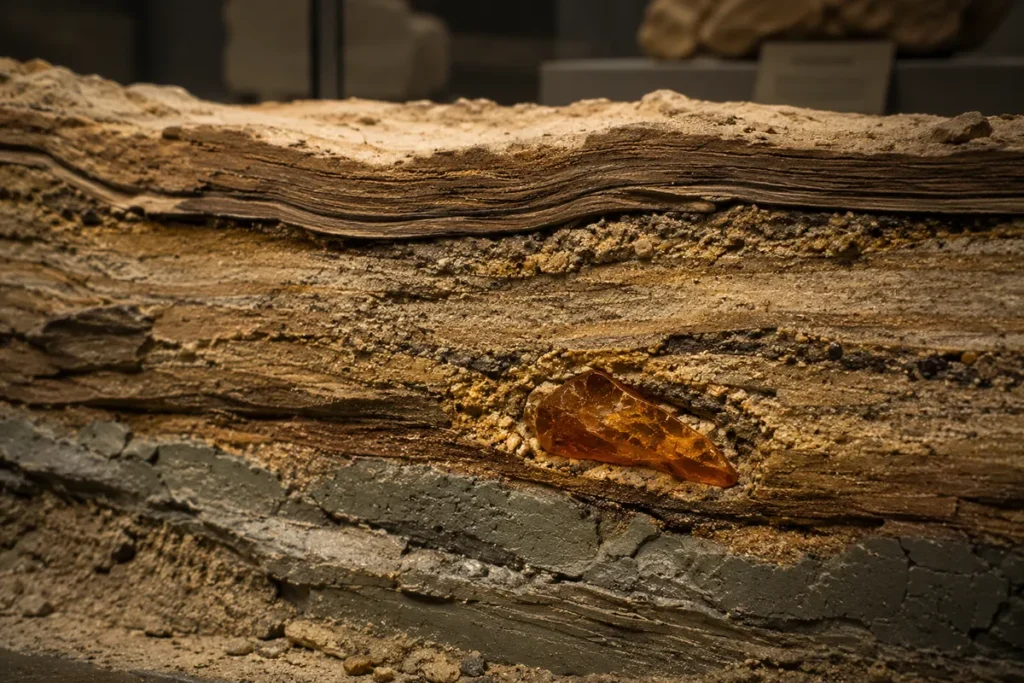
Reworked amber is amber that has been eroded from an older deposit and deposited again somewhere else.
Imagine a piece of amber that formed in an ancient forest.
It becomes buried and preserved.
Millions of years later, erosion removes the sediment around it.
The amber is released.
A river transports it.
The amber is eventually buried again in a younger sedimentary layer.
Now the amber is physically older than the sediment surrounding it.
This creates an important distinction:
The age of the amber and the age of the deposit containing the amber may not always be identical.
This is one reason scientists need to consider the complete geological history rather than simply assigning the age of a rock layer to every specimen found within it.
Why Baltic Amber Dating Has Been So Difficult
Baltic amber is an especially interesting case because it has experienced a complicated geological history.
The original resin was produced in ancient forests.
It was transported and deposited.
Later geological processes affected the amber-bearing sediments.
Some amber was subsequently eroded and redistributed.
This means researchers are not necessarily studying a single, perfectly preserved layer representing one moment in time.
The geological record contains multiple depositional environments and episodes of transport.
A recent review of Baltic amber emphasized that the age of the material has been debated for many years and argued that the main Upper Blue Earth amber-bearing layer is best placed in the late Eocene, around 36–35 million years ago.
The broader scientific literature nevertheless includes older and younger age estimates for different amber-bearing strata.
That is why responsible descriptions of Baltic amber should avoid presenting one exact number as universally established.
How Old Is Burmese Amber?
Burmese amber is dramatically older than Baltic amber.
The famous amber deposits of the Hukawng Valley in Myanmar are generally dated to the Late Cretaceous, approximately 99 million years ago.
One widely cited age estimate places Burmese amber at about 98.8 million years, based on radiometric dating of associated volcanic material.
This means that many organisms preserved in Burmese amber lived during a world very different from the one represented by Baltic amber.
Dinosaurs were still living.
Flowering plants were diversifying.
Ancient insects and other arthropods occupied ecosystems that disappeared long before the forests that produced Baltic amber existed.
This enormous difference in age is one reason Burmese amber is so important to paleontology.
How Old Is Dominican Amber?
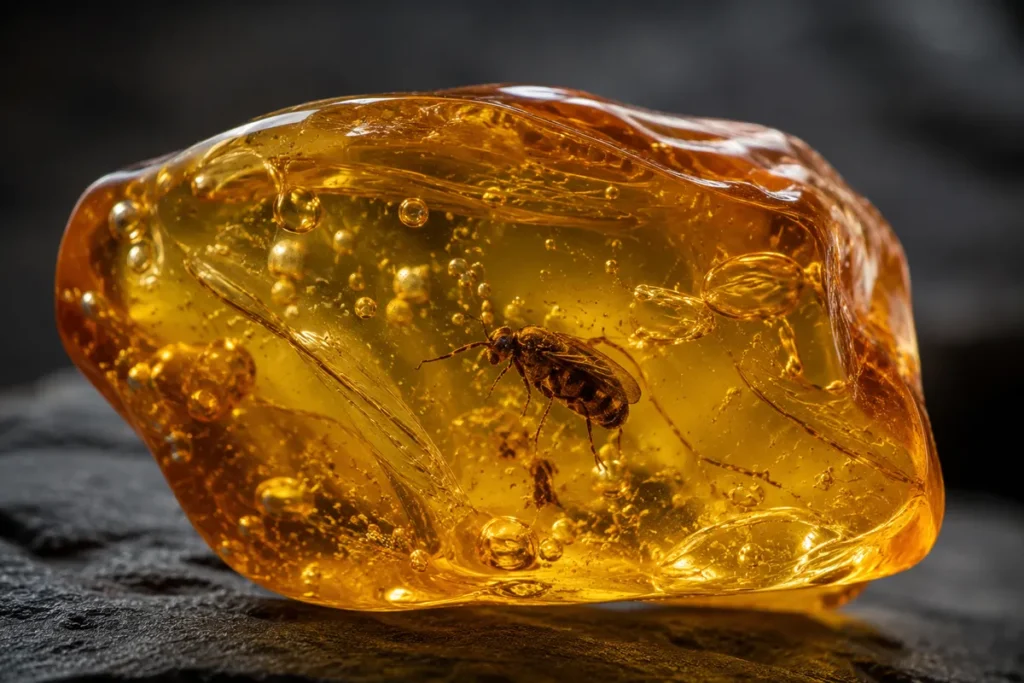
Dominican amber is much younger than Burmese amber.
It is generally associated with the Miocene, commonly estimated at roughly 15–20 million years old.
That means Dominican amber formed tens of millions of years after the principal Baltic amber deposits.
Yet it can still preserve insects and other organisms in extraordinary detail.
This is a useful reminder that amber does not have to be among the oldest fossil materials to be scientifically valuable.
Different deposits preserve different moments in Earth’s history.
How Old Can Amber Be?
Amber can be extraordinarily old.
The fossil-resin record extends deep into geological time, and amber deposits are known from periods far older than the famous Baltic and Dominican deposits. A major review describes amber occurrences ranging from the Carboniferous through the Cenozoic.
Some of the most scientifically important ancient amber deposits formed during the Cretaceous.
Examples include amber from:
- Myanmar
- Canada
- Lebanon
- Jordan
- parts of Africa
- other Cretaceous localities
These deposits preserve ecosystems that existed more than 65 million years ago.
But “older” does not automatically mean “better.”
A younger amber specimen with an exceptionally preserved organism may be scientifically fascinating, while an older piece may contain little visible biological information.
Age is only one part of the story.
A Simple Comparison of Major Amber Ages
| Amber region | Approximate geological age | Geological period |
| Burmese amber, Myanmar | ~99 million years | Late Cretaceous |
| Canadian Cretaceous amber | ~76–80 million years in major deposits | Late Cretaceous |
| Baltic amber | commonly associated with ~36–35 million-year-old principal deposits | Late Eocene |
| Dominican amber | ~15–20 million years | Miocene |
| Some Australian amber | much older occurrences exist | Mesozoic–Cenozoic |
These are approximate geological ages for major deposits, not universal ages for every specimen from those regions. Different localities, layers, and dating methods can produce different results.
Why Doesn’t Older Amber Always Look More “Fossilized”?
This is a common misconception.
You might expect extremely old amber to look dramatically different from younger amber.
But appearance alone is not a reliable geological clock.
Amber can retain a polished, glass-like appearance even after tens of millions of years.
Its color and clarity are influenced by many factors, including:
- original resin chemistry
- oxidation
- inclusions
- bubbles
- geological alteration
- exposure
- treatment
- polishing
A 20-million-year-old piece can look remarkably fresh.
A much older piece can look darker, cloudier, or more weathered.
Appearance cannot provide a reliable numerical age.
Does Darker Amber Mean Older Amber?
No.
This is another common misconception.
Amber can become darker through oxidation and other forms of alteration, but color is not a simple indicator of geological age.
A dark reddish-brown piece is not automatically older than a pale yellow piece.
Likewise, a transparent golden specimen is not necessarily younger than cloudy amber.
Color is influenced by the history and internal structure of the material rather than functioning as a simple geological stopwatch.
For more on amber color, see our guide to amber colors and what the different colors mean.
Can an Amber Inclusion Tell Us How Old the Amber Is?
An inclusion can provide valuable biological and geological information, but it does not automatically give the specimen an exact age.
Scientists can compare an organism with known fossil records and evolutionary histories.
If an organism is known to have existed only during a particular geological interval, its presence can help constrain the age of the deposit.
But this requires careful scientific analysis.
It is not enough to look at an insect and say:
“This species looks ancient, so the amber must be 50 million years old.”
The age of the inclusion and the age of the amber-bearing deposit need to be established through geological evidence.
Can Scientists Date an Amber Inclusion Directly?
Usually not in a simple or routine way.
An insect preserved inside amber is part of the fossil record, but the insect itself generally cannot be assigned an exact numerical age simply by examining it.
Researchers instead combine:
- the age of the surrounding sediment
- stratigraphic evidence
- fossil correlations
- geological relationships
- chemical information
- and, where appropriate, radiometric dating of associated materials
The inclusion can then be interpreted within that geological framework.
This is one reason why amber fossils are most useful when their geological provenance is carefully documented.
Does the Age of Amber Tell Us When the Tree Died?
Not necessarily.
The resin could have been produced while the tree was alive.
It could have accumulated over time.
It might have remained in the forest environment before being transported.
It could then have been deposited and buried much later.
So the age assigned to an amber deposit does not necessarily tell us the exact moment when a particular drop of resin left a particular tree.
The geological age represents a much broader history of formation, transport, burial, and preservation.
How Long Does It Take for Resin to Become Amber?
There is no simple stopwatch for the process.
Fresh resin does not suddenly become amber after a fixed number of years.
The transformation involves burial, chemical alteration, polymerization, loss of volatile components, and other geological processes.
Some fossil resins may remain relatively immature for long periods, while others undergo substantial chemical transformation.
This is why geological age and chemical maturity are related but not identical concepts.
Recent research on Baltic amber has specifically examined amber maturity as a separate property and found that chemical and structural maturity do not always change in exactly the same way.
So “40 million years old” and “highly mature fossil resin” are related ideas, but they are not interchangeable.
Can Scientists Tell the Age of Amber by Its Chemistry?
Chemistry can help, but not by itself.
Different fossil resins have different molecular compositions.
Scientists can examine characteristic chemical groups and molecular structures using techniques such as FTIR, Raman spectroscopy, and other analytical methods.
These measurements can help identify:
- resin type
- provenance
- degree of maturation
- geological relationships
Recent research has shown that FTIR data combined with chemometric analysis can help classify fossil resins according to both geological age and geographical origin.
But this is a scientific analytical approach, not a simple home test.
You cannot determine that a piece of amber is “36 million years old” just because it has a particular color or a particular FTIR peak.
Why Is Geological Age Important?
The age of amber matters because it tells us when the preserved ecosystem existed.
An insect preserved in 100-million-year-old Burmese amber lived in the Cretaceous.
An insect preserved in Baltic amber lived tens of millions of years later.
A specimen from Dominican amber represents an even younger ecosystem.
These differences allow scientists to compare life across enormous spans of geological time.
Amber can therefore act as a kind of time capsule.
Not a perfect one.
Not a complete one.
But an unusually detailed record of ancient terrestrial life.
Amber with inclusions can preserve detailed evidence of ancient ecosystems. Learn more about amber inclusions and what they can reveal.
Amber Is a Geological Time Capsule
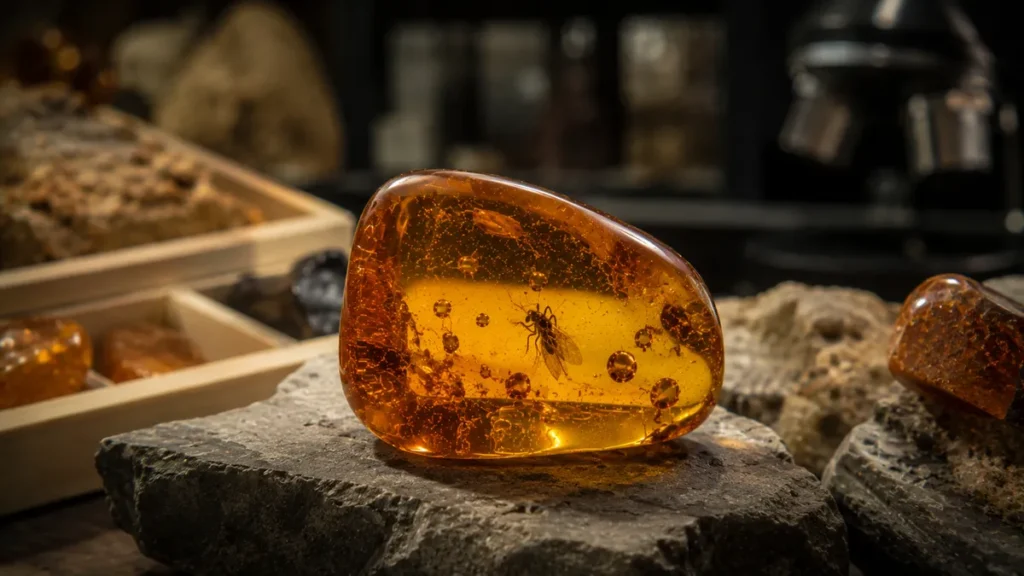
One of the most extraordinary things about amber is that it preserves more than the organisms themselves.
It preserves them in a particular geological moment.
A small insect trapped in resin becomes part of a chain of evidence connecting:
forest → resin → burial → geological transformation → fossil → scientific interpretation
Millions of years later, scientists can examine that tiny inclusion and ask questions about:
- biodiversity
- evolution
- ancient ecosystems
- climate
- plant-insect interactions
- behavior
- extinction
- geological change
That is why the age of amber is more than a number.
It determines which chapter of Earth’s history the specimen belongs to.
If you want to know more ,see our guide to why insects are preserved so well in amber.
Why Baltic Amber’s Age Matters So Much
Baltic amber is especially important because of the enormous number and diversity of inclusions it contains.
If researchers want to reconstruct an ancient ecosystem, they need to know when that ecosystem existed.
If the geological age is uncertain, interpretations of evolutionary relationships can also become more complicated.
Recent research specifically emphasizes that accurate dating of Baltic amber matters when amber inclusions are used in evolutionary studies and phylogenetic analyses.
This is one reason scientists continue to refine the age of Baltic amber rather than simply accepting an old number that has been repeated for decades.
Why You Should Be Careful With Claims Like “This Amber Is 100 Million Years Old”
A seller may describe an amber specimen as:
“100 million years old.”
That statement might be based on the geological age commonly associated with its deposit.
But it does not necessarily mean that the individual piece has been directly dated.
A more scientifically responsible description would identify:
- the geological locality
- the formation or deposit
- the estimated age of that formation
- the dating method or evidence
- whether the amber is from a primary or secondary deposit
For ordinary decorative amber, this level of documentation may not always exist.
For scientifically important specimens, provenance becomes much more important.
Does Older Amber Have More Value?
Not automatically.
Age can be an important characteristic, especially for collectors and scientific specimens, but it does not by itself determine commercial value.
A younger amber specimen with an exceptionally preserved insect may be more interesting to a collector than an older piece with no visible inclusion.
Likewise, transparency, color, size, condition, treatment, craftsmanship, rarity, and authenticity can all influence value.
For a broader discussion, see our guide to what makes amber valuable.
The Difference Between Age and Rarity
These two ideas are often confused.
Something can be:
- old but relatively common
- young but rare
- old and rare
- young and scientifically important
Amber provides examples of all four.
A geological age tells you when the material formed or was deposited.
Rarity tells you how uncommon the material or feature is.
Scientific importance tells you what information it contains.
They are related, but they are not the same thing.
So, How Old Is Amber?
There is no single answer.
Amber occurs across a vast span of geological time.
Some fossil resins are hundreds of millions of years old.
Burmese amber is roughly 99 million years old.
Major Canadian amber deposits date to around 76–80 million years ago.
Baltic amber is mainly associated with the Eocene, with the principal Upper Blue Earth amber-bearing layer now placed at roughly 36–35 million years old.
Dominican amber is considerably younger, generally around 15–20 million years old.
But these numbers should be understood as geological estimates associated with deposits, not as a simple direct birthday stamped onto every individual piece of amber.
Amber’s Age Is Really a Story About Time
A piece of amber may look small and simple.
But its history can span tens of millions of years.
A tree produced resin.
An insect became trapped.
The resin was buried.
Sediments accumulated above it.
Chemical changes transformed the material.
Geological forces moved and reshaped the landscape.
Millions of years passed.
Eventually, erosion exposed the amber again.
And now a small golden fragment can be held in the hand.
That is what makes amber so unusual.
It does not simply preserve something from the past. It carries a physical record of geological time.
Frequently Asked Questions
How old is amber usually?
There is no typical age for all amber. Major deposits range from relatively young Cenozoic material to Cretaceous and older fossil resins. Baltic amber is mainly associated with the Eocene, while Burmese amber is roughly 99 million years old.
How old is Baltic amber?
The principal Upper Blue Earth amber-bearing layer in the Samland Peninsula is currently placed at approximately 36–35 million years old, in the late Eocene. Broader Baltic amber-bearing strata and individual specimens can have more complicated geological histories.
Is Baltic amber 44 million years old?
Approximately 44 million years is an older age estimate associated with radiometric dating of minerals related to Baltic amber-bearing sediments. Later research has favored a younger late-Eocene age for the principal Upper Blue Earth layer, around 36–35 million years.
How old is Burmese amber?
Burmese amber from the Hukawng Valley in Myanmar is generally dated to approximately 99 million years ago, placing it in the Late Cretaceous.
How old is Dominican amber?
Dominican amber is generally associated with the Miocene and is commonly estimated at approximately 15–20 million years old.
Can amber be directly dated?
Direct dating of amber itself is difficult. Scientists commonly estimate its age from the geological formation, fossils, stratigraphy, and other materials associated with the amber.
Does darker amber mean older amber?
No. Amber color can be affected by oxidation, internal structure, inclusions, treatment, and other factors. Color is not a reliable indicator of geological age.
Does an insect tell you how old amber is?
An inclusion can provide important biological information, but an insect alone does not provide an exact numerical age. Its age is interpreted within the geological context of the amber deposit.
Is older amber more valuable?
Not necessarily. Age can be important, but value also depends on factors such as color, clarity, inclusions, rarity, condition, treatment, craftsmanship, and authenticity.
Why is dating Baltic amber difficult?
Baltic amber has undergone a complicated history of deposition, transport, burial, erosion, and redeposition. Different dating approaches have therefore produced different estimates, and researchers continue to refine the age of its principal deposits.
Final Thoughts
Amber is often described simply as “millions of years old.”
That is true, but it leaves out the most interesting part.
Amber does not have one universal age.
Different deposits formed during different periods of Earth’s history, and even within a major amber-producing region, geological age can be complicated by transportation, redeposition, and changes in the surrounding sediments.
Baltic amber provides one of the clearest examples.
The principal amber-bearing layers are associated with the Eocene, and current research places the Upper Blue Earth Member at roughly 36–35 million years old. Other age estimates have existed because scientists have used different geological evidence and because the history of the deposits is complex.
Ultimately, the age of amber is not just a number.
It is a way of placing a tiny piece of fossil resin—and everything preserved inside it—within the enormous timeline of Earth’s history.
When you look at an amber inclusion, you are not simply looking at an ancient organism. You are looking at a moment from a world that existed millions of years ago.