
The Baltic region is famous for amber.
Along the shores of the Baltic Sea, pieces of golden fossil resin have been collected for thousands of years. Amber appears in coastal sediments, ancient deposits, and secondary concentrations across parts of Poland, Lithuania, Latvia, Germany, Denmark, Sweden, and the Kaliningrad region of Russia.
But this raises an interesting question:
Why is so much amber found in the Baltic region in the first place?
The answer is not simply that ancient trees grew there.
Large amounts of amber required a very particular combination of circumstances: resin-producing forests, a climate favorable to abundant resin production, geological environments capable of collecting and burying that resin, and millions of years of sedimentary and geological processes that preserved and redistributed it.
The Baltic region happened to provide many of these conditions at the right time.
That is what makes its amber deposits so remarkable.
The Short Answer: A Perfect Combination of Conditions
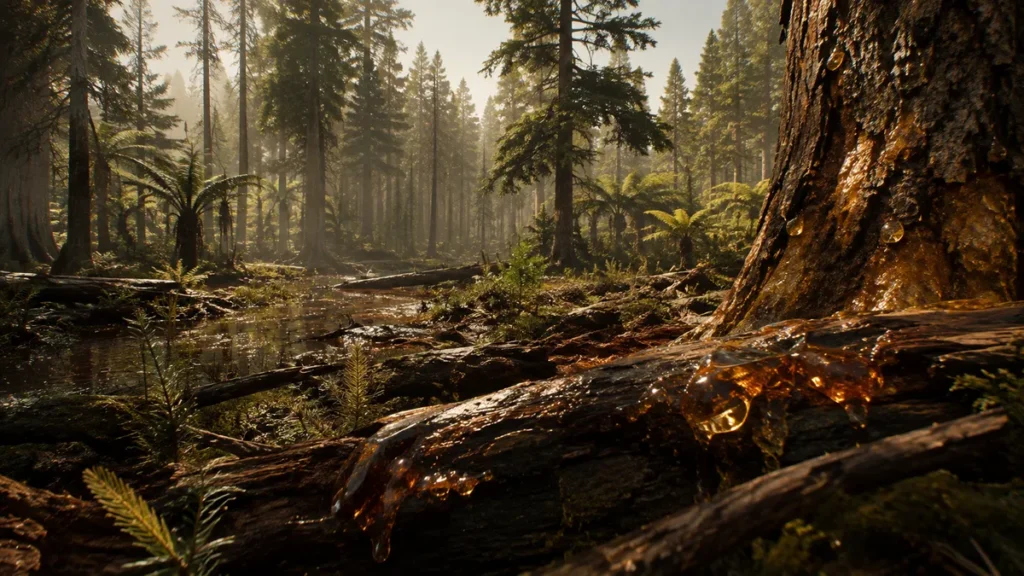
The enormous concentration of Baltic amber is the result of several processes working together over geological time.
In simplified form, the story looks like this:
Ancient forests → abundant resin → transport → sedimentary accumulation → burial and chemical transformation → geological preservation → erosion and redistribution
The original resin was produced in ancient forests that covered parts of what is now northern Europe during the Paleogene, particularly the Eocene.
That resin was then transported away from the original forests by rivers and other sedimentary processes. Much of it accumulated in coastal, deltaic, and marine environments, where it became buried in sediments.
Over millions of years, the resin underwent chemical and physical changes that transformed it into amber.
Much later, glaciers, rivers, coastal erosion, and wave action redistributed some of that amber again.
The result is a remarkable geological story in which amber can be found far from the forests that originally produced the resin.
1. The Baltic Region Once Had Vast Amber-Producing Forests
The Baltic region looked very different tens of millions of years ago.
During the Eocene, much of northern Europe experienced a considerably warmer climate than today. Forests covered large areas of what is now Scandinavia and surrounding regions.
The exact composition of these ancient forests remains an area of scientific study, and the traditional idea of a single “amber tree” is now considered too simplistic.
What is much more certain is that coniferous trees were important sources of the resin associated with Baltic amber.
Chemical and paleobotanical studies have investigated several possible botanical sources, and the exact identity of the original resin-producing trees has been debated for more than a century. Some evidence points toward extinct conifers, while the precise botanical source of Baltic succinite remains unresolved.
This uncertainty does not change the larger story.
There were extensive resin-producing forests in the region, and they supplied the raw material from which Baltic amber ultimately formed.
For more on this subject, see our where Baltic amber comes from.
2. The Eocene Climate Helped Create the Right Environment
Climate was another important part of the story.
The Eocene was one of the warmer intervals in Earth’s Cenozoic history. Northern Europe was considerably warmer than it is today, and forests extended into regions that now experience much cooler climates.
Studies of Baltic amber inclusions and associated plant fossils suggest that the ancient amber-producing forests were diverse and included warm-temperate to subtropical forest environments. Reconstructions have proposed a mixture of habitats, including wetlands, riparian forests, lowland areas, and mixed conifer-angiosperm forests.
Why does this matter?
Because resin production is closely connected with plant biology and environmental stress.
Trees produce resin for several reasons, including responding to physical damage and protecting wounded tissue from insects and microorganisms.
In a large forest containing abundant resin-producing trees, repeated damage over long periods could produce enormous quantities of resin.
But producing resin was only the first step.
For that resin to become amber, it also had to survive what happened next.
3. Large Amounts of Resin Had to Accumulate
A forest can produce resin without creating a major amber deposit.
Most fresh resin never becomes amber.
It may remain exposed on the tree, weather away, be consumed or altered by organisms, or become destroyed before it is buried.
The Baltic deposits required something different.
Large quantities of resin had to enter environments where it could be transported, accumulated, and eventually buried.
This is one reason the geological setting of the Baltic amber region is so important.
The ancient forests were not isolated from the surrounding waterways and coastal environments. Resin could be carried away from the forest floor by streams and rivers, eventually reaching lowland, deltaic, lagoonal, and marine settings.
Geological studies of Baltic amber deposits have described extensive transport from the original forest regions toward sedimentary environments around the southern Baltic basin.
So the Baltic amber story is not simply a story about where trees grew.
It is also a story about where the resin ended up.
4. Rivers Helped Move Resin Away From the Forests
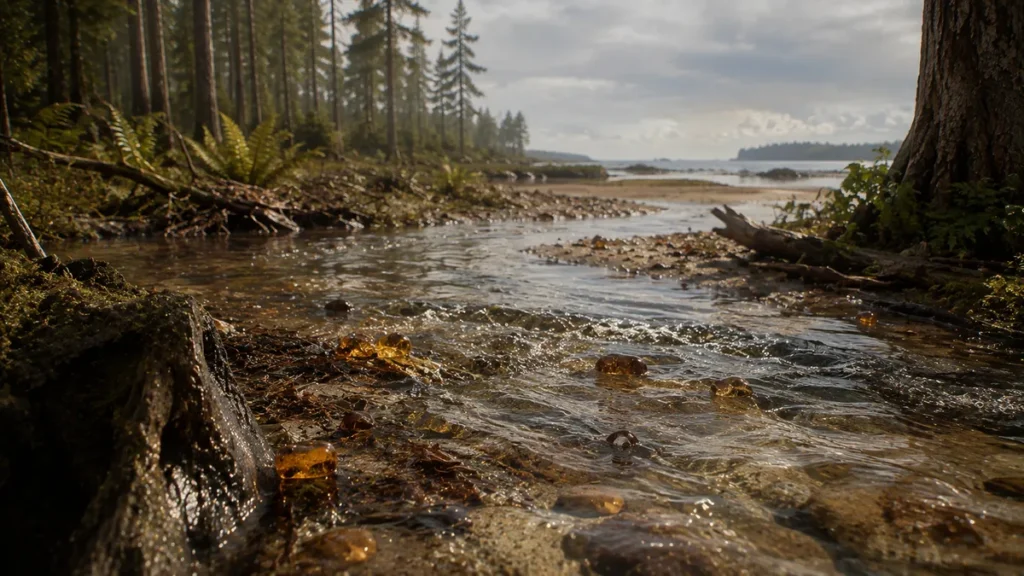
Imagine an ancient forest covering parts of northern Europe.
A tree is damaged and releases resin.
The resin hardens on the tree or falls onto the forest floor.
Rain, streams, erosion, and changing landscapes gradually move sediment and organic material away from the forest.
Some resin eventually enters river systems.
Over long periods, enormous quantities of sediment can be transported downstream.
This process provided a natural way to move resin from the ancient source forests toward the sedimentary basins where much of the Baltic amber was eventually concentrated.
Research on Baltic amber supports a history involving substantial fluvial transport from the source region toward the southern Baltic area.
This helps explain something that can otherwise seem surprising:
The place where Baltic amber is found today is not necessarily the place where the resin originally formed.
The amber has been through a geological journey.
5. The Ancient Baltic Basin Helped Concentrate the Resin
The geography of northern Europe during the Paleogene was very different from today’s Baltic Sea.
The modern Baltic Sea did not simply exist in its present form while the amber was being produced.
Instead, the region contained changing combinations of land, shallow marine environments, lagoons, river systems, and sedimentary basins.
These environments created opportunities for transported resin to accumulate.
One particularly important geological unit is commonly known as the Blue Earth or Blaue Erde, an amber-bearing sediment associated with the southern Baltic region, especially the Sambian Peninsula around present-day Kaliningrad.
The Blue Earth contains large concentrations of amber and has played a central role in scientific discussions about the geological history of Baltic amber.
The important idea is that the amber became concentrated in particular sedimentary environments rather than being evenly distributed across the entire ancient landscape.
6. Burial Protected the Resin From Destruction
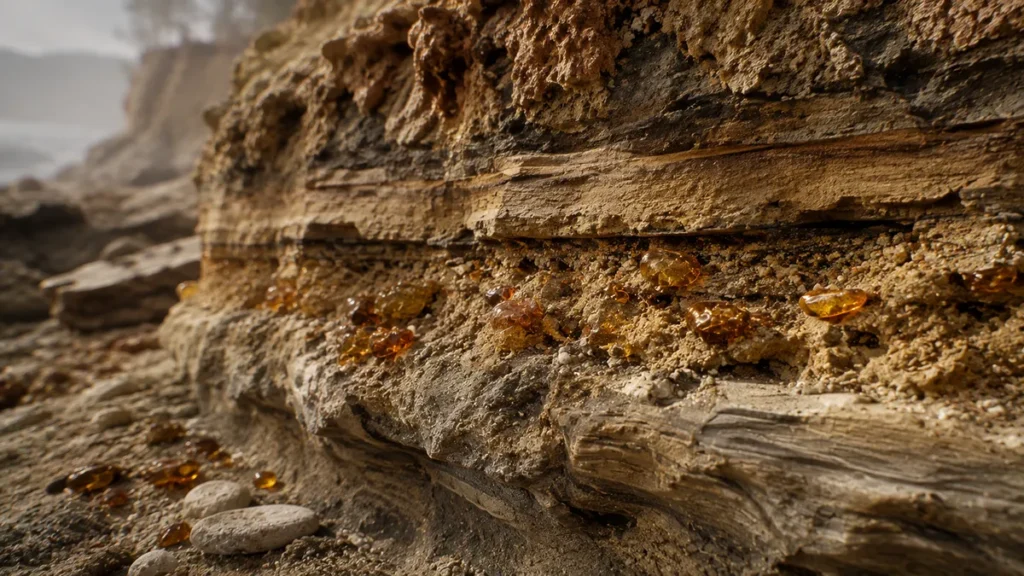
Once resin became buried beneath sediment, its chances of surviving increased.
Burial reduced exposure to weathering and other destructive surface processes.
Over geological time, the resin was subjected to chemical changes, including polymerization and the loss or alteration of volatile components.
The material gradually moved away from the chemistry of fresh tree resin and toward the stable fossil resin we recognize as amber.
Baltic amber, particularly the material known as succinite, has a distinctive chemical composition associated with its geological history. Studies have identified diterpenoid and other resin-derived compounds within the material.
This transformation did not happen quickly.
It took geological time.
That is why a piece of Baltic amber is not simply a piece of ancient tree resin that happened to survive.
It is the product of a long process of burial, chemical alteration, and geological maturation.
7. Why Didn’t All the Amber Stay Where It Was Buried?
This is where the story becomes even more interesting.
Baltic amber has not remained in one geological layer forever.
The region has experienced enormous environmental changes since the amber first accumulated.
Sediments were uplifted, eroded, transported, buried again, and in some places exposed at the surface.
During the Quaternary Period, repeated glacial advances dramatically reshaped northern Europe.
Ice sheets moved enormous quantities of sediment across the region.
They could erode older amber-bearing deposits and transport pieces of amber into younger sediments.
This helps explain why Baltic amber can be found in secondary deposits well beyond the location of the original primary amber-bearing strata. Scientific literature documents Quaternary glacial and fluvial redistribution of Baltic amber across northern Europe.
In other words, the amber’s journey did not end when it became fossilized.
8. Glaciers Helped Redistribute Baltic Amber
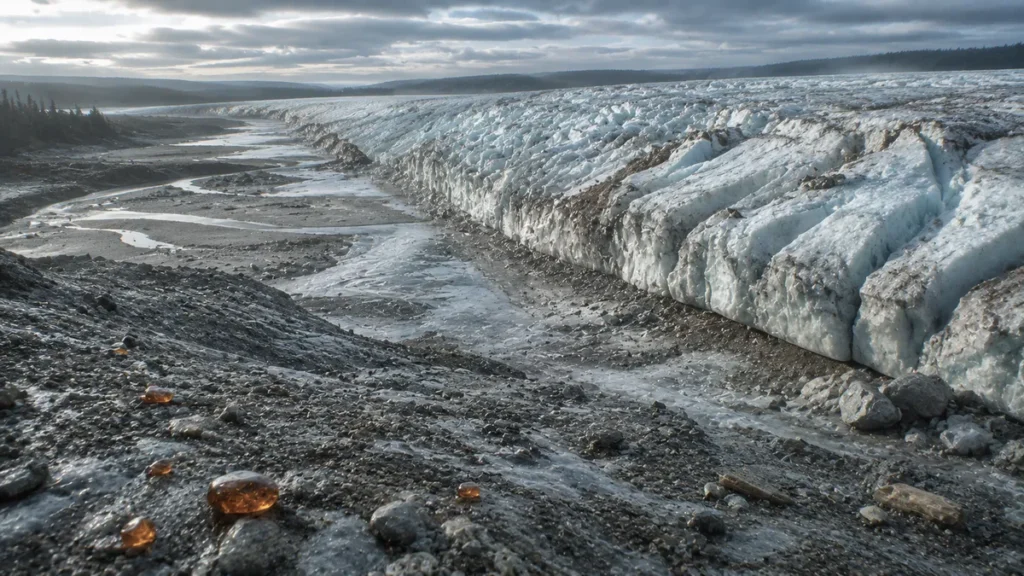
The Ice Age played an important role in shaping the modern distribution of Baltic amber.
Northern Europe was repeatedly covered by large continental ice sheets during the Pleistocene.
As glaciers advanced and retreated, they scraped, transported, and redeposited enormous quantities of sediment.
Amber could be moved along with that sediment.
Some pieces were carried considerable distances from their original deposits and later became concentrated in younger sediments.
This is one reason amber can occur in areas that are geographically distant from the major primary deposits.
It also helps explain why amber is found in parts of northern Europe that were not necessarily the location of the original Eocene amber-producing forests.
The amber had effectively been recycled through the landscape.
9. The Baltic Sea Continues to Move Amber Today
The geological story is still continuing.
Amber-bearing sediments around the Baltic Sea can be eroded by waves, currents, and storms.
When coastal sediments are disturbed, pieces of amber may be released.
Because amber is relatively light and buoyant compared with many common minerals, loose pieces can be transported by water and eventually deposited elsewhere along the coast. Research on Baltic coastal sediments has documented modern redistribution of amber by coastal currents and storm activity.
This is why Baltic amber can sometimes be found washed onto beaches.
A storm may expose or release pieces that have been buried in coastal sediments for much longer periods.
The amber itself may be tens of millions of years old.
Its appearance on a beach may have happened only yesterday.
10. Why Is So Much Amber Concentrated Around Kaliningrad?
The Sambian Peninsula, in the Kaliningrad region, is particularly important because it contains exceptionally rich amber-bearing deposits.
The area around present-day Yantarny has been associated with major amber extraction for centuries and contains the famous Blue Earth amber-bearing strata.
The geological history of the region allowed large quantities of resin to become concentrated in sedimentary deposits.
Later erosion could release amber from these deposits and transport it into surrounding environments.
This combination of an exceptionally rich primary or early sedimentary concentration and later redistribution helps explain why the area became one of the world’s most important amber-producing regions.
It is therefore useful to think of the Sambian Peninsula not as the place where all Baltic amber was originally created, but as an exceptionally important geological collection point in the history of Baltic amber.
11. Why Is Baltic Amber Found in Poland, Lithuania, Latvia and Other Countries?
Because amber did not remain confined to one deposit.
Over millions of years, natural processes redistributed it.
Amber-bearing sediments occur across a broad area of the Baltic region, and secondary deposits can be found in parts of:
- Poland
- Lithuania
- Latvia
- Germany
- Denmark
- Sweden
- Belarus
- Ukraine
- and other parts of northern Europe
Coastal erosion and marine currents can move amber along shorelines, while rivers and glacial processes can transport it inland.
Some amber found today therefore represents secondary deposits rather than the original place of accumulation.
This distinction is important when discussing Baltic amber.
“Baltic amber” describes a geological and historical material associated with the Baltic region; it does not mean that every piece was formed exactly where it was found.
12. Why Is Baltic Amber So Much More Abundant Than Amber in Many Other Regions?
The simplest answer is that several favorable conditions happened to coincide.
There were:
Large resin-producing forests
A substantial supply of resin was available over a large geographical area.
A favorable climate
The Eocene environment supported extensive, diverse forests across northern Europe.
Efficient transport
Rivers and other sedimentary processes could move resin away from the source forests.
Suitable depositional environments
Lowland, deltaic, lagoonal, and marine settings provided places where resin could accumulate and become buried.
Long-term preservation
Burial and subsequent geological processes transformed and preserved the resin as fossil amber.
Later redistribution
Glaciers, rivers, waves, and coastal currents redistributed the amber and created additional secondary deposits.
No single factor explains the abundance.
It was the combination.
13. Was the Baltic Amber Forest One Giant Forest?
Not necessarily.
The phrase “Baltic amber forest” is useful as a general description, but it can create a misleading picture of one enormous, uniform forest covering northern Europe.
The ancient landscape was probably much more varied.
Evidence from fossil plants, insects, and other inclusions points toward a mosaic of habitats.
These may have included:
- wetlands
- river margins
- lowland forests
- mixed forests
- conifer-rich environments
- coastal habitats
- other locally distinct ecosystems
Different plants and animals occupied different parts of this landscape.
This ecological diversity helps explain the remarkable variety of inclusions found in Baltic amber.
Researchers have described thousands of fossil species from Baltic amber, although the exact number depends on how taxa and specimens are counted.
The amber therefore preserves not just individual organisms, but fragments of a much larger ecosystem.
14. What Made the Ancient Forests Produce So Much Resin?
This question is more complicated than it first appears.
Trees produce resin for biological reasons, particularly as part of their defense against injury, insects, and microorganisms.
Warm conditions, physical damage, insect activity, storms, and other environmental stresses may all influence resin production.
The Eocene climate in northern Europe was warm and supported extensive forest ecosystems.
However, it would be too simplistic to say that warm weather alone caused the enormous Baltic amber deposits.
The amount of resin that ultimately became amber depended on what happened after the resin was produced.
A forest could produce enormous quantities of resin, but if that resin was destroyed before burial, it would never become a geological amber deposit.
The Baltic region was unusual because production, transport, deposition, burial, and later preservation all worked together.
15. Why Doesn’t All Ancient Resin Become Amber?
Because becoming amber is not automatic.
Fresh resin can be destroyed long before fossilization.
It may:
- weather at the surface
- be broken down biologically
- be oxidized
- be transported away
- become incorporated into unsuitable sediments
- be exposed and eroded again
Only a fraction of the resin produced by ancient forests ultimately survived long enough to enter the fossil record.
This makes the enormous Baltic amber deposits even more remarkable.
They represent not merely abundant resin production, but exceptionally successful long-term preservation.
16. Does the Baltic Region Still Produce New Amber?
The answer depends on what “produce” means.
The Baltic region does not produce new fossil amber in the sense of creating another enormous Eocene-scale amber deposit today.
The amber found today is ancient.
What continues is the redistribution and exposure of existing amber.
Coastal erosion can uncover old amber-bearing sediments.
Storms can move sediment.
Waves and currents can transport loose pieces.
Collectors may then find amber on beaches.
So when someone discovers a piece of Baltic amber along the coast, the piece itself may have been formed tens of millions of years ago even though it was only recently exposed.
17. Why Is Amber Sometimes Found on Baltic Beaches After Storms?
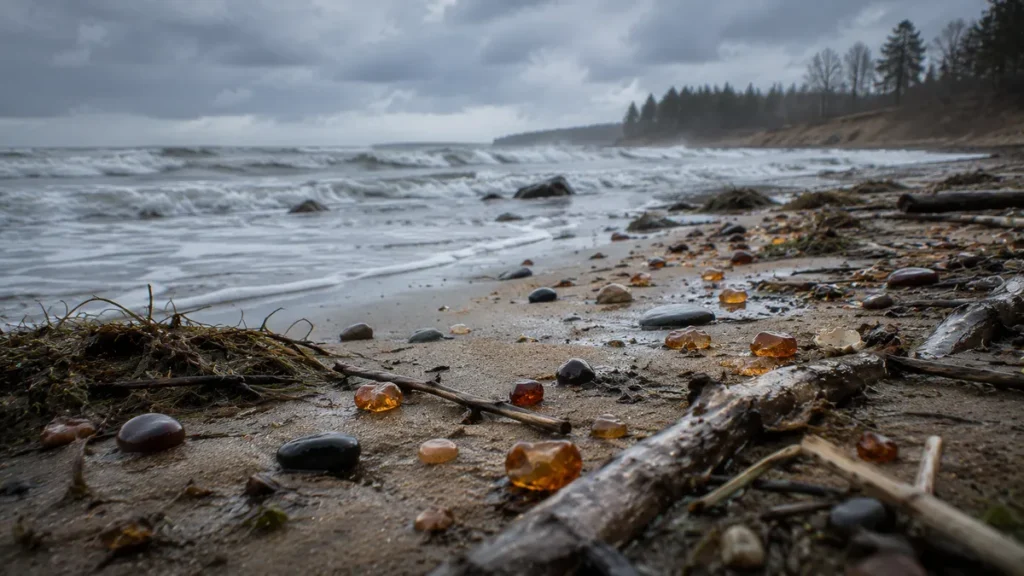
Storms can be particularly effective at disturbing coastal sediments.
Strong waves and currents can erode the seabed and shoreline, releasing materials that have been buried beneath sediment.
Because amber is relatively light, loose pieces can be transported by water and become concentrated along particular sections of coast.
After a storm, conditions may therefore become favorable for finding small pieces of amber.
This phenomenon has contributed to the long cultural tradition of collecting Baltic amber along the coast.
It also provides a direct connection between modern coastal landscapes and geological processes that began millions of years ago.
18. Is All Baltic Amber the Same Age?
Not necessarily.
This is an important point.
The age of Baltic amber has been discussed extensively in geological literature, and different amber-bearing layers do not necessarily represent exactly the same moment in time.
The principal Baltic amber deposits are generally associated with the Eocene, but the geological history is more complicated than assigning one exact age to every piece.
Some studies place important amber-bearing sediments in the Late Eocene, while other research has argued for different ages or for the reworking and redeposition of older amber into younger sediments.
This is why it is better to say that Baltic amber is broadly associated with Paleogene geological history rather than claiming that every piece is exactly a particular number of years old.
The distinction becomes especially important when discussing secondary deposits.
19. Does the Origin of Baltic Amber Remain a Scientific Mystery?
Parts of it do.
The broad geological story is well established:
ancient forests produced resin → resin was transported and deposited → burial and geological processes transformed it → later erosion redistributed it.
But some details remain under discussion.
For example:
- Which exact tree groups produced the resin?
- Where precisely were the largest source forests?
- How much resin was transported by rivers versus coastal or marine processes?
- Which deposits represent primary accumulation?
- Which deposits contain reworked amber?
- How should the different amber-bearing layers be dated?
These questions have been studied for decades.
Modern geochemical, paleobotanical, sedimentological, and spectroscopic techniques continue to refine the picture.
That uncertainty does not weaken the story.
In fact, it makes Baltic amber even more interesting.
A material that has survived for tens of millions of years can still contain unanswered geological questions.
20. Why Is Baltic Amber So Important to Science?
The sheer quantity of Baltic amber is only part of its importance.
Its inclusions are equally significant.
Tiny insects, spiders, plants, fungi, and other organisms became trapped in resin before it was buried and transformed into amber.
Because amber can preserve organisms in three dimensions, it sometimes retains structures that would be difficult or impossible to study in ordinary sedimentary fossils.
For more on this subject, see our guide to why insects are preserved so well in amber.
This gives researchers a detailed window into ancient ecosystems.
The diversity of Baltic amber inclusions is one reason the deposit has become one of the world’s most important fossil-resin resources.
For more on this subject, see our guide to amber inclusions.
Amber can preserve far more than insects. Learn more about what can be found inside amber in our detailed guide.
Baltic Amber Is the Result of a Geological Chain Reaction
It is tempting to explain Baltic amber with a single sentence:
Ancient trees produced a lot of resin.
But that is only the beginning.
The real story is much more interesting.
Ancient forests provided the raw material.
A warm Eocene climate supported extensive ecosystems.
Trees produced resin.
Rivers and other processes moved the resin.
Sedimentary environments concentrated and buried it.
Geological processes transformed it into fossil resin.
Glaciers later redistributed some of it.
Rivers and coastal processes moved it again.
And today, waves and storms can still release pieces onto Baltic beaches.
The abundance of Baltic amber is therefore not the result of one extraordinary event.
It is the result of millions of years of interacting biological, geological, and environmental processes.
Why the Baltic Region Became Amber’s Most Famous Home
The Baltic region did not simply happen to contain amber.
It contained the right combination of conditions for producing, concentrating, preserving, and redistributing unusually large quantities of fossil resin.
That combination began with ancient forests during the Eocene and continued through geological processes that reshaped northern Europe again and again.
Today, Baltic amber is famous not only because so much of it exists, but because its geological journey connects several fields of natural history at once.
It tells us about ancient forests.
It tells us about climate.
It tells us about sedimentary environments.
It tells us about glaciers and coastal processes.
And, through its inclusions, it tells us about organisms that lived tens of millions of years ago.
A piece of Baltic amber is therefore more than fossilized resin. It is a small fragment of a much larger geological story.
Frequently Asked Questions
Why is there so much amber in the Baltic region?
The Baltic region had extensive resin-producing forests during the Eocene, favorable climatic conditions, effective transport and depositional environments, and geological processes that allowed large quantities of resin to be buried and preserved. Later glacial, river, and coastal processes redistributed the amber across northern Europe.
Where did Baltic amber originally come from?
The original resin is generally thought to have come from ancient forests in the broader Fennoscandian/northern European region. The precise botanical source remains debated, although extinct conifers are strongly implicated.
Why is so much amber found around Kaliningrad?
The Sambian Peninsula contains exceptionally rich amber-bearing sediments, particularly the famous Blue Earth deposits. Geological transport and sedimentary processes concentrated large quantities of fossil resin in this region.
Did the Baltic Sea create Baltic amber?
No. Baltic amber formed from ancient plant resin millions of years ago. The modern Baltic Sea and its coastal processes mainly affect the later erosion, transport, and redistribution of existing amber.
Why can Baltic amber be found on beaches?
Waves, storms, and coastal currents can erode amber-bearing sediments and transport loose pieces along the coast. Amber’s relatively low density also makes it easier for water to move than many common minerals.
How old is Baltic amber?
Baltic amber is broadly associated with Paleogene geological history, particularly the Eocene. The exact age varies depending on the deposit and geological interpretation, and some amber was later reworked into younger sediments.
Was there one giant Baltic amber forest?
Probably not in the simple sense of one uniform forest. Evidence suggests a diverse landscape containing different forest and wetland habitats. The term “Baltic amber forest” is useful, but it should not be interpreted too literally.
Why does Baltic amber contain so many insects?
Large resin-producing forests provided abundant opportunities for insects and other small organisms to become trapped in sticky resin. The subsequent burial and preservation of that resin allowed some of these organisms to survive as exceptionally detailed inclusions.
Is Baltic amber the only major amber deposit in the world?
No. Major amber deposits also occur in places such as Myanmar, the Dominican Republic, Mexico, Romania, Canada, and other regions. Baltic amber is particularly notable for the size and historical importance of its deposits.
Does Baltic amber always come from the Baltic Sea?
No. Baltic amber is associated with the broader Baltic region and can occur in inland and secondary deposits. Some pieces were transported and redeposited far from their original place of accumulation.
Final Thoughts
The extraordinary abundance of amber in the Baltic region is the result of a remarkable chain of events.
Ancient forests supplied enormous quantities of resin. The Eocene climate supported extensive ecosystems. Rivers and other geological processes transported the resin. Sedimentary environments buried and preserved it. Later glaciers, rivers, waves, and storms redistributed it across northern Europe.
Each stage mattered.
If even one part of that chain had been significantly different, the world might not have inherited the extraordinary amber deposits that exist today.
And that is perhaps the most fascinating thing about Baltic amber:
what we find on a beach today began as tree resin in an ancient forest tens of millions of years ago.