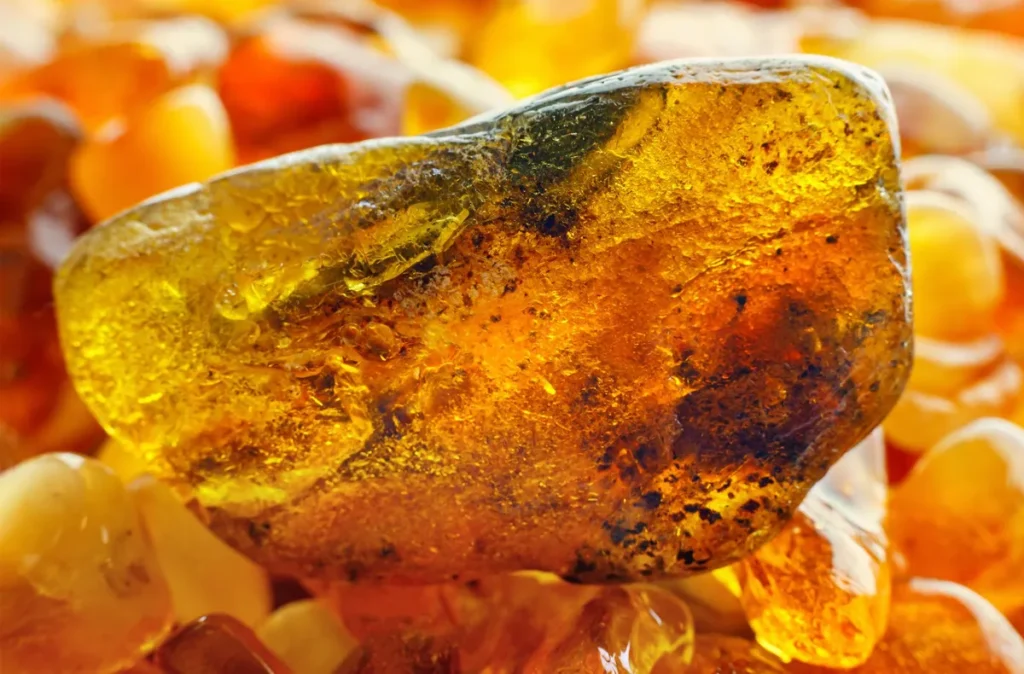
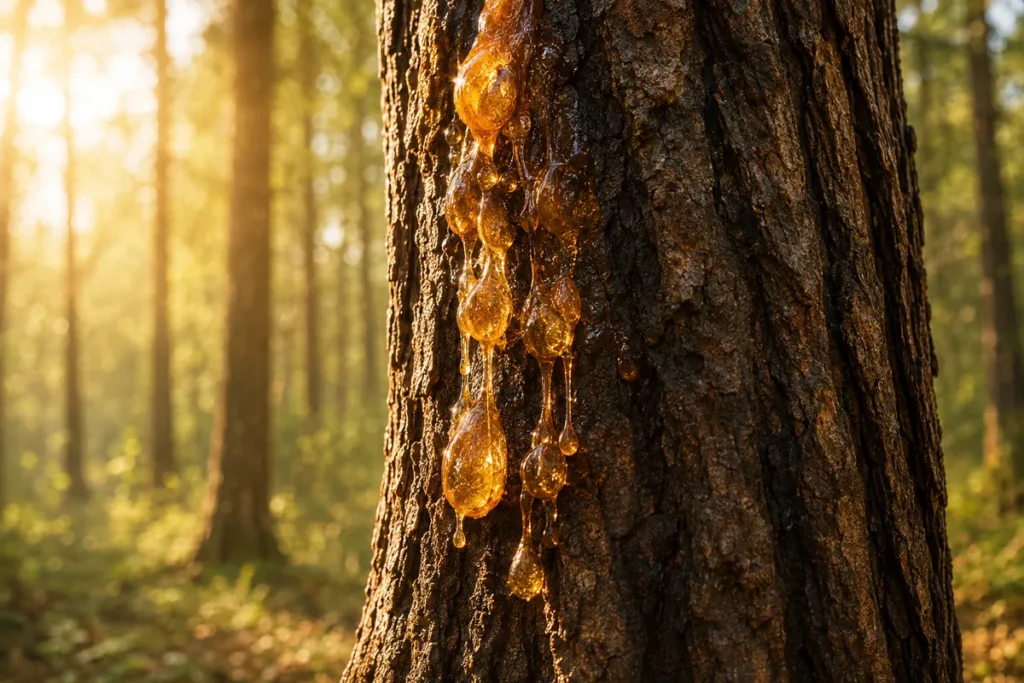
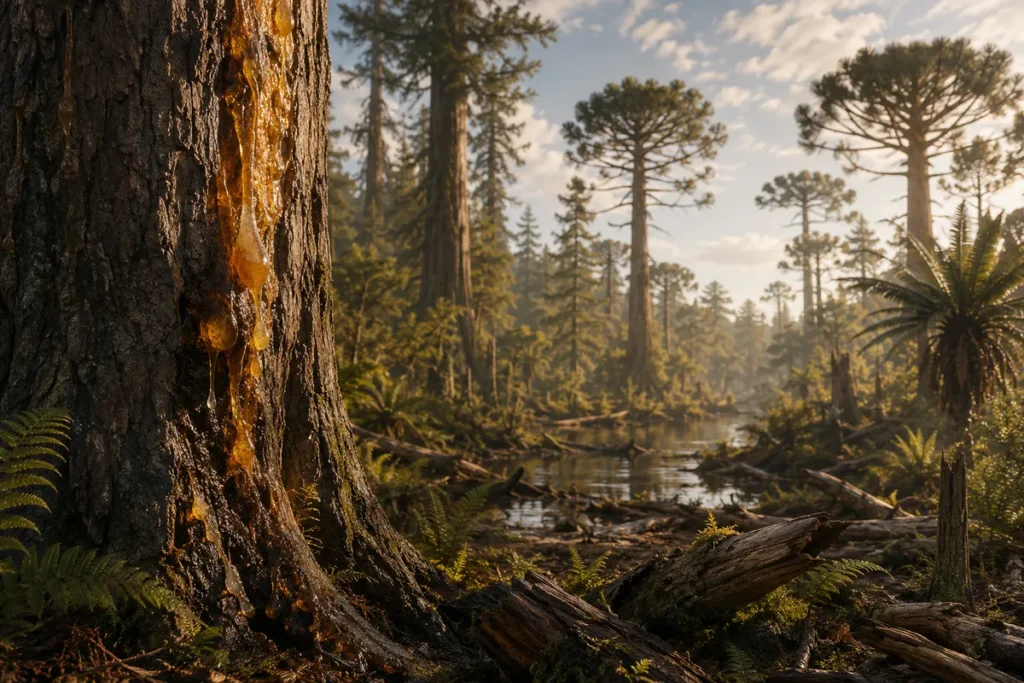
Amber is found in many parts of the world, from the shores of the Baltic Sea to the tropical forests of the Caribbean and the ancient Cretaceous deposits of Southeast Asia.
Although amber is often associated with the Baltic region, it is not unique to northern Europe. Fossilized tree resin occurs on several continents and in rocks ranging from the Cretaceous to much younger geological periods. Different deposits can vary considerably in age, color, chemistry, transparency, inclusions, and geological history.
Some amber deposits are important because they produce large quantities of material. Others are far more significant scientifically because they preserve insects, plants, fungi, and other traces of ancient ecosystems.
So where exactly is amber found?
The answer is much broader than the familiar image of amber washing up on a Baltic beach.
Where Is Amber Found?
Amber has been discovered on nearly every continent, although the deposits differ greatly in size, age, quality, and commercial importance.
The world’s best-known amber regions include:
- The Baltic region of Northern Europe
- The Dominican Republic
- Myanmar
- Mexico
- Romania
- Italy, particularly Sicily
- Canada
- The United States
- Indonesia and other parts of Southeast Asia
- Vietnam
- Australia and New Zealand
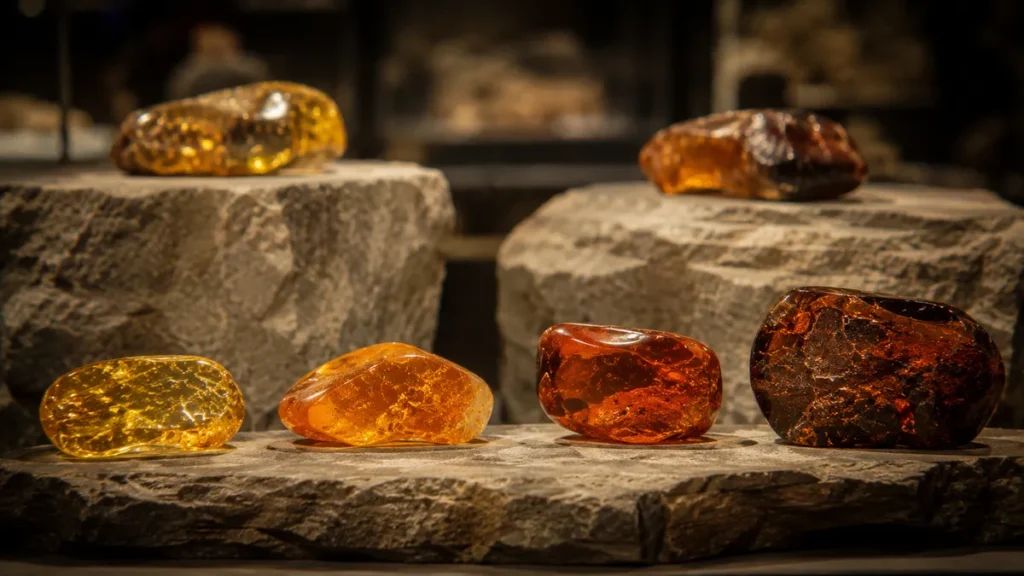
There are also smaller or less commercially important occurrences in other parts of Europe, Asia, Africa, and the Americas.
GIA notes that amber is widely distributed in rocks of Cretaceous age and younger, with the Baltic region, Myanmar, and the Dominican Republic among the major sources known today.
The important point is that “amber” does not refer to material from one single geological source.
Amber from different regions formed from different plant resins, in different environments, and at different times in Earth’s history.
Amber from different regions can vary considerably in color, transparency, geological age, and internal characteristics. Our guide to the different types of amber explores these varieties in more detail.
1. Baltic Amber — Northern Europe
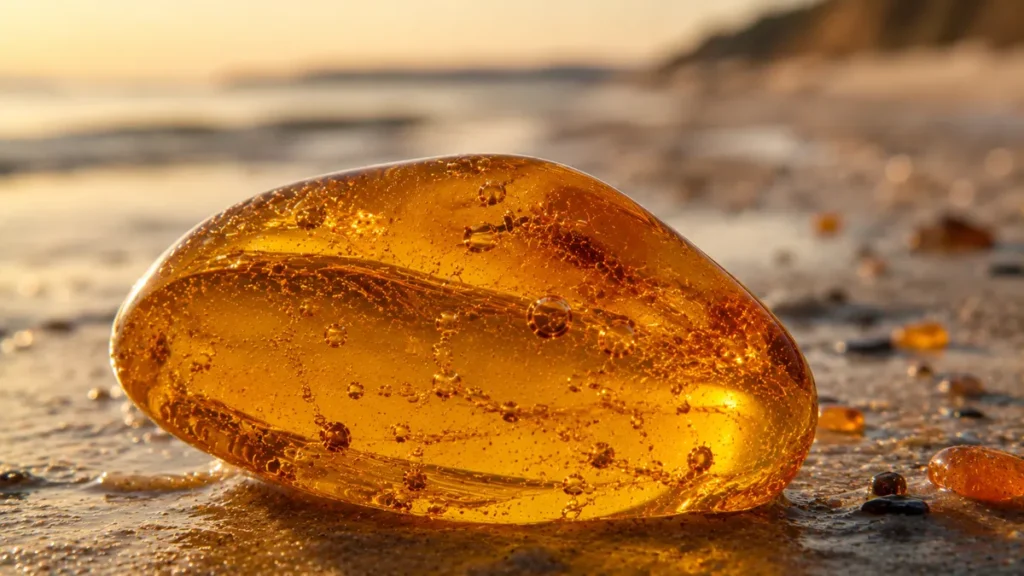
When people think of amber, the Baltic region is probably the first place that comes to mind.
The Baltic region has been the world’s most important historical source of amber and contains one of the largest concentrations of fossilized plant resin known. Major occurrences extend around the southern and eastern Baltic Sea, including areas of:
- Poland
- Lithuania
- Latvia
- Kaliningrad, Russia
- Northern Germany
- Denmark
- Southern Sweden
The richest historical deposits are associated with the Sambia Peninsula around present-day Kaliningrad, although amber is distributed much more broadly around the Baltic region.
Baltic amber is particularly famous for its warm yellow, honey, orange, and brown colors. It can be transparent, translucent, or cloudy, and some pieces contain beautifully preserved insects, plants, and other organic material.
What makes the Baltic deposits especially interesting is their geological history.
Much of the amber originally formed in ancient forests and was later transported, buried, reworked, and deposited in sediments. Glacial activity subsequently moved amber-bearing material across northern Europe, while erosion and coastal processes continue to release pieces into the Baltic Sea and onto beaches.
That is why amber can sometimes be found naturally along the coastline after storms.
In other words, the amber found on a Baltic beach may have traveled a surprisingly long geological journey before reaching the shore.
For a closer look at this region, see our guide to where Baltic amber comes from.
2. Dominican Amber — The Caribbean
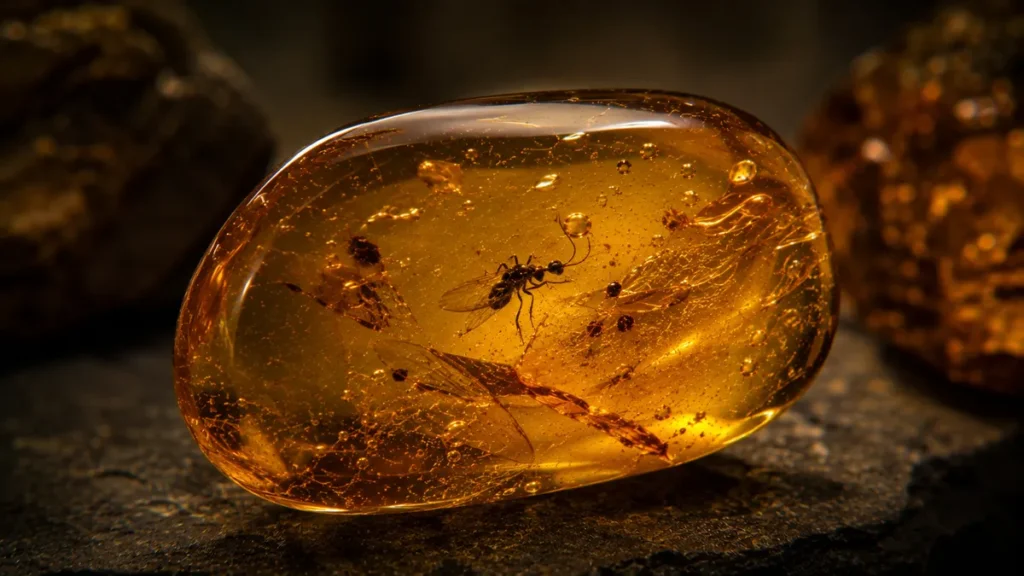
The Dominican Republic is one of the world’s most famous sources of amber, particularly among collectors interested in fossil inclusions.
Dominican amber deposits occur mainly in the northern and eastern parts of the country. They are associated with sedimentary rocks formed during the Miocene, and many pieces contain insects and other organisms preserved inside the resin.
Dominican amber is especially well known for its transparency and biological inclusions.
Depending on the specimen, you may encounter:
- ants
- flies
- beetles
- spiders
- plant material
- fungi
- other small organisms
The region is also famous for blue amber.
Blue amber is unusual because its apparent blue or blue-green color is strongly related to fluorescence and optical effects. Under ordinary lighting, some specimens can appear yellow or orange, while against a dark background they may show a striking blue appearance.
This makes Dominican amber particularly interesting because its appearance can change dramatically depending on lighting conditions.
It is also a good reminder that amber color does not always tell the whole story about a specimen.
3. Burmese Amber — Myanmar
Myanmar is home to one of the world’s most scientifically important amber deposits.
Often called Burmese amber or burmite, this material is primarily associated with the Hukawng Valley in northern Myanmar.
What makes Burmese amber particularly remarkable is its age.
Many Burmese amber deposits date to approximately 80–100 million years ago, placing them in the Cretaceous Period. This makes them considerably older than the major Baltic and Dominican deposits commonly encountered in the gem trade.
Burmese amber is exceptionally important to paleontologists because of its extraordinary diversity of inclusions.
Researchers have documented:
- insects
- spiders
- plants
- fungi
- snails
- scorpions
- lizards
- other arthropods and vertebrate material
Some specimens preserve anatomical details at a remarkable level of resolution.
Recent research continues to reveal new organisms and biological relationships from Burmese amber, demonstrating that these specimens are not simply attractive collector’s pieces. They can provide direct evidence of ecosystems that existed during the Cretaceous.
For anyone interested in amber inclusions, Burmese amber is therefore one of the most important deposits in the world.
4. Mexican Amber — Chiapas
Mexico is another important source of fossil amber, particularly the state of Chiapas in southern Mexico.
Mexican amber is generally associated with Miocene-age deposits and is often found in sedimentary layers associated with lignite and other organic-rich materials.
Like Dominican amber, Mexican amber can display attractive yellow, orange, reddish, and brown colors.
Some Mexican material can also show unusual fluorescence and blue-green optical effects under particular lighting conditions.
However, Mexican amber is not simply a smaller version of Dominican amber.
Each deposit has its own geological history and chemical characteristics, and specimens from different localities can vary considerably in appearance and preservation.
Mexican amber is also important scientifically because it contains fossil organisms that help researchers reconstruct ancient tropical ecosystems.
5. Romanian Amber — Rumanite
Romania has a long history of amber occurrences, particularly in the Buzău region of the Carpathian area.
Romanian amber is often referred to as rumanite.
Compared with the familiar golden appearance of Baltic amber, rumanite is often associated with deeper brown, reddish-brown, and dark colors.
Some pieces can appear almost black until light passes through them, revealing warmer reddish tones.
Romanian amber is less abundant on the modern market than Baltic amber, Dominican amber, or Burmese amber, but it has considerable historical and geological interest.
It is also a useful reminder that amber does not have to be bright yellow to be natural or desirable.
Color, transparency, internal structure, geological origin, and preservation history can vary considerably between deposits.
6. Sicilian Amber — Italy
Amber has also been found in Sicily, Italy, where it is traditionally known as simetite.
The name comes from the Simeto River.
Sicilian amber is relatively rare today, and its geological history is more complicated than that of some better-known deposits. Scientific studies have noted uncertainty concerning the precise age and original geological setting of some Sicilian amber material because much of it occurs in secondary deposits.
Historically, however, Sicilian amber was important in Mediterranean cultures.
Archaeological evidence shows that amber from Sicily was used thousands of years ago, while later Baltic amber increasingly entered Mediterranean exchange networks.
This makes Sicilian amber interesting not only as a fossil resin but also as part of the history of prehistoric trade.
7. Canadian Amber
Amber is also found in Canada, particularly in Alberta and Manitoba.
Canadian amber is generally much older than Baltic amber and is associated with Cretaceous deposits.
One particularly interesting example comes from the Cedar Lake area of Manitoba.
The amber found there is approximately 78–79 million years old and contains fossil insects. Interestingly, the resin itself originally came from trees growing much farther west, near what is now Alberta, and was later transported by rivers before being deposited near Cedar Lake.
Other important Cretaceous amber deposits occur in Alberta, including the Grassy Lake area.
These deposits are scientifically valuable because they preserve evidence of high-latitude ecosystems that existed during the Cretaceous.
Canadian amber is therefore a fascinating example of how amber can be transported far from the place where the original trees grew.
8. Amber in the United States
The United States has several amber occurrences, although most are much smaller and less commercially important than the major Baltic, Dominican, or Burmese deposits.
One of the best-known sources is New Jersey, where Cretaceous amber occurs in sediments along the Atlantic Coastal Plain.
New Jersey amber can contain fossil insects and other biological material and has been studied extensively by paleontologists.
Other Cretaceous fossil resin occurrences have been documented in parts of the United States, including Alaska and several areas of the central and western United States.
These deposits are particularly valuable scientifically because some preserve evidence of ancient Cretaceous forests and ecosystems.
The existence of amber in the United States also illustrates an important point:
A deposit does not need to be commercially large to be scientifically significant.
A relatively small amount of amber can preserve organisms that are otherwise extremely difficult to study in the fossil record.
9. Amber in Indonesia and Southeast Asia
Amber also occurs in several parts of Southeast Asia.
Indonesia is particularly interesting because amber from the region can display unusual optical properties, including blue or greenish fluorescence in some specimens.
GIA research has examined blue amber from Indonesia alongside material from the Dominican Republic, Mexico, and Myanmar.
Other Southeast Asian occurrences have also been documented, including amber associated with coal-bearing sediments in parts of Malaysia and Borneo.
These deposits can differ substantially from the better-known Baltic and Caribbean sources in both geological age and chemical composition.
Because Southeast Asia has a complex geological history and a wide range of sedimentary environments, researchers continue to investigate fossil resin occurrences throughout the region.
10. Vietnamese Amber
Vietnam is another example of a relatively recent addition to the scientific understanding of global amber deposits.
Amber has been identified on Phu Quoc Island, where researchers investigated material found within sandstone layers.
The deposit was only recently documented in detail compared with the famous amber-producing regions of Europe and the Caribbean.
GIA research found that Phu Quoc amber has distinctive FTIR characteristics that allow it to be differentiated from amber from several other major sources.
This is significant because it shows that the global distribution of amber is still being refined.
The world’s amber deposits are not simply a fixed list established centuries ago. New occurrences can be discovered, studied, and chemically characterized as geological research continues.
11. Amber in Australia and New Zealand
Amber is not restricted to the Northern Hemisphere.
Scientific research has documented fossilized resin from both Australia and New Zealand, including deposits dating from the Late Triassic through the Paleogene.
Some Australian occurrences are approximately 230 million years old, making them much older than the famous Baltic deposits. Other deposits are considerably younger.
Researchers have found evidence of ancient arthropods, plants, and fungi preserved in some of these materials.
These southern deposits are particularly valuable because they provide information about ancient ecosystems in regions that occupied very different positions in the global climate system during Earth’s geological past.
They also help broaden our understanding of amber beyond the Northern Hemisphere, where most of the world’s best-known deposits occur.
Is Amber Found in Every Continent?
Amber is widely distributed, but that does not mean every continent contains large commercial deposits.
Fossilized plant resin has been documented from a remarkably wide range of geological settings, including Europe, Asia, North America, Central America, the Caribbean, Australia, and New Zealand.
Some occurrences consist of large deposits that have been mined commercially.
Others may contain only small amounts of resin that are mainly important to researchers.
The distinction matters.
When people ask, “Where is amber found?”, they may actually be asking two different questions:
Where has amber been discovered?
and
Where is amber commercially important?
Those are not the same thing.
Why Are Some Countries Famous for Amber While Others Are Not?
The presence of amber depends on several geological factors.
First, ancient resin-producing trees must have been present.
Second, enough resin must have accumulated.
Third, the resin needed to become buried under suitable conditions rather than being completely destroyed or recycled.
Finally, geological processes had to preserve the material and sometimes concentrate it into deposits that can still be recovered today.
Even when amber formed, it might later have been:
- buried deeply
- transported by rivers
- eroded
- redeposited
- incorporated into younger sediments
- carried by glaciers
- released onto beaches
This is why the modern location of amber does not necessarily correspond to the location of the forest where the resin originally formed.
Baltic amber provides one of the clearest examples of this complicated journey. Geological processes moved amber-bearing material across northern Europe long after the original resin-producing forests disappeared.
Does Amber Look Different Depending on Where It Comes From?
Yes, but geographic origin should not be inferred from appearance alone.
Amber from different deposits can show differences in:
- color
- transparency
- fluorescence
- internal structure
- chemical composition
- inclusions
- geological age
- hardness and other physical properties
For example, Baltic amber is strongly associated with yellow, honey, orange, and brown tones, while Burmese amber can show rich reddish and brown colors.
Dominican amber is particularly famous for its transparency and abundant inclusions, while some Dominican material can also display the unusual blue-amber effect.
But these characteristics overlap.
A particular color does not automatically prove where a piece came from.
Professional laboratories can use methods such as infrared spectroscopy and other analytical techniques when geographic origin needs to be investigated.
This is especially important for valuable specimens, because visual appearance alone is rarely enough to establish provenance with confidence.
Which Amber Deposits Are Most Important for Inclusions?
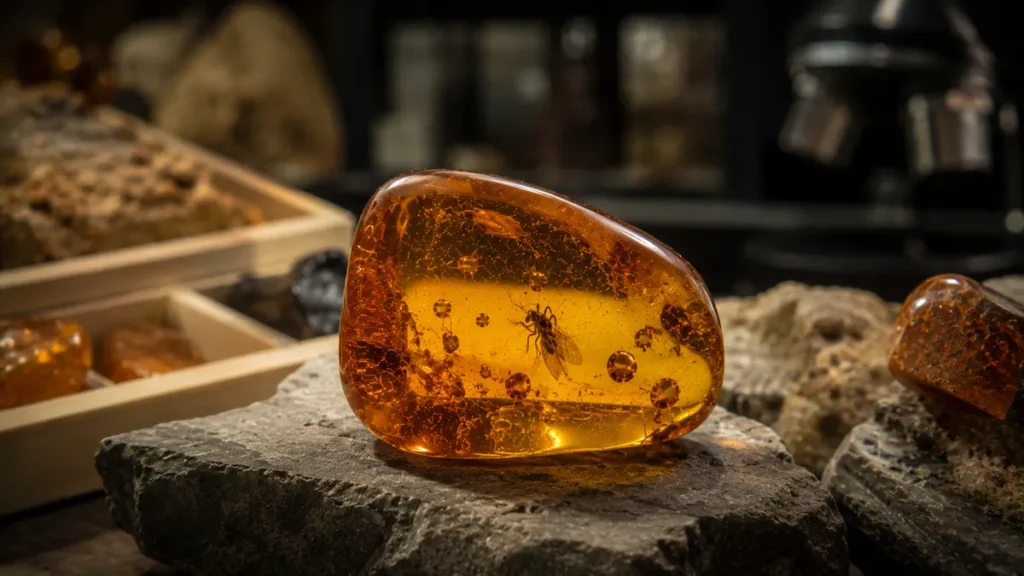
Different deposits are famous for different reasons, but several stand out for their biological inclusions.
Baltic Amber
Baltic amber contains an enormous diversity of insects, plants, and other organisms and represents one of the world’s great fossil-resin deposits.
Dominican Amber
Dominican amber is particularly well known for transparent specimens containing insects and other biological material.
Burmese Amber
Burmese amber is exceptionally important for Cretaceous paleontology because of its age and remarkable diversity of preserved organisms.
Canadian Amber
Canadian Cretaceous amber provides evidence of high-latitude ecosystems and ancient insect communities.
This is one reason why the scientific value of amber is not determined simply by how beautiful the piece looks.
A small, ordinary-looking specimen may contain information that is far more important to science than a much larger decorative piece.
Many of these deposits are especially important because of their fossil inclusions. Learn more about amber inclusions and why they matter in our detailed guide.
These inclusions can include insects, plants, fungi, feathers, and other materials. See what can be found inside amber for a closer look at the remarkable variety of preserved material.
Where Is the Most Amber Found?
The Baltic region remains the world’s most important and historically prolific amber-producing area.
The southern Baltic region, particularly the area around the Sambia Peninsula and Kaliningrad, has been an exceptionally important source of amber for thousands of years.
However, “most amber” can mean different things.
It might refer to:
- the largest geological deposit
- the greatest historical production
- the largest amount currently mined
- the greatest number of known specimens
- the richest source of inclusions
- or the greatest commercial importance
Those categories do not necessarily have the same answer.
For example, Burmese amber is extraordinarily important for Cretaceous inclusions, while Dominican amber is particularly famous for transparent pieces and biological inclusions.
So it is better to talk about major amber-producing regions rather than trying to name a single source as the “best” amber in the world.
Can Amber Be Found on Beaches?
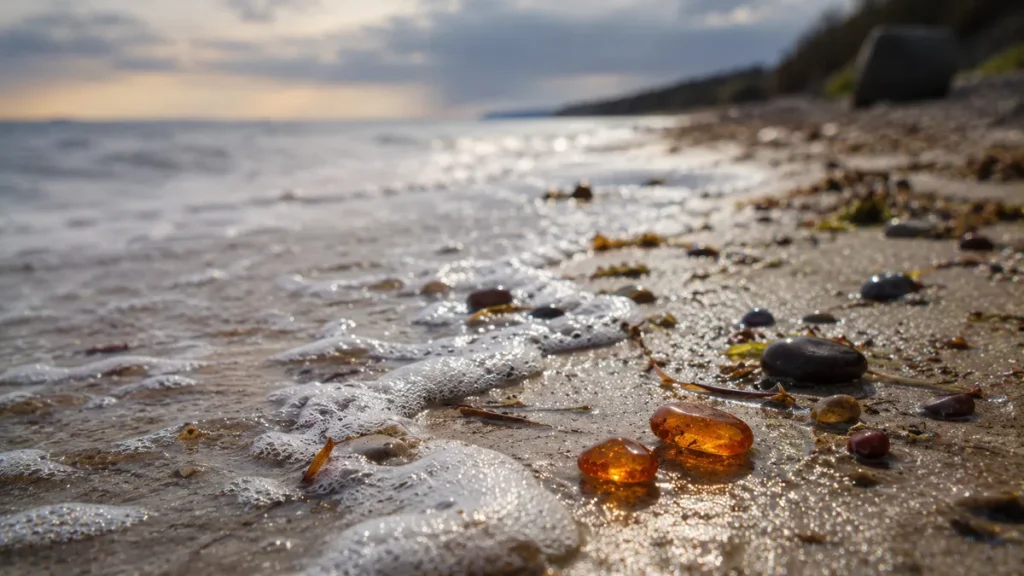
Yes.
Beach-collected amber is particularly associated with the Baltic region.
Amber can become exposed or released from coastal sediments and then be transported by waves, tides, and storms.
After rough weather, small pieces may wash onto beaches where they can sometimes be collected.
But beach amber is not unique to the Baltic.
Amber from other regions can also occur in secondary deposits where erosion and water transport have moved fossil resin away from its original geological setting.
The journey from ancient forest to modern beach can therefore involve millions of years of burial, geological change, erosion, and transportation.
Why Is Baltic Amber So Closely Associated With the Baltic Sea?
The answer is partly geological and partly historical.
The Baltic region contains an enormous concentration of amber-bearing sediments, and coastal processes have repeatedly brought pieces of amber into accessible environments.
At the same time, people in northern Europe have collected and traded Baltic amber for thousands of years.
Over time, the region became so closely associated with amber that the material itself became known as “gold of the North.”
The archaeological record also shows how Baltic amber traveled far beyond northern Europe through ancient trade networks.
So the Baltic connection is not simply about geology.
It is also a story about human history, trade, craftsmanship, and cultural exchange.
Does the Country of Origin Determine Amber Quality?
Not by itself.
Geographic origin can be an important characteristic, especially for collectors and researchers, but origin alone does not determine the quality or value of an individual piece.
Two pieces from the same deposit can differ dramatically in:
- transparency
- color
- inclusions
- condition
- size
- treatment
- craftsmanship
Likewise, amber from different regions can have overlapping characteristics.
When evaluating an individual specimen, it is better to consider its actual physical and visual qualities rather than assuming that a geographic name automatically makes it superior.
For more on the factors that influence amber value, see our guide to what makes amber valuable.
A Simple Guide to the World’s Major Amber Regions
| Region | What It Is Known For |
| Baltic region | Huge deposits, long history, yellow-to-brown amber, diverse inclusions |
| Dominican Republic | Transparent amber, abundant biological inclusions, blue amber |
| Myanmar | Very old Cretaceous amber, exceptional fossil diversity |
| Mexico | Chiapas amber, Miocene deposits, varied colors and inclusions |
| Romania | Rumanite, darker reddish and brown material |
| Sicily, Italy | Simetite, rare Mediterranean amber, archaeological importance |
| Canada | Cretaceous amber, high-latitude ecosystems and fossil insects |
| United States | Smaller Cretaceous deposits, especially New Jersey and Alaska |
| Indonesia / Southeast Asia | Multiple deposits and unusual fluorescence in some material |
| Vietnam | Recently studied deposits including Phu Quoc amber |
| Australia & New Zealand | Southern-hemisphere amber, including very old geological deposits |
This table is best understood as a general overview rather than a complete list of every amber occurrence.
Why the Location of Amber Matters
Knowing where amber comes from can tell us much more than its commercial origin.
A deposit’s location can help researchers understand:
- the age of the resin
- the ancient climate
- the plants that produced it
- the environment in which the resin accumulated
- the organisms living nearby
- how sediments transported the resin
- how ancient ecosystems changed over time
Inclusions make this even more valuable.
An insect trapped in amber is not simply an insect inside a gemstone. It may provide evidence about an ecosystem that disappeared tens of millions of years ago.
This is why amber occupies such an unusual position between gemology, geology, paleontology, and natural history.
Amber Is a Global Fossil Material
Amber is often presented as if it belongs to one place.
In reality, it is a global geological phenomenon.
From the Baltic coastline to the Caribbean, from Cretaceous Myanmar to the ancient landscapes of Canada and Australia, fossilized resin records a remarkable range of ancient environments.
Each deposit tells a slightly different story.
Baltic amber reveals ancient northern forests and the geological history of northern Europe. Dominican amber offers a window into tropical ecosystems. Burmese amber preserves Cretaceous life at extraordinary detail. Canadian amber records ancient high-latitude environments, while Australian and New Zealand deposits expand the story into the southern hemisphere.
That diversity is one of the reasons amber is so fascinating.
The next time you look at a piece of amber, it is worth asking not only what is inside it, but also where it came from—and what that place looked like millions of years ago.
Frequently Asked Questions
Where is amber mainly found?
The Baltic region is the world’s most historically important and prolific amber-producing region. Major amber sources also include the Dominican Republic, Myanmar, Mexico, Romania, Canada, and several regions of Southeast Asia.
What country has the most amber?
The Baltic region contains the world’s most significant concentration of amber, with particularly important deposits around the southern Baltic and the Sambia Peninsula near Kaliningrad.
Is amber only found in the Baltic Sea?
No. Amber occurs in many parts of the world, including the Dominican Republic, Myanmar, Mexico, Canada, the United States, Romania, Italy, Indonesia, Vietnam, Australia, and New Zealand.
Where is the oldest amber found?
Some of the oldest well-known amber deposits are from the Cretaceous Period. Burmese amber, for example, is commonly dated to roughly 80–100 million years ago. Australia and New Zealand also contain very old fossil-resin occurrences, including material dating back to around 230 million years.
Where is amber with insects found?
Insect-bearing amber occurs in many regions, including the Baltic region, Dominican Republic, Myanmar, Canada, Mexico, and the United States. Burmese and Dominican amber are particularly well known for diverse biological inclusions.
Is Baltic amber the only valuable amber?
No. Amber from different regions can be scientifically or commercially valuable for different reasons. Individual value depends on factors such as color, clarity, inclusions, condition, size, treatment, craftsmanship, and authenticity—not simply geographic origin.
Can amber be found naturally on beaches?
Yes. Baltic amber is especially famous for being washed onto beaches after storms, although amber can also occur in secondary deposits elsewhere.
Is amber found in the United States?
Yes. The United States has several fossil-resin deposits, including important Cretaceous occurrences in New Jersey and Alaska. Most are much smaller than the major commercial deposits of the Baltic region.
Why is Burmese amber so important?
Burmese amber is particularly important because it preserves a highly diverse Cretaceous ecosystem, with many insects, arthropods, plants, fungi, and other organisms. Its age makes it an important window into life roughly 80–100 million years ago.
Does amber’s origin prove that it is real?
No. Geographic origin is not, by itself, proof of authenticity. A piece described as Baltic, Dominican, Burmese, or another type still needs to be evaluated based on its physical characteristics and, when necessary, professional testing.
Final Thoughts
Amber is found across a much larger part of the world than its famous Baltic identity might suggest.
The Baltic region remains the most historically important source, but amber from Myanmar, the Dominican Republic, Mexico, Canada, the United States, Europe, Southeast Asia, Australia, and New Zealand has added enormously to our understanding of Earth’s past.
What makes these deposits truly fascinating is that each one represents a different chapter in geological history.
The next question is even more interesting:
Why is so much amber concentrated around the Baltic region in particular?
That story involves ancient forests, geological processes, sediment movement, glaciers, and millions of years of natural history.