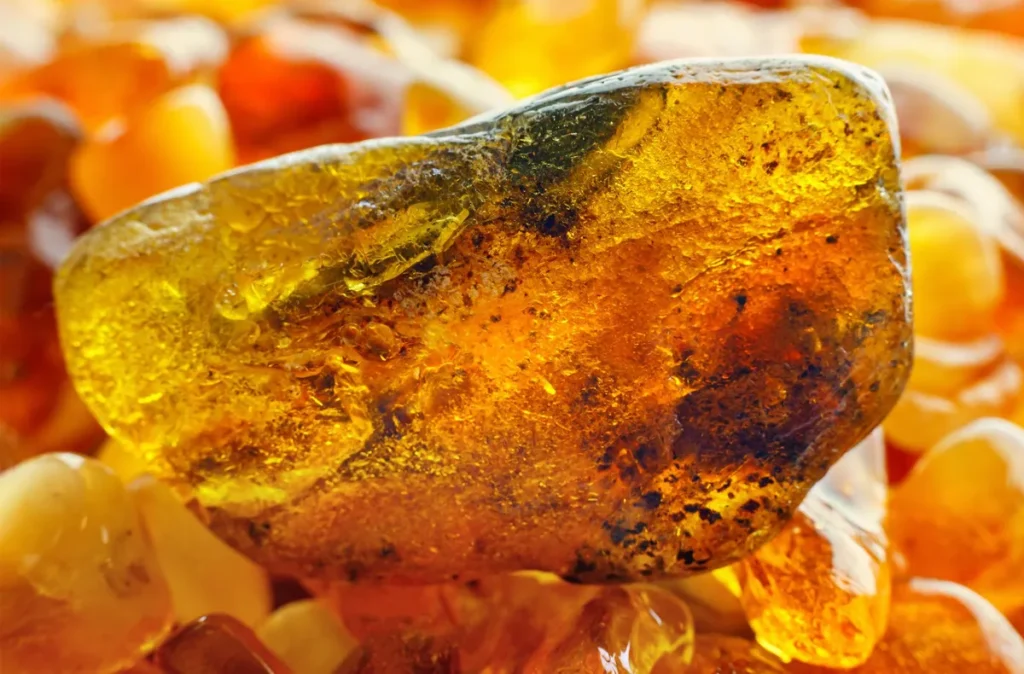
Amber is often admired for its warm color and natural glow, but some of its most fascinating features are hidden beneath the surface.
Look closely at a clear piece of amber and you may find much more than a golden fossil resin. Tiny insects, plant fragments, pollen, fungi, feathers, and other organic materials have all been found preserved in amber. Even seemingly insignificant details, such as a strand of plant material or a cluster of microscopic structures, can offer clues about the environment in which the resin formed.
These materials are known as amber inclusions.
If you’re new to the subject, our guide to what amber inclusions are explains the preservation process and why these inclusions can be scientifically important.
Some are easy to recognize with the naked eye. Others only become visible under magnification. And not everything trapped inside amber is a fossil or a biological inclusion—air bubbles, mineral particles, cracks, and natural resin structures can also occur within the material.
So, what exactly can be found inside amber?
Let’s take a closer look.
What Is an Amber Inclusion?
An amber inclusion is a material that became trapped inside tree resin before the resin eventually matured and was preserved as amber.
The material may be biological, such as an insect or plant fragment, or non-biological, such as a small mineral particle or an air bubble.
The process is essentially one of accidental preservation.
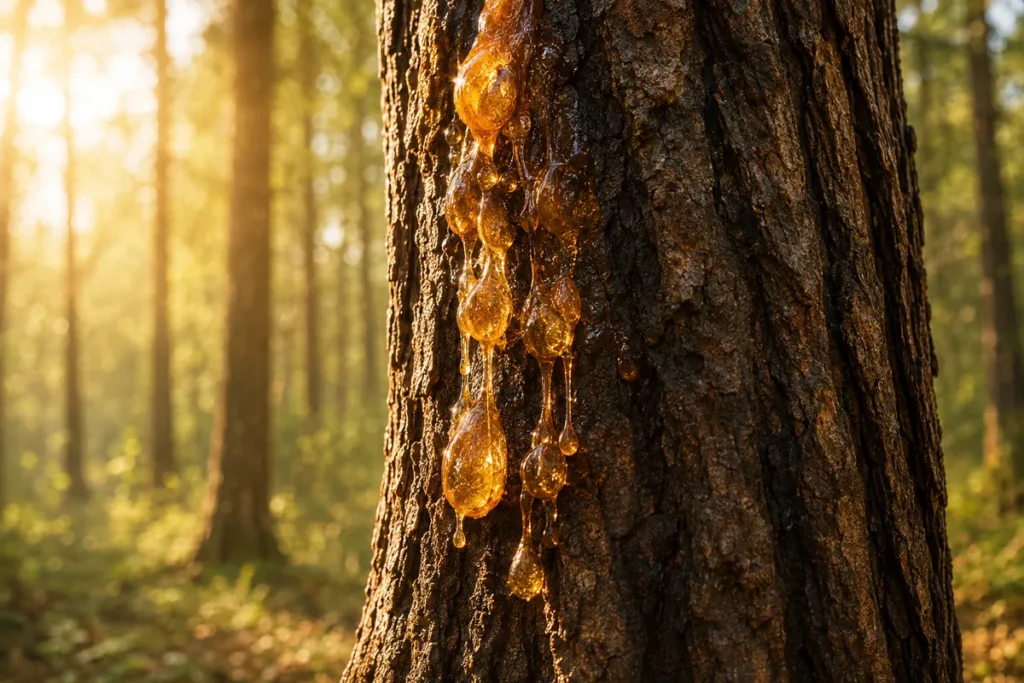
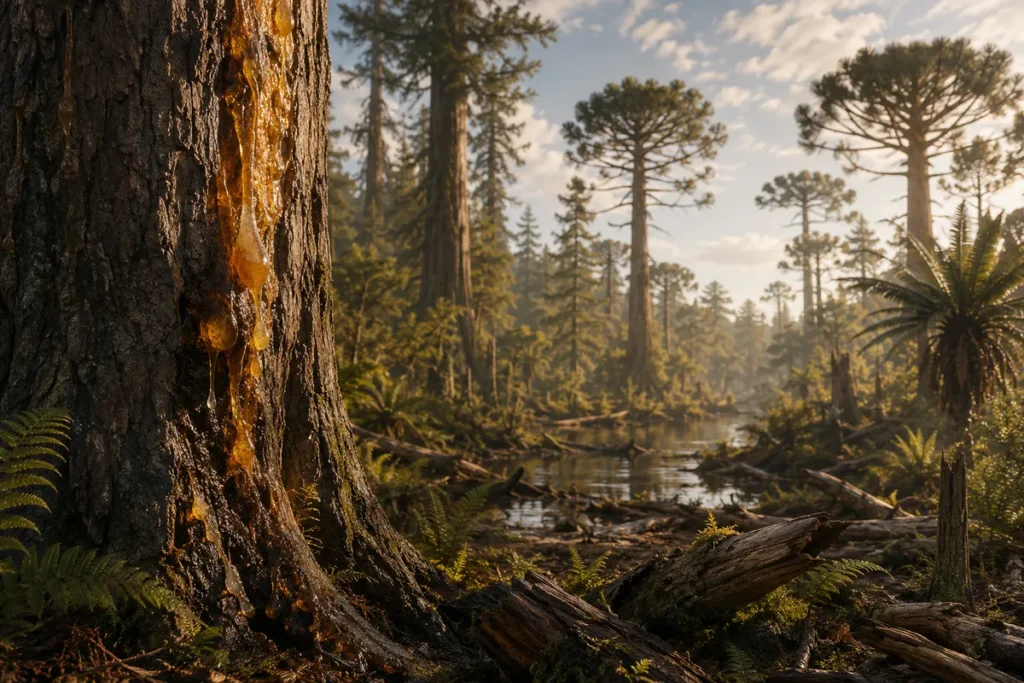
A small insect may become caught in sticky resin flowing from a tree. A leaf fragment, flower part, or piece of bark may become embedded at the same time. As additional resin covers the material, it can become sealed away from the outside environment.
Over geological time, the original resin undergoes chemical and physical changes. Eventually, under the right conditions, it becomes amber.
The result can be remarkably detailed preservation of material that would otherwise have disappeared.
If you’re new to the subject, our guide to what amber inclusions are explains the preservation process and why these inclusions can be scientifically important.
1. Insects
Insects are probably the most familiar type of amber inclusion.
Beetles, flies, wasps, ants, termites, mosquitoes, and many other groups have been found preserved in amber from different parts of the world.
The remarkable thing is not simply that insects occur in amber, but how much detail can sometimes survive.
In a well-preserved specimen, you may be able to see:
- legs and feet
- wings
- antennae
- body segments
- eyes
- fine hairs
- delicate surface structures
Some insects are preserved almost completely, while others are represented only by fragments.
Their position inside the amber can also tell part of the story. An insect may appear to have landed directly on the resin, become stuck while walking across it, or been covered by a later flow of resin.
Not every insect inclusion is scientifically exceptional. A common insect with poor preservation may be less informative than a rarer specimen with unusually clear anatomical detail.
Still, even an apparently ordinary insect can provide a glimpse into an ecosystem that existed millions of years ago.
2. Spiders and Other Arthropods

Amber does not preserve insects alone.
Spiders and other arthropods have also been found inside amber, including mites, ticks, centipedes, millipedes, and related organisms.
These inclusions are particularly interesting because they can reveal interactions between organisms.
For example, a piece of amber may preserve a spider alongside another small arthropod, or capture an organism in a position that suggests what it was doing when the resin trapped it.
Such specimens can provide more than a picture of a single animal. They may offer evidence of relationships within an ancient ecosystem.
This is one reason amber is so valuable to paleontologists and other researchers. A fossilized bone can tell us a great deal about an animal’s structure, but an amber inclusion can sometimes preserve an organism together with traces of the environment around it.
3. Plant Fragments
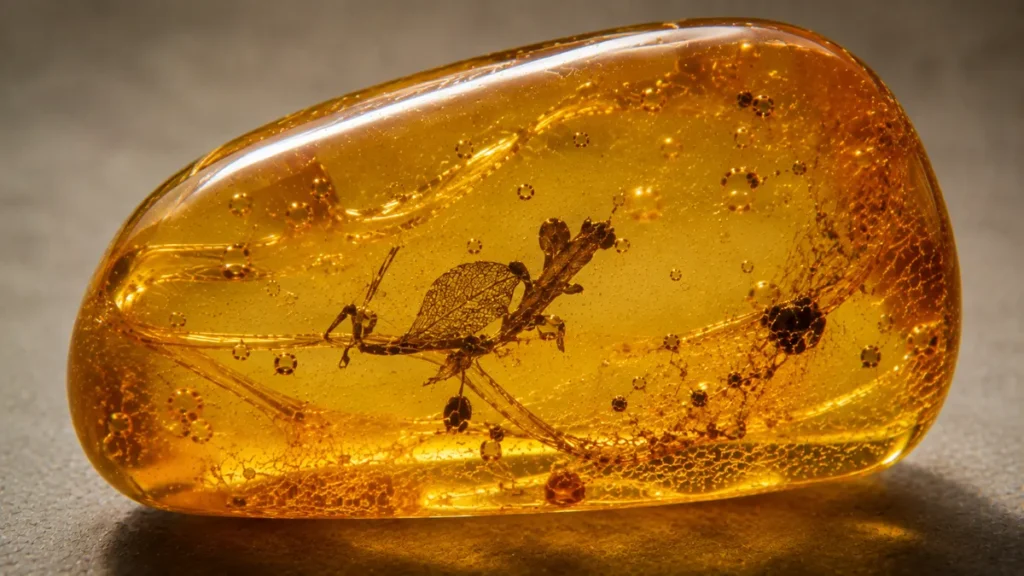
Plants are another important group of amber inclusions.
Small pieces of leaves, bark, stems, flowers, and other plant material have been found trapped in fossil resin.
These fragments can be much less visually dramatic than a perfectly preserved insect, but they can be scientifically significant.
Plant inclusions may help researchers reconstruct the vegetation that surrounded the resin-producing trees. They can provide clues about ancient forests and the kinds of plants that lived alongside insects and other organisms.
In some cases, even a very small fragment can contain useful anatomical features.
The preservation of plant material also demonstrates that amber was not simply a trap for moving animals. Anything that came into contact with sticky resin could potentially become embedded.
4. Pollen and Tiny Plant Structures
Some amber inclusions are so small that they are difficult to appreciate without magnification.
Pollen grains and other microscopic plant structures have been found in amber and can provide another window into ancient vegetation.
Pollen is particularly useful because it can sometimes be associated with specific types of plants.
When studied together with larger plant fragments and other evidence, these microscopic inclusions can help researchers build a more detailed picture of an ancient environment.
This is also a good reminder that the scientific value of amber does not always come from the most visually impressive specimen.
A tiny inclusion that looks almost insignificant to a collector may contain information that is difficult to obtain from larger fossils.
5. Flowers and Delicate Plant Material
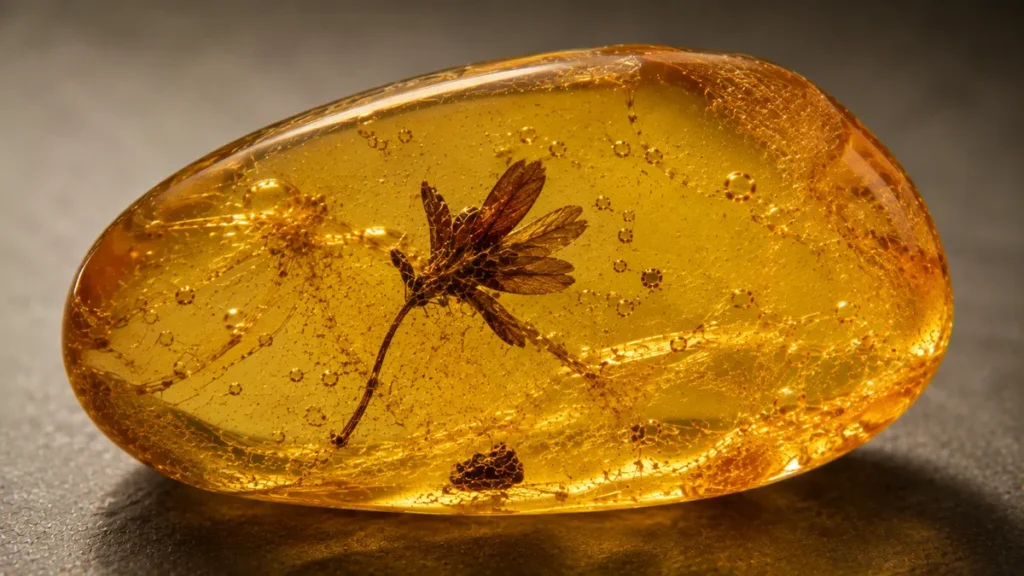
Amber can occasionally preserve delicate botanical structures that are rarely found in ordinary fossil deposits.
Small flowers, reproductive structures, seeds, and other fragile plant remains have been documented in amber.
Their preservation can be extraordinary because these structures are easily damaged or decomposed under normal conditions.
A flower trapped in resin may retain its shape and fine features long after the original plant has disappeared.
These specimens can be particularly useful when researchers are trying to understand ancient plant diversity and the relationships between plants and insects.
A flower preserved next to an insect, for example, may provide clues about the ecological setting in which both organisms lived.
6. Fungi and Microorganisms

Amber can also contain much smaller forms of life.
Fungi, spores, algae, bacteria-like structures, and other microorganisms or microscopic remains have been reported in amber deposits.
These inclusions are usually far less obvious than insects. Some require microscopy or specialized examination before they can be confidently identified.
Their importance comes from the fact that ancient ecosystems were not made up of large animals and plants alone.
Microorganisms played essential roles in decomposition, nutrient cycling, plant health, and interactions between different organisms. Evidence of these tiny organisms can therefore add another layer to our understanding of an ancient environment.
However, identifying microscopic inclusions can be challenging. A shape visible inside amber is not automatically a fossil organism. Careful examination is necessary to distinguish biological remains from mineral particles, cracks, bubbles, and other natural features.
7. Feathers and Other Delicate Organic Material
Some amber specimens contain exceptionally delicate organic remains, including feathers and other fragile biological material.
These discoveries are particularly interesting because feathers and similar structures are easily damaged and rarely survive in their original form.
When such material becomes trapped in resin at the right moment, its fine structure can sometimes be preserved in remarkable detail.
Researchers can potentially study characteristics such as surface structure, branching patterns, and other microscopic features.
These discoveries have helped broaden the scientific importance of amber beyond insects and plants.
A tiny piece of biological material can sometimes provide evidence about animals and ecosystems that would otherwise leave very little behind.
8. Animal Hair and Other Soft Tissues

Amber has occasionally preserved other fragile animal materials, including hairs and soft organic remains.
These types of inclusions are much less common than insects and are often extremely small.
Their preservation depends heavily on circumstances at the moment the material encountered the resin.
For a soft structure to survive, it generally needs to become enclosed quickly enough to avoid being destroyed by the surrounding environment.
Because these materials are uncommon and can be difficult to identify, researchers must examine them carefully rather than assuming that every thread-like structure inside amber is biological.
9. Small Pieces of Bark and Wood
Not all plant-related inclusions are leaves or flowers.
Pieces of bark, wood, and other plant tissue can also become trapped in resin.
These inclusions can sometimes look like simple brown fragments, but under magnification they may reveal much more complicated structures.
The relationship between these fragments and the resin itself can also be interesting. Flow patterns may show how the resin moved around the original material before hardening.
In this sense, the amber preserves not only the object that became trapped but sometimes something about the event that trapped it.
10. Air Bubbles

Not every feature inside amber is a fossil.
One of the most common internal features is the air bubble.
Small bubbles can form or become trapped within resin and remain visible after the material matures into amber.
They may appear as:
- tiny round bubbles
- elongated bubbles
- clusters of bubbles
- irregular cavities
Air bubbles are important because they can help reveal the internal structure and formation history of a piece of amber.
They can also affect the way light travels through the material, contributing to differences in transparency and appearance.
But an important distinction should be made:
An air bubble is an internal feature, not a biological inclusion.
This matters when examining amber for authenticity or quality. Not every interesting object inside amber is evidence of ancient life.
11. Resin Flow Structures
Amber can contain structures created by the movement and layering of resin itself.
These may appear as:
- flowing bands
- cloudy zones
- internal swirls
- layered structures
- subtle changes in transparency
They are not fossils, but they can make each piece visually distinctive.
In some specimens, these structures are particularly beautiful because they record differences in the way resin accumulated or changed before becoming amber.
They can also help explain why two pieces of amber from the same general deposit can look surprisingly different.
A clear golden specimen and a cloudy honey-colored specimen may have very different internal structures even though both are genuine amber.
12. Tiny Mineral Particles and Other Non-Biological Material
Small mineral grains, sediment particles, and other inorganic material can also become trapped in resin.
These inclusions are usually less famous than insects or flowers, but they can still be useful when studying how amber formed and what was happening in its surrounding environment.
A tiny particle may tell researchers something about the material present around the resin-producing tree.
Again, identification is important.
A dark spot inside amber is not necessarily an insect.
A thread is not necessarily a plant fiber.
And a cloudy area is not necessarily a biological inclusion.
Proper examination is needed before making a confident identification.
Are All Things Inside Amber Considered Fossils?
No.
This distinction is easy to overlook.
The word inclusion describes something trapped inside the amber. It does not automatically mean that the material is a fossil.
For example:
- an ancient insect can be preserved as a fossil inclusion
- a plant fragment can represent fossilized biological material
- an air bubble is an internal feature
- a mineral grain is a non-biological inclusion
- a crack is part of the amber’s internal structure
In other words:
All fossils preserved inside amber can be inclusions, but not every inclusion is a fossil.
This distinction becomes especially important when examining amber scientifically or evaluating an unusual specimen.
Why Are Insects So Commonly Found in Amber?
There is a simple reason: resin is extremely effective at trapping small organisms that come into contact with it.
Many resin-producing trees produced sticky material on their bark, branches, or damaged areas.
Small insects moving through these environments could become trapped.
Additional resin could then cover the organism, creating a protective layer.
Over time, the resin matured and eventually became amber.
The process was not designed to preserve insects, of course. It was simply an unusual chain of events in which the physical properties of resin happened to create excellent conditions for preservation.
Why Does Amber Preserve Such Fine Detail?
Amber can preserve delicate structures because the organism or material may become enclosed relatively quickly.
Once surrounded by resin, the material is physically isolated from many of the processes that would normally destroy it.
The resin can also capture the three-dimensional shape of a small organism.
This is one of the major differences between many amber inclusions and ordinary impressions or flattened fossils.
In especially good specimens, structures can remain visible from several angles, allowing researchers to study features that would be difficult or impossible to recover from a flattened fossil.
Preservation is not always perfect, however.
Some specimens are distorted, damaged, partially decomposed, or obscured by cloudy amber and fractures.
Can You See Amber Inclusions With the Naked Eye?
Sometimes.
Large, well-preserved inclusions can be visible without magnification, particularly when they are inside clear amber.
But many inclusions are extremely small.
A piece of amber may look completely ordinary until it is examined with:
- a loupe
- a microscope
- transmitted light
- reflected light
- other specialized techniques
This is why professional examination can reveal details that are impossible to see when simply holding amber in your hand.
It is also one reason photographs of amber inclusions can sometimes be misleading. A macro photograph may reveal details that are barely visible in the actual specimen.
Does an Inclusion Prove That Amber Is Real?
No.
An inclusion can be an important clue, but it is not automatic proof of authenticity.
Artificial inclusions can be introduced into synthetic materials, and genuine amber can also be pressed or reconstructed from smaller amber fragments.
The appearance of an insect alone therefore does not establish that a specimen is natural amber.
When authenticity matters, the material itself needs to be evaluated rather than relying on one attractive feature.
For a practical introduction to identification, see our guide on how to tell if amber is real.
Are Amber Inclusions Valuable?
Some are, but value depends on much more than simply having something trapped inside.
Factors that can influence the desirability and value of an inclusion-bearing specimen include:
- rarity of the inclusion
- quality of preservation
- visibility
- completeness
- scientific significance
- position within the amber
- condition of the amber
- authenticity
- overall appearance
The broader factors that influence amber value are discussed in our guide to what makes amber valuable.
A common insect that is poorly preserved may have limited significance.
A rare organism preserved with exceptional anatomical detail may be much more interesting to researchers and collectors.
And sometimes a very small inclusion can be scientifically important even if it is not particularly impressive to the eye.
This is why scientific importance and market value should not be treated as the same thing.
What Makes Some Amber Inclusions Scientifically Important?
Scientific importance often comes from information rather than appearance.
An inclusion may be valuable to research because it:
- represents a previously unknown species
- preserves unusual anatomical structures
- provides evidence of an ancient ecosystem
- records an interaction between organisms
- preserves delicate biological material
- helps establish the geographic or geological history of an amber deposit
In some cases, an inclusion can preserve an ecological moment rather than simply an individual organism.
For example, several organisms or biological materials may occur together in the same piece of amber, providing clues about the environment in which they lived.
This is one of the reasons amber is so fascinating to paleontologists.
It can preserve snapshots of ancient life rather than isolated remains alone.
Where Are Amber Inclusions Found?
Amber deposits around the world contain different types of inclusions, reflecting their geological age, environment, and biological history.
Baltic amber
Baltic amber is famous for its abundance of insect and other biological inclusions. It comes from deposits associated with forests that existed in northern Europe during the Eocene.
Dominican amber
Dominican amber is particularly well known for exceptionally diverse and often visually striking inclusions. Insects, spiders, plant material, and other organisms have all been documented.
Burmese amber
Amber from Myanmar, commonly referred to as Burmese amber, is much older than Baltic and Dominican amber and dates to the Cretaceous Period. It contains an extraordinary diversity of ancient organisms, making it especially important for research into prehistoric ecosystems.
Different deposits should not simply be judged by which one has the “best” inclusions. Each represents a different geological and biological window into Earth’s past.
What Can Amber Tell Us About Ancient Life?
Amber can reveal details that are difficult to obtain from many other fossil materials.
It may show:
- what insects looked like
- how small organisms interacted
- what plants were present
- how ancient forests were structured
- what microorganisms existed
- how organisms may have lived together
- details of anatomy and behavior
The most interesting discoveries sometimes come from combinations of inclusions rather than isolated specimens.
A piece of amber containing an insect, plant material, and other tiny structures can potentially preserve several parts of an ancient ecological setting at once.
That makes amber more than a beautiful fossil material.
It can function as a remarkably detailed record of a vanished environment.
What Should You Look For When Examining an Amber Inclusion?
If you are examining an amber specimen yourself, start slowly.
Look at the piece under good natural or neutral light before reaching for magnification.
Pay attention to:
1. The inclusion itself
What does it appear to be?
Is it clearly biological, or could it be a bubble, crack, mineral particle, or resin structure?
2. Preservation
Is the organism complete?
Can you see recognizable anatomical details?
3. Position
How is the inclusion positioned inside the amber?
Does the surrounding resin show flow structures or layers?
4. Transparency
Can you see the inclusion clearly, or is it partly hidden by cloudy amber?
5. Internal structure
Look for natural resin flow, bubbles, fractures, and changes in transparency.
6. Authenticity
Don’t assume that an impressive inclusion automatically means natural amber.
If the specimen is valuable or the identification matters, professional testing is the safer approach.
For a broader introduction to evaluating amber quality, see our guide on how to tell good quality amber.
Why Amber Inclusions Matter
Amber inclusions are fascinating for two very different reasons.
For collectors, they can make an ordinary-looking piece of fossil resin extraordinary.
For scientists, they can preserve evidence of life that disappeared millions of years ago.
An insect trapped in amber is not simply an insect inside a pretty stone. It may preserve anatomy, behavior, ecological relationships, or environmental information that would otherwise be lost.
And sometimes the most important inclusion is not the one that looks the most impressive.
A tiny fragment of plant tissue, a microscopic organism, or a delicate structure may contain information that cannot easily be found anywhere else.
That is what makes amber unique.
Its beauty comes from the resin itself. Its scientific significance often comes from what happened to become trapped inside it.
Final Thoughts
So, what can be found inside amber?
The answer goes far beyond insects.
Amber can preserve insects and spiders, plant fragments, pollen, flowers, fungi, feathers, tiny organic materials, and other traces of ancient life. It can also contain air bubbles, mineral particles, resin flow structures, fractures, and other features that are not fossils at all.
Some inclusions are easy to see. Others require magnification. Some are visually spectacular, while others are scientifically important precisely because they are so small.
Most importantly, an inclusion should be studied in context.
Its appearance, preservation, position, the surrounding amber, and the geological origin of the material all matter.
The next time you look into a clear piece of amber, remember that the most interesting thing may not be the golden color on the surface. It may be the tiny fragment of an ancient world preserved just beneath it.
Frequently Asked Questions
What is the most common inclusion found in amber?
Insects and other small arthropods are among the most familiar and frequently encountered biological inclusions in amber. Different amber deposits contain different assemblages, however, so there is no single inclusion type that applies equally to all deposits.
Can plants be found inside amber?
Yes. Amber can preserve leaves, bark, flowers, pollen, seeds, and other plant material. These inclusions can provide information about ancient vegetation and forest environments.
Can feathers be found in amber?
Yes. Rare amber specimens have preserved feathers and other delicate biological materials. Their fine preservation can make them particularly interesting for scientific research.
Are all things inside amber fossils?
No. Amber can contain biological fossils as well as non-biological inclusions and internal features. Air bubbles, mineral particles, cracks, and resin flow structures are not fossils.
Can you see amber inclusions without a microscope?
Some large inclusions can be seen with the naked eye, especially in clear amber. Many smaller inclusions require a loupe or microscope to identify and examine properly.
Does an insect inside amber prove that the amber is real?
No. An insect inclusion can be an important clue, but it does not by itself prove that the material is natural amber. Artificial inclusions and reconstructed materials are possible.
Why are amber inclusions important to scientists?
They can preserve organisms and ecological details with unusual three-dimensional and microscopic detail. This can help researchers study ancient biodiversity, anatomy, behavior, and ecosystems.
Are amber inclusions always valuable?
No. An inclusion does not automatically make a piece valuable. Rarity, preservation, visibility, scientific significance, authenticity, condition, and other characteristics all influence how a specimen is evaluated.