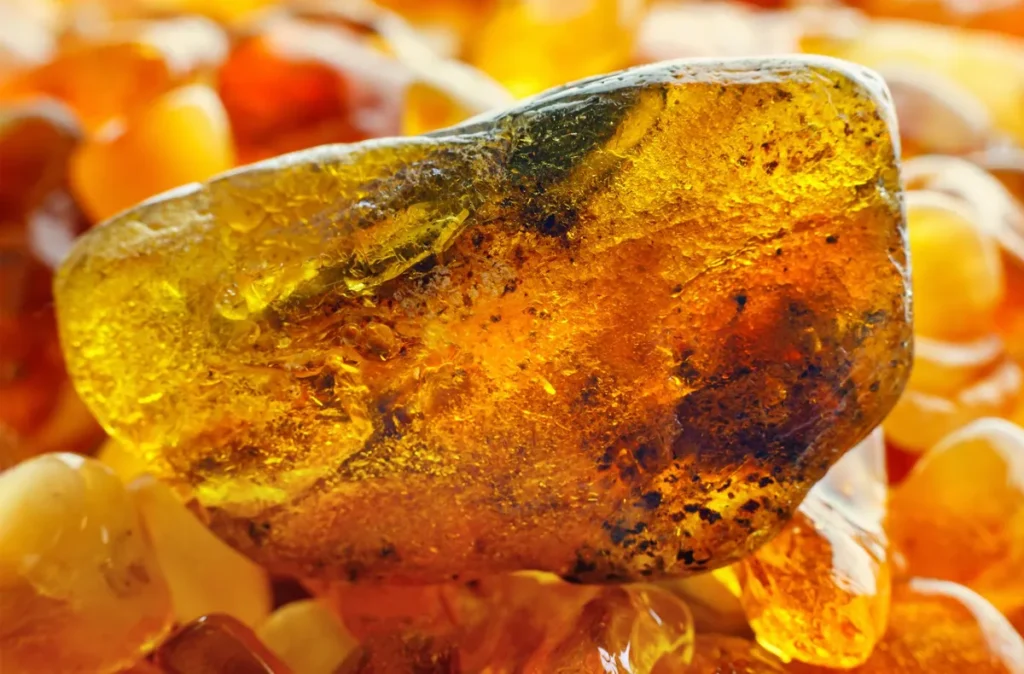
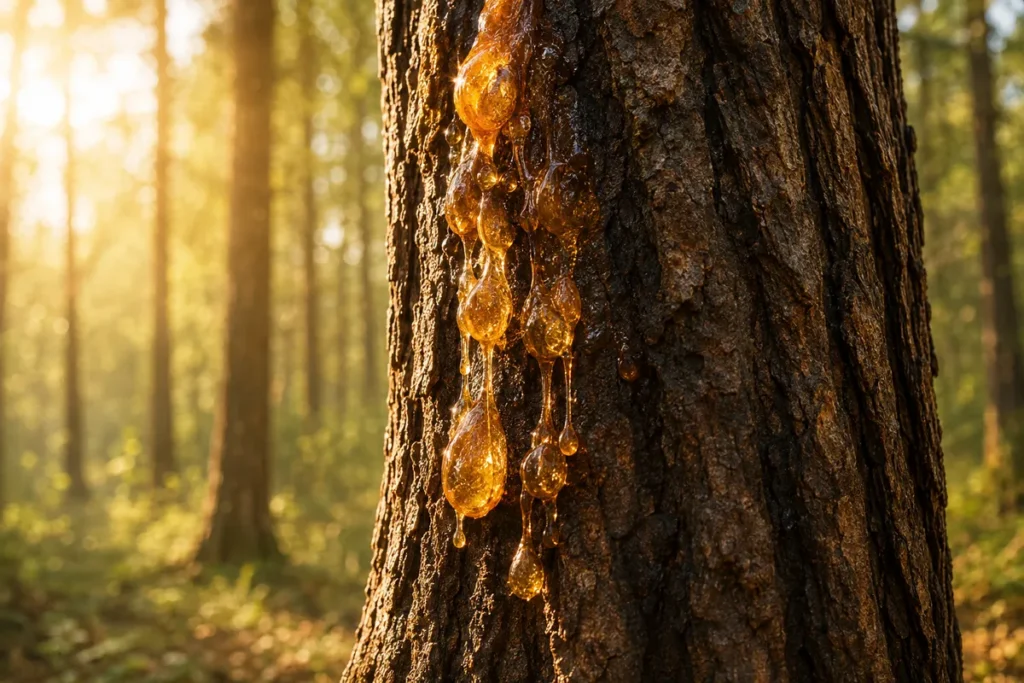
Amber and copal can look remarkably similar.
Both can have warm golden colors, a glossy surface, and the unmistakable appearance of tree resin. When polished, both may be used in jewelry and decorative pieces. To an inexperienced eye, it can be difficult to tell them apart.
If you’re new to amber, our complete beginner’s guide to amber explains what amber is, where it comes from, and why it has been valued for thousands of years.
But amber and copal are not the same material.
The simplest distinction is geological maturity. Copal is generally a younger natural resin that has undergone less chemical transformation, while amber is older and more geologically mature.
That difference sounds simple, but there is more to the story.
Age alone does not tell you everything about a specimen. The botanical source, chemical composition, geological history, and testing method can all matter when scientists determine whether a piece is amber or copal.
In this guide, we’ll look at the differences between amber and copal, how each forms, why they can look so similar, and what you should know before buying either material.
The Short Answer: Amber vs. Copal
Amber is more geologically mature fossilized resin, while copal is generally younger natural resin that has undergone less maturation.
Both originate from plant resin, but they represent different stages in geological history.
A simplified way to think about the difference is:
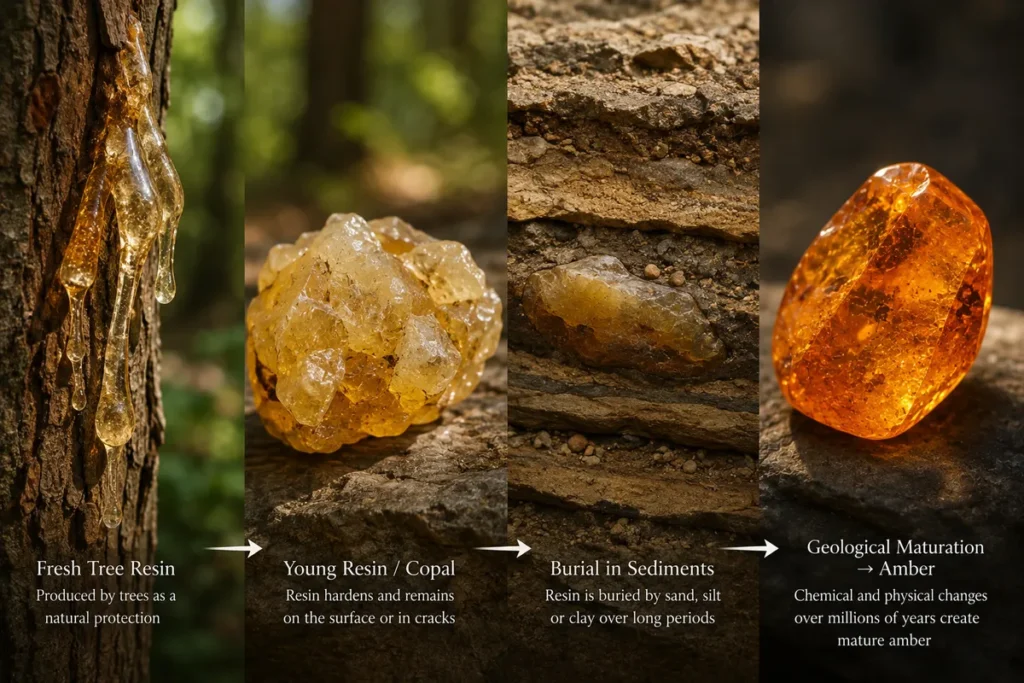
Fresh resin → young resin/copal → greater geological maturation → amber
However, this is a useful illustration rather than a universal timeline. Nature does not provide one exact age at which every piece of copal suddenly becomes amber.
Different deposits formed under different conditions, and scientists often use a combination of chemical and geological evidence to distinguish them.
What Is Amber?
Amber is a fossilized organic resin that has undergone significant chemical and physical changes over geological time.
The story begins with resin produced by plants, often as a protective response to injury or environmental stress.
If the resin is preserved rather than completely decomposed, it can become buried by sediments. Over long periods, chemical changes alter the original resin and gradually produce a more stable material.
This process can take millions of years.
Baltic amber is a well-known example. Much of the amber associated with the Baltic region formed during the Eocene Epoch, tens of millions of years ago.
Amber can occur in many colors, including:
- Pale yellow
- Golden yellow
- Honey
- Orange
- Cognac
- Reddish brown
- Creamy white
- Greenish shades
- Dark brown
Some specimens are transparent, while others are cloudy or almost opaque.
Amber can also contain inclusions such as insects, plant fragments, pollen, and other organic material preserved during its formation.
What Is Copal?
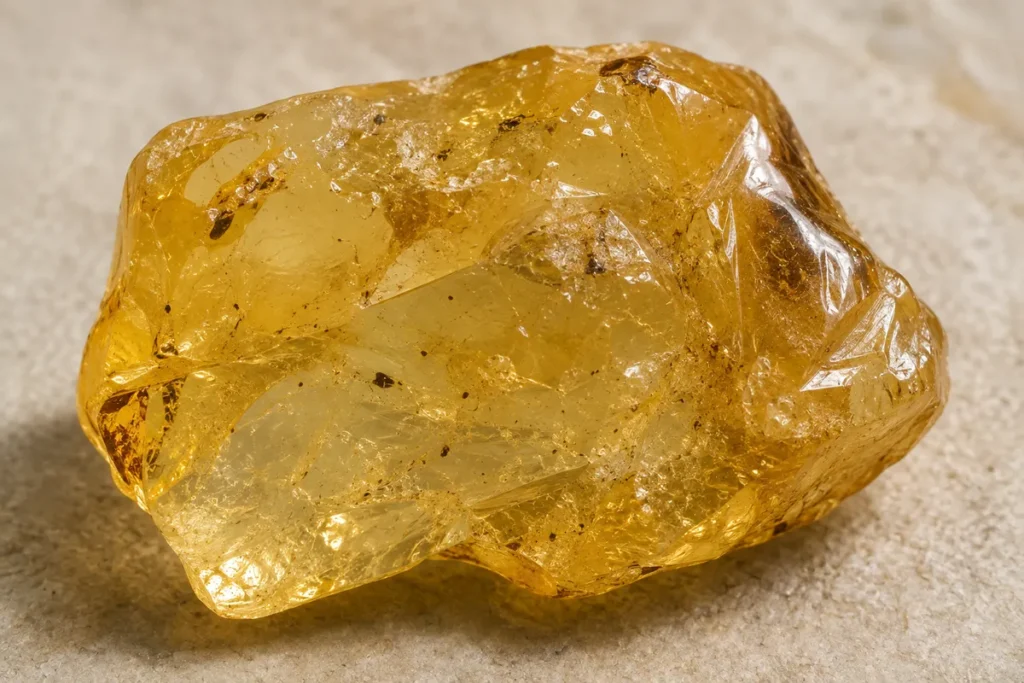
Copal is a term generally used for relatively young natural plant resin that has not undergone the same degree of geological maturation as amber.
Copal can come from a variety of plant sources and occurs in several regions around the world.
Some natural copal deposits are associated with tropical and subtropical environments, while other forms occur in different geological settings.
The appearance of copal can be surprisingly close to amber.
It may be:
- Clear or translucent
- Yellow or golden
- Orange
- Reddish
- Cloudy
- Richly textured
Some copal specimens also contain insects or other inclusions.
This is one reason the two materials are sometimes confused.
An attractive piece with a perfectly preserved insect inside is not automatically amber.
The Main Difference Between Amber and Copal
The most important difference is maturity.
Amber has undergone greater chemical transformation over geological time. Copal is younger and generally retains more characteristics of relatively fresh plant resin.
Think of it less as two completely unrelated materials and more as two materials at different stages of geological history.
However, it is important not to treat the process as a simple stopwatch.
There is no universally accepted rule such as:
“Anything older than X years is amber, and anything younger is copal.”
The boundary is more complicated than that.
Scientists may examine chemical composition, molecular structure, geological context, and other characteristics when determining what a specimen actually is.
Amber vs. Copal: A Quick Comparison
| Feature | Amber | Copal |
| Origin | Ancient plant resin | Younger natural plant resin |
| Geological maturity | More mature | Less mature |
| Age | Often millions of years old | Generally much younger |
| Chemical transformation | More extensive | Less extensive |
| Appearance | Often golden, yellow, orange, brown, or cloudy | Can look very similar |
| Inclusions | Can preserve insects and plants | Can also contain insects and plants |
| Hardness | Generally harder | Generally softer |
| Surface behavior | More resistant to some solvents | More readily affected by some solvents |
| Typical use | Jewelry, collecting, art, research | Jewelry, decorative objects, research |
The table is useful as a general guide, but none of these characteristics should be treated as a standalone identification test.
Why Do Amber and Copal Look So Similar?
The answer is straightforward: they share the same basic biological origin.
Both begin as plant resin.
Fresh resin can already have the warm translucent appearance that people associate with amber. As resin becomes buried and matures, its physical and chemical characteristics change, but its original appearance can sometimes remain surprisingly recognizable.
Polishing makes the similarity even stronger.
A polished piece of copal can have:
- A bright golden color
- High transparency
- A glossy surface
- Attractive internal patterns
- Insect inclusions
To someone buying a piece of jewelry or looking at a loose specimen, it may look completely convincing.
That is why appearance alone is not a reliable way to distinguish amber from copal.
Is Copal Just Young Amber?
This is where things become a little more complicated.
It is tempting to describe copal simply as “young amber,” but that description can be misleading.
Copal is generally understood as a less mature natural resin, while amber represents resin that has undergone greater geological transformation.
However, copal deposits can have different botanical origins and geological histories.
Not every piece of young resin is necessarily destined to become amber.
For a resin to survive and eventually become a mature fossilized resin, it needs suitable conditions of burial, preservation, and chemical transformation.
So it is better to think of copal and amber as related materials with different degrees of geological maturity, rather than assuming that every piece of copal is simply amber waiting to get old enough.
How Does Amber Become Different From Fresh Resin?
To understand this process in more detail, see our guide to How Is Amber Formed?.
When a tree produces fresh resin, the material contains a mixture of chemical compounds characteristic of the plant that produced it.
Once resin becomes buried and isolated from its original environment, its chemistry begins to change.
Some volatile components can be lost. Other compounds react with one another, and the molecular structure of the material gradually changes.
Over geological time, these changes produce a more stable, mature resin.
This is part of what distinguishes amber from younger resins.
The transformation is not simply:
wet resin → dry resin → amber
It is a much longer chemical and geological process.
Can Copal Contain Insects?
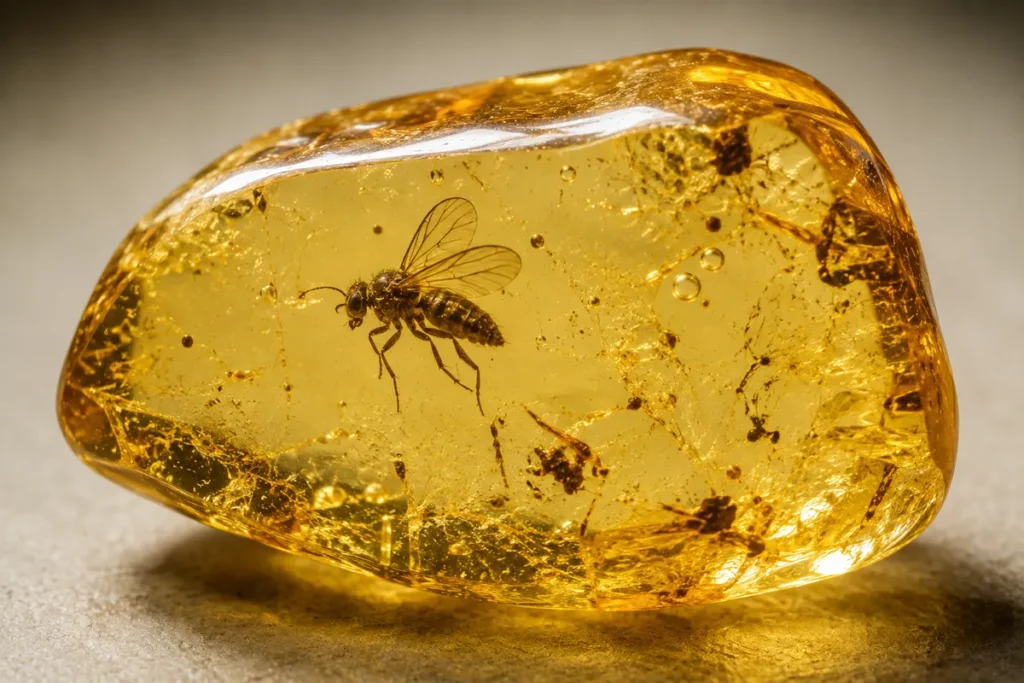
Yes.
This is an important point for collectors.
People sometimes assume that finding an insect inside a resin specimen proves that it is amber.
It does not.
Insects can become trapped in relatively young resin as well.
In fact, some copal specimens are famous for their insect inclusions.
Because copal is much younger than most commercially important amber deposits, its inclusions can represent relatively recent ecosystems.
This makes copal scientifically interesting in its own right.
An insect preserved in copal may tell us something about a much younger environment than an insect preserved in Baltic amber.
Amber Inclusions vs. Copal Inclusions
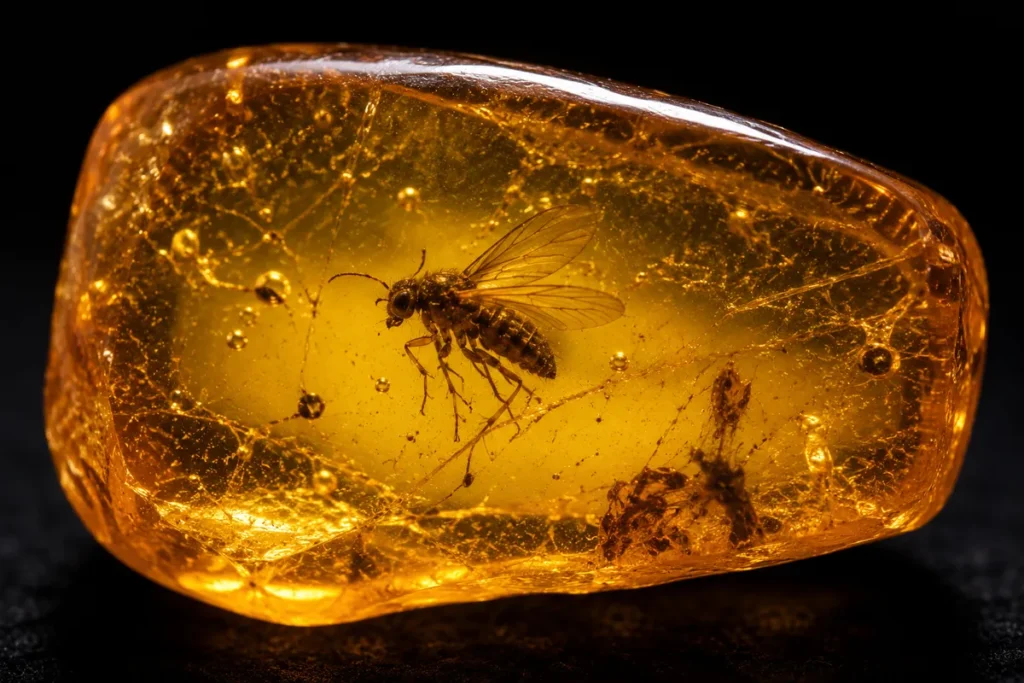
Both materials can preserve biological material.
Possible inclusions include:
- Ants
- Beetles
- Flies
- Spiders
- Plant fragments
- Seeds
- Leaves
- Pollen
- Fungal material
The scientific value depends on the specimen and its geological context.
Amber can preserve organisms from ecosystems that existed tens of millions of years ago.
Copal can preserve much younger organisms, sometimes providing a glimpse into relatively recent tropical or subtropical environments.
This difference in age can make the two materials valuable for different reasons.
Which Is Harder: Amber or Copal?
Generally, amber is harder and more geologically stable than copal.
Copal is a younger resin and tends to be more susceptible to changes caused by heat, solvents, and other environmental conditions.
This is one reason copal may behave differently during polishing, handling, and testing.
However, hardness should not be used as the only method of identification.
Natural materials vary, and a specimen can have surface treatments, coatings, or other factors that affect how it behaves.
Can You Tell Amber and Copal Apart With a Simple Test?
Some traditional tests can provide clues, but there is no single simple household test that can reliably identify every specimen.
One commonly discussed difference involves how the materials respond to certain solvents.
Copal is generally more susceptible to some organic solvents than mature amber.
However, deliberately applying solvents to a valuable specimen is not something we recommend.
A test can damage the surface, alter the finish, or reduce the value of a collectible piece.
For inexpensive educational samples, controlled testing may sometimes be appropriate. For valuable amber jewelry or specimens, professional identification is the safer approach.
What About the Scratch Test?
You may also come across the suggestion of scratching amber or copal to compare hardness.
Again, this is not ideal for valuable pieces.
A scratch test is destructive, and the result can be affected by surface treatments or differences within the material itself.
If you’re holding an expensive amber specimen, intentionally damaging it just to confirm what it is doesn’t make much sense.
There are better options.
What Is the Best Way to Identify Amber?
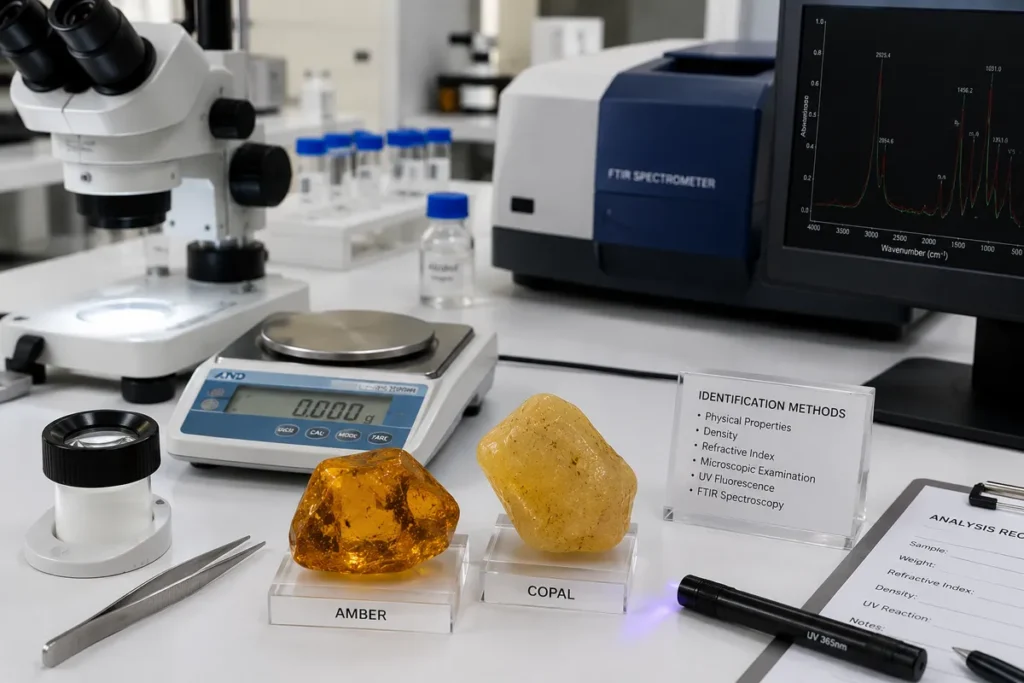
For a valuable or disputed specimen, the most reliable approach is to combine several forms of evidence.
Depending on the specimen, identification may consider:
Geological origin
Knowing where the material was collected can provide important context.
Physical properties
Density, hardness, optical behavior, and other physical characteristics can help narrow down the possibilities.
Chemical analysis
Modern analytical techniques can provide much stronger evidence about the molecular composition of a resin.
Spectroscopy
Techniques such as infrared spectroscopy can help identify characteristic chemical structures associated with different fossil resins.
Microscopic examination
Inclusions, internal structures, surface features, and other details can provide additional clues.
For valuable specimens, professional gemological or scientific testing is far more meaningful than relying on a single internet “home test.”
Why Does This Matter When Buying Amber Jewelry?
The distinction between amber and copal becomes particularly important when buying jewelry.
A necklace, bracelet, pendant, or carved piece can look beautiful regardless of whether it is made from amber or copal.
But they are not the same material, and they should not automatically be represented or priced as equivalent.
This is especially important when a seller describes something as:
Baltic amber
That term implies a particular geographic and geological association.
A piece of young copal from another region should not be presented as Baltic amber simply because it has a similar golden appearance.
If you’re buying higher-value amber, ask questions about:
- Material
- Geographic origin
- Whether it is natural or treated
- Whether it is reconstructed
- Whether it contains synthetic components
- Whether the seller can provide documentation for expensive specimens
A transparent description is always preferable to vague claims.
Amber, Copal, and “Fake Amber” Are Not the Same Thing
Another common source of confusion is the difference between copal and imitation amber.
Copal is a natural plant resin.
Synthetic or imitation amber is something different.
Imitations may be made from materials such as:
- Plastic
- Synthetic resin
- Other manufactured polymers
- Reconstructed or composite materials
A natural piece of copal is therefore not necessarily “fake.”
It is simply a different natural resin material.
The same distinction matters when discussing treated or reconstructed amber. Not every non-solid piece of amber is necessarily counterfeit, but it should be accurately described.
For buyers, accurate disclosure is more important than simply asking whether something looks real.
Does Baltic Amber Ever Look Like Copal?
To learn more about its geographic and geological origins, see [Where Does Baltic Amber Come From?].
Yes, visually they can overlap.
Baltic amber can be very clear, pale, cloudy, or richly colored. Some pieces may have a soft, resin-like appearance that resembles younger material.
This is why color and transparency cannot reliably establish geological origin.
A clear golden specimen is not automatically Baltic amber.
Likewise, cloudy or opaque material is not automatically copal.
If geographic origin matters, the identification should be based on more than appearance.
Which One Is More Valuable: Amber or Copal?
There is no universal answer.
Value depends on many factors, including:
- Authenticity
- Geological origin
- Rarity
- Color
- Transparency
- Size
- Inclusions
- Craftsmanship
- Condition
- Provenance
- Market demand
Natural Baltic amber with an unusual inclusion, for example, can be highly desirable to collectors.
A well-preserved copal specimen with a scientifically interesting inclusion can also have value.
The key is not to assume that “older always means more expensive.”
A beautiful, well-made piece of jewelry may have considerable artistic value even when the raw material itself is relatively common.
Can You Wear Copal as Jewelry?
Yes.
Copal has been used for decorative purposes and jewelry, and polished pieces can be attractive.
The main consideration is that copal is generally less mature and more sensitive than amber.
That means it may require more careful handling.
Avoid unnecessary exposure to:
- High heat
- Strong chemicals
- Harsh cleaning products
- Excessive sunlight
- Abrasive materials
If you’re buying a copal piece, it is worth asking the seller how the material has been treated and what care it requires.
How Should You Care for Amber and Copal?
The safest approach is gentle care.
For amber:
- Wipe it with a soft cloth.
- Use mild soap and lukewarm water when necessary.
- Avoid harsh chemicals.
- Keep it away from prolonged high heat.
- Store it separately from harder gemstones.
- Avoid ultrasonic cleaners.
For copal, take an even more cautious approach because the material is generally more sensitive.
A soft, dry cloth is often the safest starting point.
If a piece has significant sentimental or monetary value, follow the care instructions provided by the seller or have it professionally evaluated before cleaning.
Amber vs. Copal: Which Should You Choose?
It depends on what you want.
If you’re interested in geological history, ancient fossils, collecting, or traditional Baltic amber jewelry, amber may be the material you’re looking for.
If you appreciate natural resin, younger geological materials, or unusual inclusions, copal can be fascinating in its own right.
Neither material needs to be dismissed simply because it is not the other.
The important thing is knowing what you’re buying.
A beautiful piece of copal should be sold as copal.
A piece of Baltic amber should be accurately represented as Baltic amber.
And if a seller is asking a premium price based on a specific origin or geological claim, that claim should be supported by appropriate evidence.
Amber vs. Copal: The Bottom Line
Amber and copal share the same basic story: both begin with plant resin.
The difference lies largely in what happens afterward.
Copal is generally younger and less geologically mature. Amber has undergone much greater chemical transformation and preservation over geological time.
That difference affects their physical properties, stability, geological significance, and sometimes their commercial value.
But the two can look remarkably similar.
That’s why color, transparency, or even the presence of an insect inside a specimen cannot by themselves prove that a piece is amber.
If you’re simply admiring a beautiful resin specimen, the distinction may not matter much.
If you’re buying a valuable piece, however, it matters a great deal.
Know the material. Know the origin. And don’t rely on appearance alone.
Frequently Asked Questions
Is copal the same as amber?
No. Both are natural plant resins, but copal is generally younger and less geologically mature than amber.
Is copal just young amber?
It is often described this way for simplicity, but the relationship is more complicated. Copal represents younger, less mature natural resin, and different deposits can have different botanical and geological histories.
Can copal contain insects?
Yes. Insects and other organic material can become trapped in young resin, so an insect inclusion does not automatically prove that a specimen is amber.
Is Baltic amber more valuable than copal?
Not necessarily in every case. Value depends on origin, rarity, color, inclusions, size, condition, craftsmanship, provenance, and market demand.
Can you tell amber from copal by color?
No. Amber and copal can have very similar colors and levels of transparency.
Is copal natural?
Yes. Copal is a natural plant resin. It should not automatically be considered fake simply because it is not mature amber.
Is copal softer than amber?
Generally, yes. Younger resin such as copal tends to be less mature and more susceptible to certain forms of damage than amber.
How can you tell if amber is real?
No single household test is reliable for every specimen. For valuable pieces, professional identification using physical and chemical evidence is a much safer approach.
Final Thoughts
Amber and copal are easy to confuse because they share the same beginning.
Both come from plants. Both can be golden and translucent. Both can preserve insects. Both can be polished into beautiful objects.
But their geological stories are different.
Copal represents relatively young natural resin that has experienced less chemical maturation. Amber represents resin that has survived burial and geological change long enough to become a much more mature fossilized material.
That distinction is worth understanding—not only if you’re interested in geology, but also if you’re buying amber jewelry or collecting natural specimens.
After all, the most interesting thing about amber isn’t simply how it looks.
It’s how long it took to become what it is today.