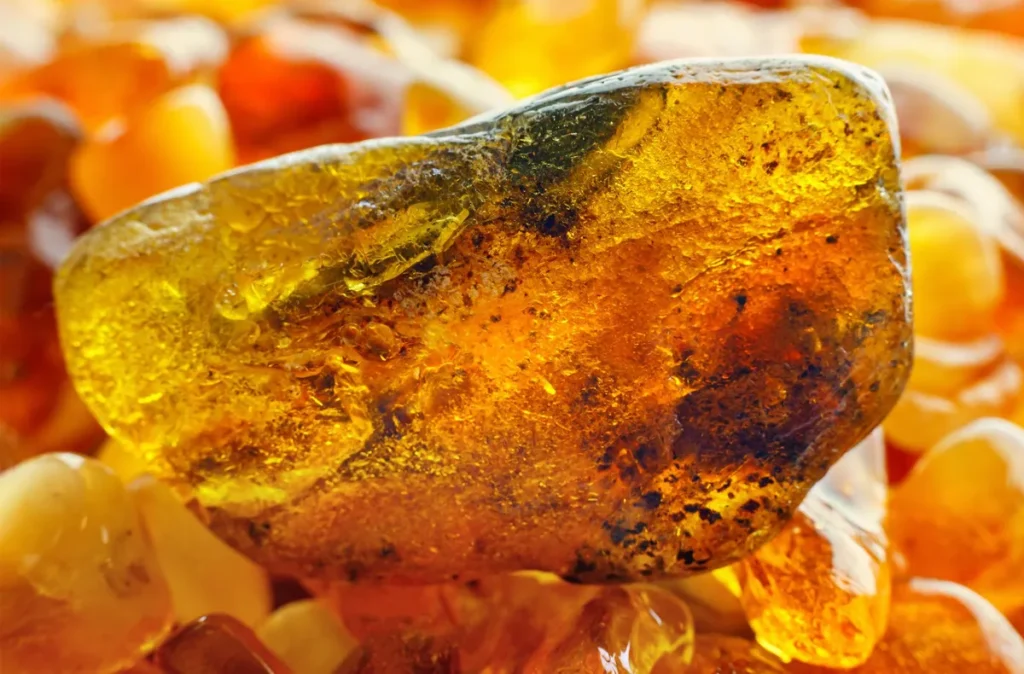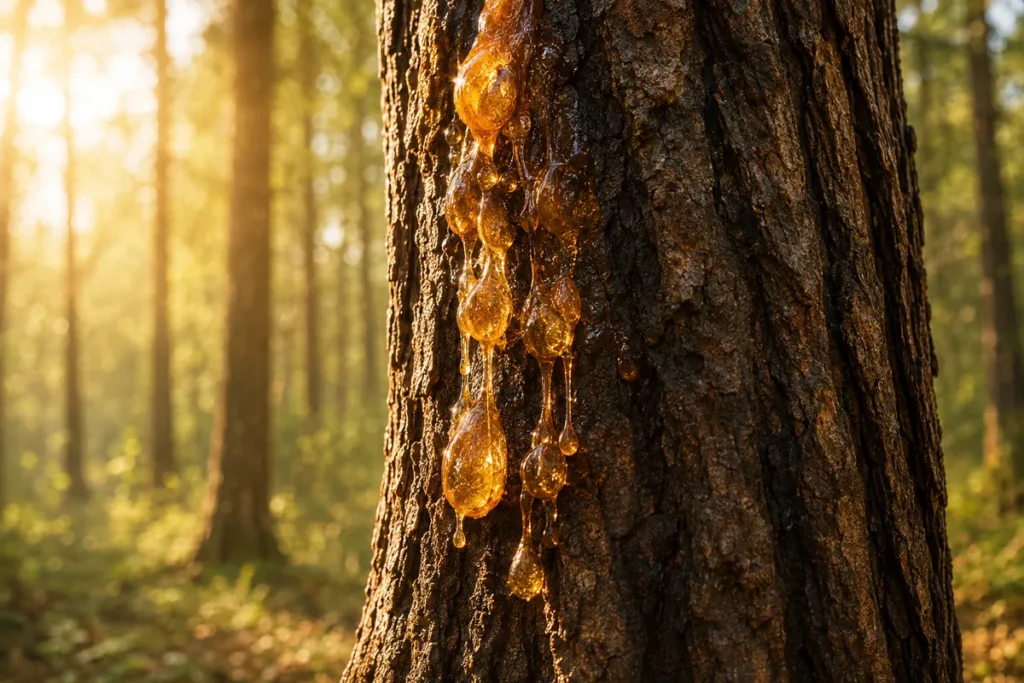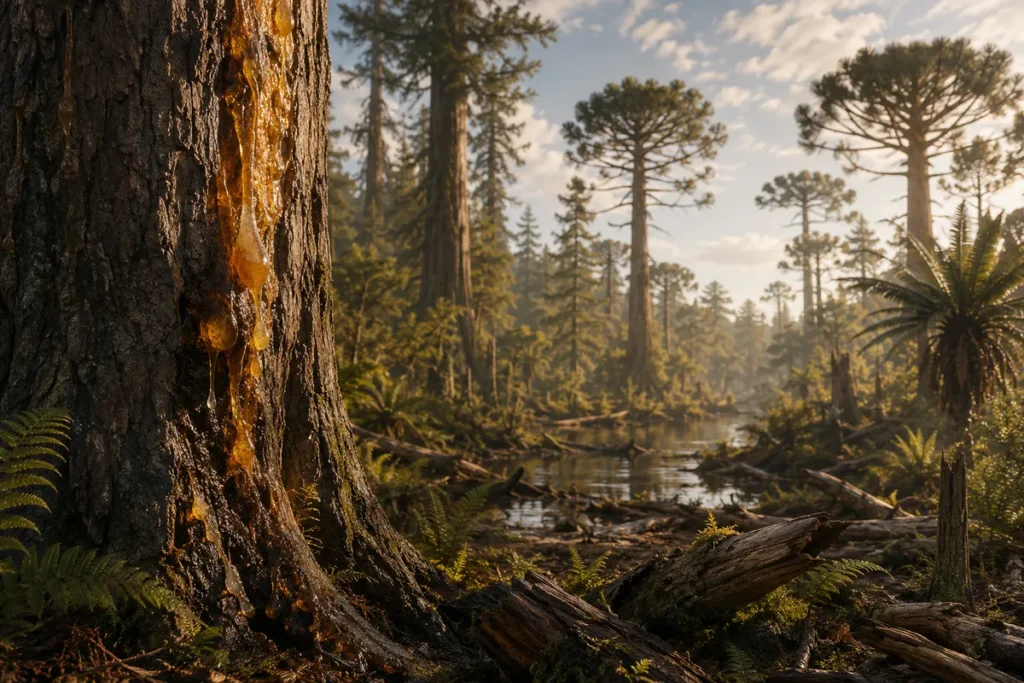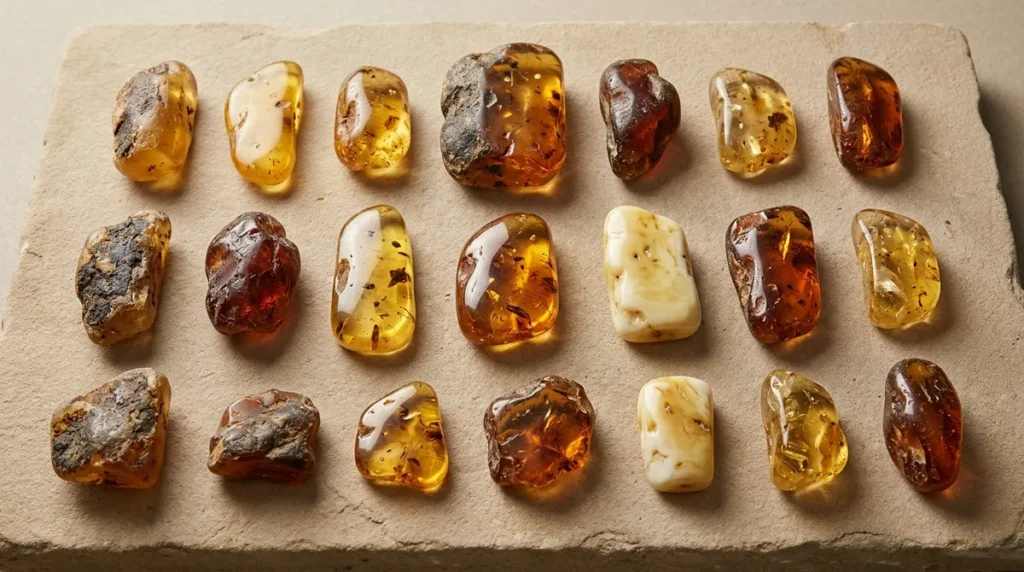
Amber is often described as a golden gemstone, but that familiar image represents only a small part of its natural variety. Some amber is almost transparent, while other pieces have a cloudy, milky appearance. Colors range from pale yellow and honey to deep cognac, reddish brown, and even unusual blue tones. Certain specimens contain insects or plant fragments, while others appear remarkably clear.
With so much variation, identifying different types of amber can be confusing, especially for beginners.
The key is to understand that amber can be classified in several ways. Its color, transparency, internal appearance, inclusions, geological characteristics, and geographic origin all provide useful information. These categories overlap, however, so a single piece may belong to several descriptions at once.
This guide explains how to recognize the main types of amber, what their visible characteristics can tell you, and where appearance alone is not enough to establish an identification.
What Does It Mean to Identify a Type of Amber?
Before looking at individual varieties, it helps to understand that there is no single classification system covering every type of amber.
Gemological descriptions often focus on visible characteristics, such as color and transparency. Geological and scientific classifications may instead consider chemical composition, age, botanical origin, and the location where the material was found.
For example, a single specimen might be described as:
- Baltic amber by geographic origin
- Honey amber by color
- Translucent amber by transparency
- Amber with insect inclusions by internal contents
- Polished amber by surface finish
These descriptions do not contradict one another. They simply identify different aspects of the same material.
For practical identification, it is useful to examine amber from several angles rather than relying on one characteristic.
1. Identify Amber by Color
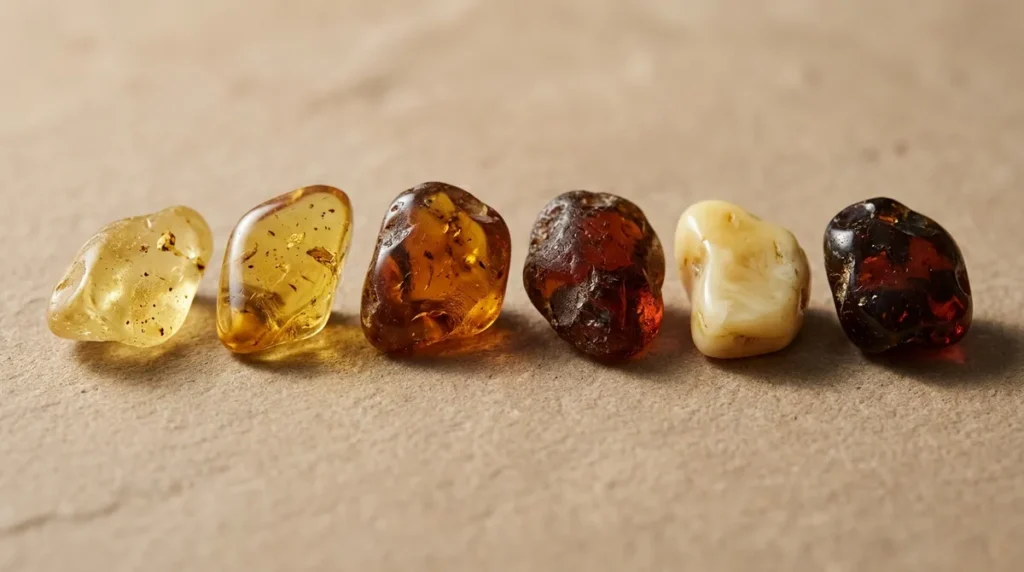
Color is usually the first feature people notice. It is also one of the easiest ways to describe different amber specimens.
For a closer look at the different shades and their characteristics, see our guide to amber colors.
However, amber color is influenced by several factors, including its chemical composition, internal structure, natural weathering, and any treatments it may have received. Color names used in the jewelry trade are not always standardized, so the same shade may be described differently by different sellers.
Yellow Amber
Yellow amber is one of the most familiar varieties. It can range from pale straw yellow to a richer golden shade.
Some pieces are transparent or translucent, allowing light to pass through them. Others have a slightly cloudy appearance caused by tiny internal bubbles or other structural features.
Yellow amber is especially associated with traditional Baltic amber jewelry, although yellow-colored amber is not exclusive to the Baltic region.
Honey Amber
Honey amber has a warm golden-orange appearance that resembles the color of natural honey.
It may be transparent, translucent, or slightly cloudy, depending on the specimen. The depth of color can vary considerably, from light golden yellow to a richer orange-brown tone.
The term is primarily a visual description rather than a formal geological classification.
Cognac Amber
Cognac amber is typically darker than ordinary yellow or honey amber. Its color ranges from warm orange-brown to deep reddish brown.
Some specimens have a relatively transparent appearance, while others contain darker internal areas that create visual depth.
Cognac is a widely used commercial color description, particularly in jewelry, but it does not identify a specific geographic origin.
White or Milky Amber
White amber, sometimes called milky or bone-colored amber, has a cloudy, creamy appearance rather than the transparency associated with clearer specimens.
Its appearance is often related to numerous microscopic gas bubbles or other internal structures that scatter light. These features can make the material look opaque or softly translucent.
Some pieces show subtle combinations of white, pale yellow, and honey tones.
White amber is especially associated with Baltic amber, although the appearance of a specimen alone cannot establish its origin.
Red or Cherry Amber
Red and cherry-colored amber can range from reddish orange to deep brown-red.
Some natural amber specimens have reddish tones, while others may have developed or intensified their color through heating or other treatments. Surface oxidation and weathering can also influence appearance.
For this reason, a red color should not automatically be interpreted as evidence of either natural origin or treatment. More information about the material and its processing history may be necessary.
Blue Amber
Blue amber is an unusual and particularly interesting variety, best known from certain Dominican amber deposits.
Under suitable lighting conditions, some specimens display a blue or bluish glow, especially when viewed against a dark background or under ultraviolet illumination. The effect is associated with the material’s optical properties and fluorescence rather than simply being a conventional blue pigment.
Not every piece of Dominican amber displays this effect, and a blue appearance under one lighting condition should not be treated as proof of geographic origin.
Blue amber is relatively uncommon compared with the more familiar yellow and honey-colored varieties.
Blue amber is not limited to a single geographic source. Research has documented commercially available blue amber from the Dominican Republic, Mexico, and Myanmar.
Its distinctive appearance is associated with optical and fluorescence effects rather than simply a blue body pigment. Depending on the specimen and lighting conditions, the material may appear blue, greenish blue, or much less distinctive.
The strength of the effect can vary considerably, even among specimens from the same locality. For this reason, a blue appearance should not be used by itself to identify Dominican, Mexican, or Burmese amber.
Why Color Alone Cannot Identify Amber Origin
Amber color is useful for describing a specimen, but it is not a reliable way to determine its geographic origin.
Different amber deposits can produce overlapping colors. Yellow, honey, orange, and brown varieties occur in multiple regions, while treatments and natural aging can further change the appearance of a specimen.
Blue amber is a particularly good example. Although it is strongly associated with the Dominican Republic, blue amber has also been documented from Mexico and Myanmar. These varieties may look similar under ordinary lighting, even though laboratory studies have identified differences in their optical and fluorescence characteristics.
Color should therefore be treated as one descriptive feature rather than a geographic identification method. To assess origin, gemologists may consider internal characteristics, geological context, chemical composition, and instrumental analysis.
2. Identify Amber by Transparency
Transparency provides another useful way to describe amber.
Light behaves differently as it passes through individual specimens, depending on their internal structure, inclusions, and the presence of microscopic features that scatter light.
Three broad descriptions are commonly used.
Transparent Amber
Transparent amber allows light to pass through relatively clearly. Objects viewed through a sufficiently clear piece may remain visible, although their appearance can be affected by the specimen’s shape, thickness, and internal features.
Transparent amber often reveals its internal structure more clearly than opaque varieties.
Some specimens contain small bubbles, flow patterns, or inclusions that become visible when examined under good lighting.
Translucent Amber
Translucent amber allows light to pass through but does not produce a completely clear view of objects behind it.
It often has a soft, glowing appearance, particularly when illuminated from behind. Honey-colored and cloudy yellow specimens frequently fall into this category.
The boundary between transparent and translucent is not always sharp. A single piece may contain both clearer and cloudier areas.
Opaque Amber
Opaque amber does not allow a clear view through the material. It may appear creamy, white, yellow, brown, or a combination of colors.
Its internal structure scatters or blocks enough light to prevent transparency.
Opaque amber is sometimes described using commercial terms such as bone amber or milky amber, depending on its appearance.
Importantly, transparency is not a direct measure of authenticity or quality. Both transparent and opaque amber can be genuine, naturally occurring material.
3. Identify Amber by Its Internal Appearance
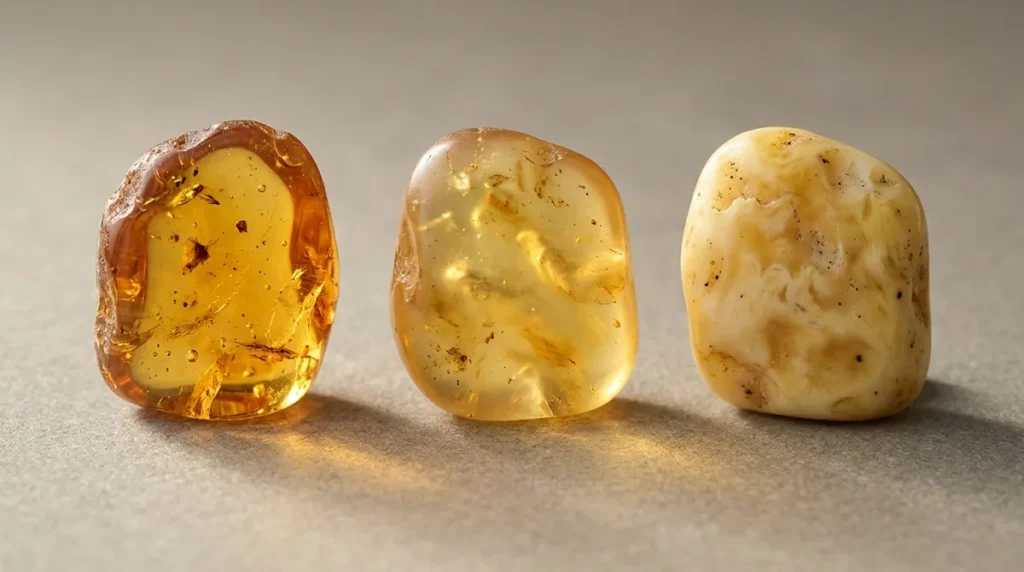
Looking inside a piece of amber can reveal details that are not obvious from its surface.
Some specimens are remarkably clear, while others contain cloudy areas, tiny bubbles, flow structures, or irregular patterns formed during the resin’s history and geological transformation.
Clear Amber With Few Visible Features
Some amber specimens have relatively uniform internal appearances, with few obvious inclusions or cloudy areas.
Their clarity allows the natural color and depth of the material to become the main visual features.
However, an apparently clear specimen should not automatically be considered more valuable or more natural than one with visible internal characteristics.
Cloudy or Bubbly Amber
Cloudy amber often contains numerous tiny gas bubbles or other microscopic structures that scatter light.
These features can produce a soft, opaque, or creamy appearance. In some pieces, the cloudy areas are distributed throughout the specimen; in others, they appear as irregular patches or bands.
The density and arrangement of these features can vary considerably.
Amber With Flow Structures
Amber may contain internal patterns that appear as subtle lines, curves, or irregular bands.
These structures can be associated with the movement and accumulation of resin before it became fossilized, as well as later changes within the material.
They may be visible under magnification or when light passes through a suitable specimen.
Internal flow patterns are interesting natural features, but they should not be used alone to confirm authenticity or geographic origin.
4. Identify Amber by Its Inclusions
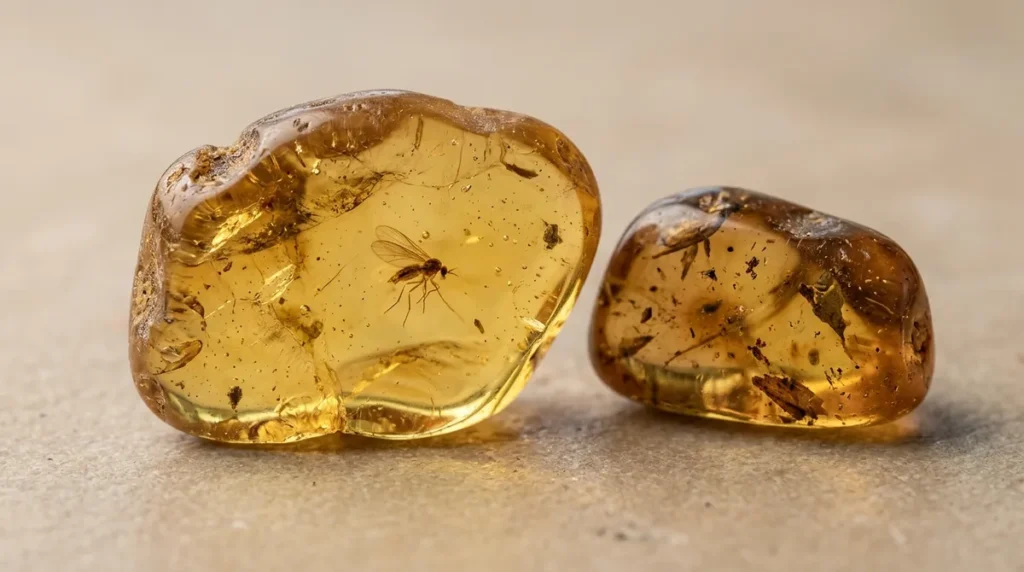
One of amber’s most fascinating characteristics is its ability to preserve small fragments of ancient life.
Inclusions are materials trapped within resin before it became fossilized. They can include insects, plant fragments, pollen, and other organic or inorganic material.
Amber With Insect Inclusions
Some amber specimens contain insects such as flies, gnats, beetles, and other small arthropods.
These inclusions are scientifically interesting because they can preserve details of organisms that lived millions of years ago.
The appearance of an inclusion depends on the organism, its position, the condition of the resin, and the preservation process.
Not every insect-containing specimen is especially valuable, and the presence of an insect does not by itself prove that a piece is genuine amber.
Amber With Plant Inclusions
Plant material can also become trapped in resin.
Examples include fragments of leaves, stems, flowers, seeds, and other botanical remains. Some inclusions are easily visible, while others require magnification.
Plant inclusions are important to the study of ancient vegetation and the environments in which resin-producing trees once lived.
Amber With Multiple Inclusions
Some specimens contain more than one type of inclusion, such as an insect together with plant fragments or other small organisms.
These pieces can offer particularly interesting insights into ancient ecosystems.
However, inclusions vary widely in scientific significance. Their identity, preservation, geological context, and documentation all matter when assessing a specimen.
For a closer look at this subject, see our guide to what amber inclusions are and how they form.
5. Identify Amber by Surface and Form
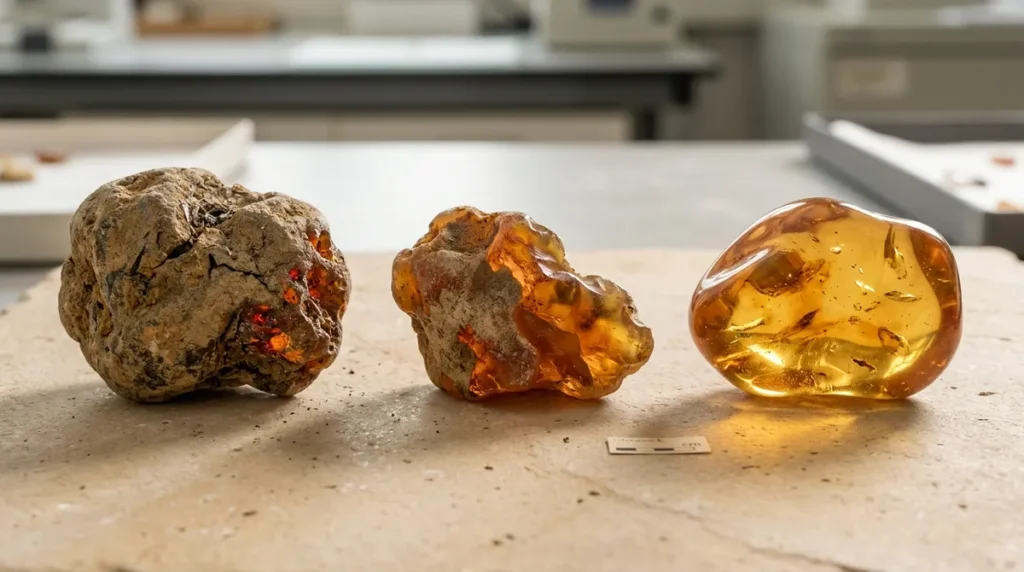
Amber is also described according to its natural shape and the way its surface has been finished.
These descriptions are especially useful when comparing raw specimens with polished jewelry materials.
Raw or Rough Amber
Raw amber is material that has not been extensively shaped or polished.
It may have an irregular outline, a weathered surface, or a naturally rounded appearance. Some pieces retain a rough outer layer, while others have smoother surfaces resulting from natural exposure and erosion.
Raw amber can vary significantly in color, transparency, and internal structure.
Polished Amber
Polished amber has been shaped and finished to create a smoother surface.
Polishing can make its color appear more vivid and allow light to pass through the material more evenly. It may also reveal internal features that were less noticeable on a rough surface.
Polished amber is commonly used in pendants, beads, earrings, and other jewelry.
Natural Surface Amber
Some specimens retain portions of their original outer surface rather than being completely polished.
These surfaces may appear irregular, textured, or weathered. They can provide clues about the specimen’s physical history, although surface appearance alone cannot establish its geological origin.
6. Identify Amber by Geographic Origin
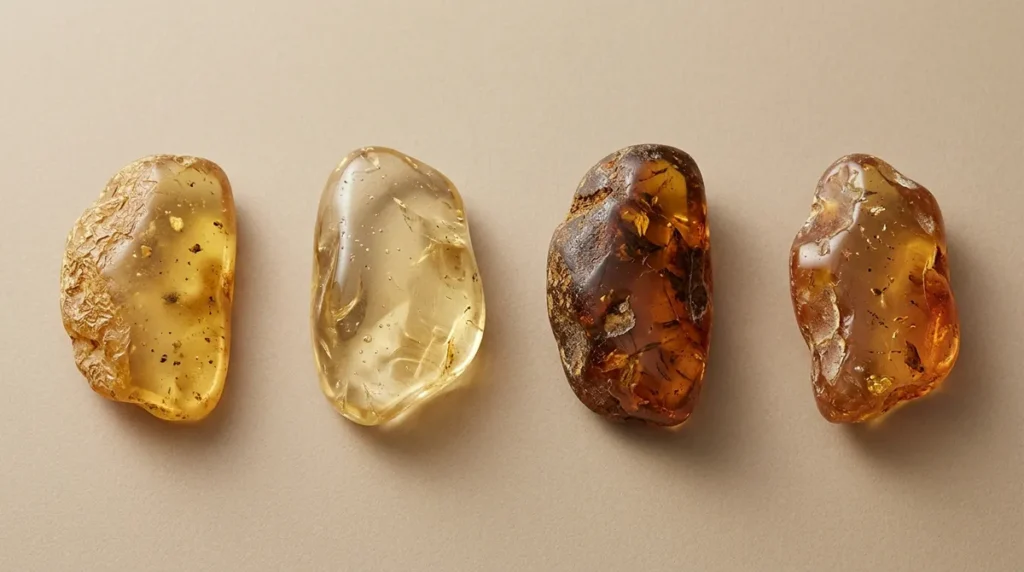
Amber is found in several parts of the world. Different deposits are associated with different geological ages, chemical characteristics, and regional histories.
Some geographic names are widely used in the jewelry and fossil trades. They are useful descriptions, but they should not be confused with identification based only on color or appearance.
Baltic Amber
Baltic amber is among the best-known types of amber. It is associated with deposits around the Baltic Sea region and is particularly important in the history of European amber trade.
Much Baltic amber is classified as succinite, a specific type of fossil resin with characteristic chemical features.
Its colors include yellow, honey, orange, cognac, reddish brown, and creamy white. It may be transparent, translucent, or opaque, and some specimens contain insect or plant inclusions.
The term Baltic amber refers to a geographic and geological association, not one single color or appearance.
Learn more about where Baltic amber comes from.
Dominican Amber
Dominican amber comes from deposits in the Dominican Republic, on the island of Hispaniola.
It is well known for specimens with relatively high transparency and for its occasional blue fluorescence. Some pieces contain exceptionally well-preserved insect and plant inclusions.
Dominican amber is often associated with yellow, honey, and reddish tones, although its appearance varies.
Blue fluorescence is a notable characteristic of certain specimens, but it is not present in all Dominican amber.
Burmese Amber
Burmese amber, also known as burmite, comes from deposits in Myanmar.
It is particularly important in paleontological research because many specimens date to the Cretaceous Period and preserve a wide variety of ancient organisms.
Burmese amber can vary in color, transparency, and internal appearance. Its scientific importance is closely connected to the fossil material preserved within it and its geological context.
Because geographic origin and age cannot be reliably established from color alone, specialist examination and documented provenance are important when identifying Burmese amber.
Mexican Amber
Mexican amber is especially associated with deposits in Chiapas, in southern Mexico.
It can display yellow, orange, honey, and reddish-brown colors, with variations in transparency and internal structure.
Some specimens contain well-preserved inclusions, making them of interest to both collectors and researchers.
As with other geographic varieties, its appearance overlaps with amber from other regions. A specimen’s color is not sufficient to establish that it originated in Mexico.
Appearance, Geographic Origin, and Provenance Are Different Things
When identifying amber, it is important to distinguish between its visible appearance and its geographic origin.
Color, transparency, and internal features describe what a specimen looks like. Geographic origin refers to the region where the original resin was deposited and eventually fossilized. Provenance refers to the documented history or source information associated with a particular specimen.
These are related, but they are not interchangeable.
For example, a piece of amber may be polished, cut, or assembled into jewelry in a country different from the place where the original fossil resin was mined. A seller’s location or the country from which a product is shipped does not necessarily establish the geological origin of the material.
Likewise, similar-looking amber can occur in different deposits. A specimen’s appearance may be consistent with a particular region, but appearance alone is rarely enough to establish its origin with confidence.
When geographic origin is important, reliable sourcing information and appropriate laboratory analysis should be considered together.
7. How to Identify Different Types of Amber Step by Step
If you are examining an unfamiliar specimen, a systematic approach makes it easier to describe what you see without jumping to conclusions.
Step 1: Observe the Main Color
Begin with the overall color under neutral, natural lighting.
Is the specimen pale yellow, honey-colored, orange, cognac, reddish brown, creamy white, or another shade?
Record the visible color rather than immediately assigning a geographic origin.
Step 2: Check Its Transparency
Hold the specimen near a soft light source.
Does light pass through clearly, pass through diffusely, or fail to pass through?
This helps you describe it as transparent, translucent, or opaque.
Step 3: Examine the Internal Structure
Look for cloudy areas, tiny bubbles, flow patterns, or other internal features.
A magnifying lens can help reveal details that are difficult to see with the naked eye.
Step 4: Look for Inclusions
Check whether the specimen contains insects, plant fragments, or other visible material.
Avoid assuming that every dark spot or irregular shape is an insect. Careful examination may be necessary to distinguish a genuine inclusion from an internal feature or surface imperfection.
Step 5: Observe the Surface
Determine whether the piece is rough, naturally weathered, partly polished, or fully polished.
Remember that surface finishing can change how a specimen looks without changing its underlying geological origin.
Step 6: Consider Its Claimed Origin
If a seller or collection record identifies the specimen as Baltic, Dominican, Burmese, or Mexican amber, treat that information as a claim that may need supporting documentation.
Geographic origin is not reliably established by color, transparency, or inclusions alone.
When a precise identification is important, specialist gemological or laboratory examination may be necessary.
8. Common Mistakes When Identifying Amber
Even experienced collectors can make mistakes when relying too heavily on one visible feature.
Here are several common misunderstandings worth avoiding.
Mistake 1: Assuming color identifies the origin.
Yellow amber is not necessarily Baltic, and blue-looking amber is not automatically Dominican. Similar colors can occur in material from different deposits.
Mistake 2: Assuming transparent amber is always better.
Transparency is one characteristic, not a universal measure of quality. Opaque and cloudy amber can also be genuine and desirable.
Mistake 3: Assuming inclusions prove authenticity.
Insects and plant fragments can occur in genuine amber, but their presence alone does not establish that a specimen is authentic. Inclusions should be examined in context.
Mistake 4: Confusing natural color with treatment.
Some amber colors occur naturally, while others may be influenced by heat or other processing. A color description alone cannot reliably reveal whether a specimen has been treated.
Mistake 5: Treating commercial names as scientific classifications.
Terms such as honey amber, cherry amber, and bone amber are useful visual descriptions, but they do not necessarily correspond to formal scientific categories.
A careful identification considers several characteristics together rather than relying on a single label.
How Gemologists Identify Amber More Reliably
Visual examination is an important starting point, but identifying the geographic origin or material characteristics of amber can require more specialized methods.
Gemologists may examine:
- Internal structures: Natural flow patterns, inclusions, bubbles, and color transitions can provide useful comparative information.
- Refractive index and specific gravity: These physical measurements help assess whether a specimen is consistent with amber, although values can overlap among different materials.
- UV fluorescence: Fluorescence can provide additional information, but its appearance varies and is not a stand-alone identification method.
- FTIR spectroscopy: Infrared analysis can help distinguish amber from imitation materials and can provide evidence relevant to geographic classification.
One feature often discussed in relation to Baltic amber is the so-called Baltic shoulder in its infrared spectrum. This characteristic absorption pattern is useful in gemological analysis, but it should be interpreted by a qualified professional rather than treated as a simple visual test.
Even laboratory results need to be understood in context. Treatment, reconstruction, sample condition, and the reference materials used can affect interpretation.
The most reliable identification comes from combining several forms of evidence rather than relying on one color, inclusion, or test result.
Frequently Asked Questions
What are the main types of amber?
Amber can be classified by color, transparency, internal appearance, inclusions, surface finish, and geographic origin. Commonly discussed geographic varieties include Baltic, Dominican, Burmese, and Mexican amber.
What is the rarest color of amber?
Blue amber is among the more unusual and sought-after color varieties, particularly specimens from the Dominican Republic that display blue fluorescence. However, rarity and value depend on the specimen and the market, and not every blue-looking piece has the same characteristics.
Is white amber real amber?
Yes. White or milky amber is a recognized appearance of genuine amber. Its cloudy look is often associated with microscopic structures that scatter light.
Is all Baltic amber yellow?
No. Baltic amber occurs in a range of colors, including pale yellow, honey, orange, cognac, reddish brown, and creamy white. It can also vary from transparent to opaque.
Can you identify amber by color alone?
No. Color can help describe a specimen, but it cannot reliably establish authenticity, geographic origin, or treatment history. Several different amber deposits can produce visually similar material.
What is the difference between raw and polished amber?
Raw amber has not been extensively shaped or polished and may retain an irregular or weathered surface. Polished amber has been shaped and finished to create a smoother appearance, often making its color and internal features easier to see.
Does amber with insects come from a specific region?
No. Insect inclusions occur in amber from several geographic regions. The presence of an insect does not, by itself, establish where the amber originated.
Final Thoughts: Identifying Amber Requires More Than Appearance
Amber occurs in a wide range of colors, transparencies, internal structures, and geographic varieties. These characteristics make it fascinating to study, but they can also make identification more complicated than it first appears.
Color and inclusions are useful for describing and comparing specimens. They may suggest similarities with amber from particular regions, but they cannot independently establish geographic origin or authenticity.
For everyday learning, careful visual observation is a good starting point. For valuable specimens or purchases where origin matters, professional gemological examination and reliable provenance information provide a stronger basis for identification.
The key is to understand what each characteristic can tell you—and what it cannot.