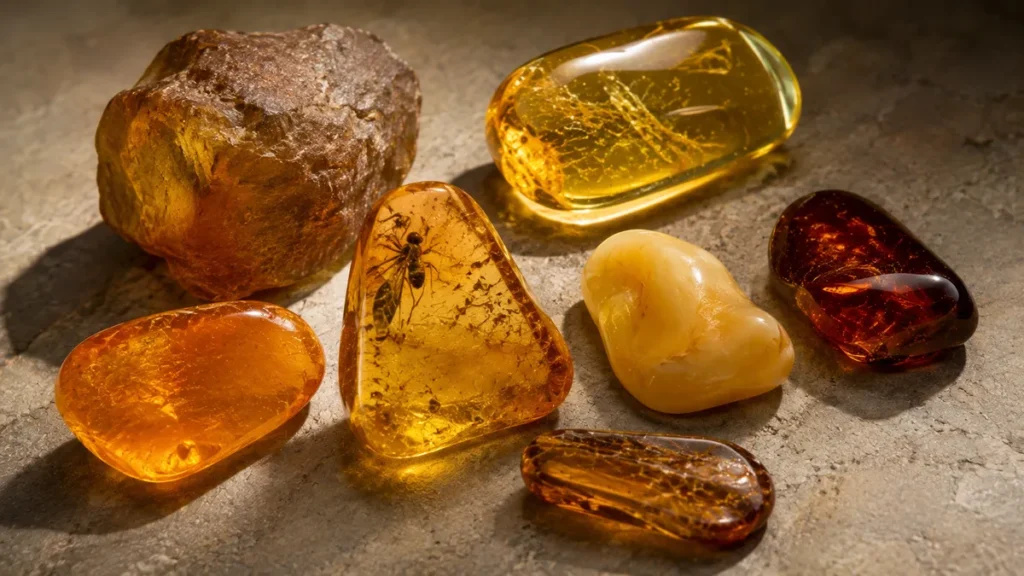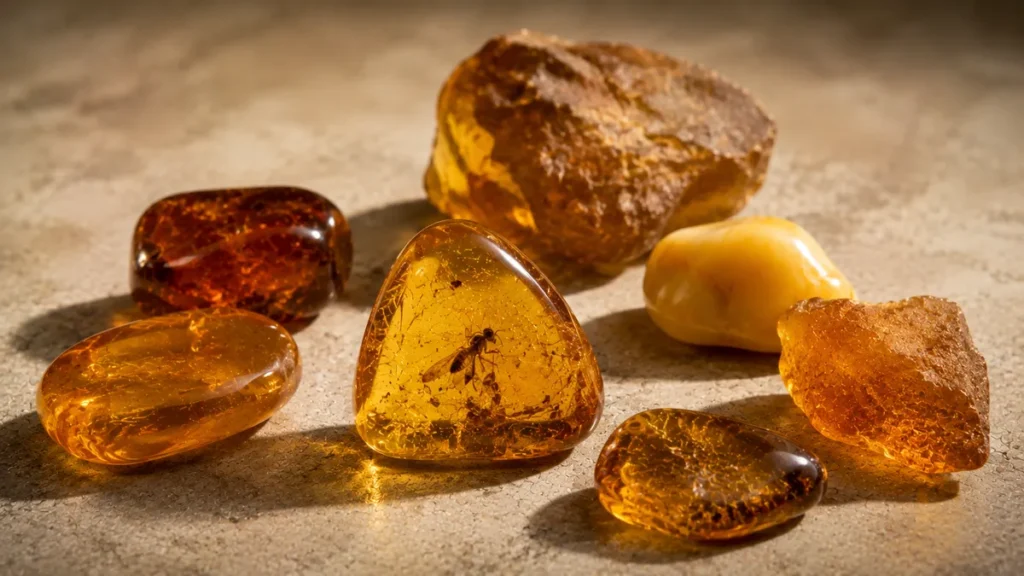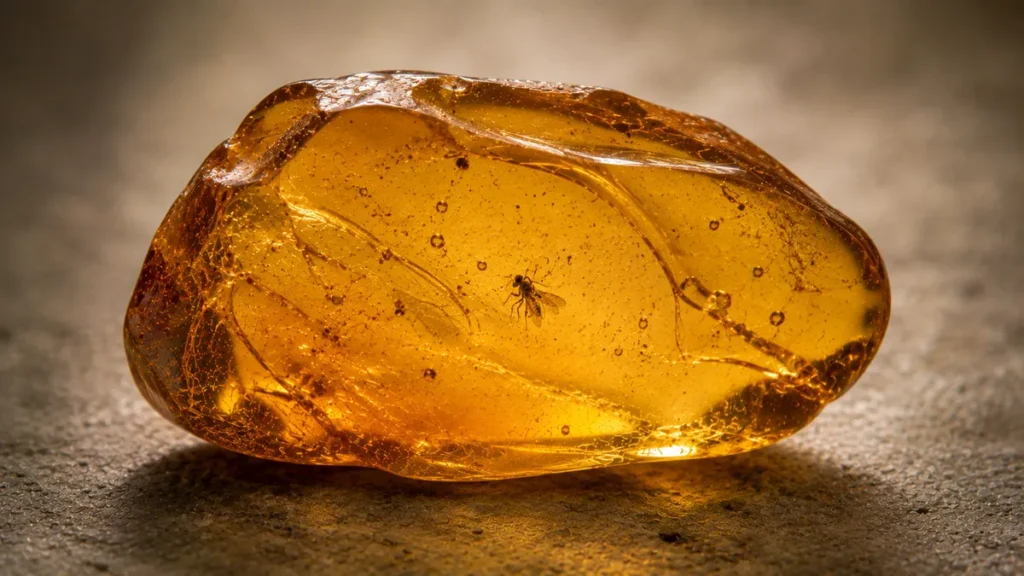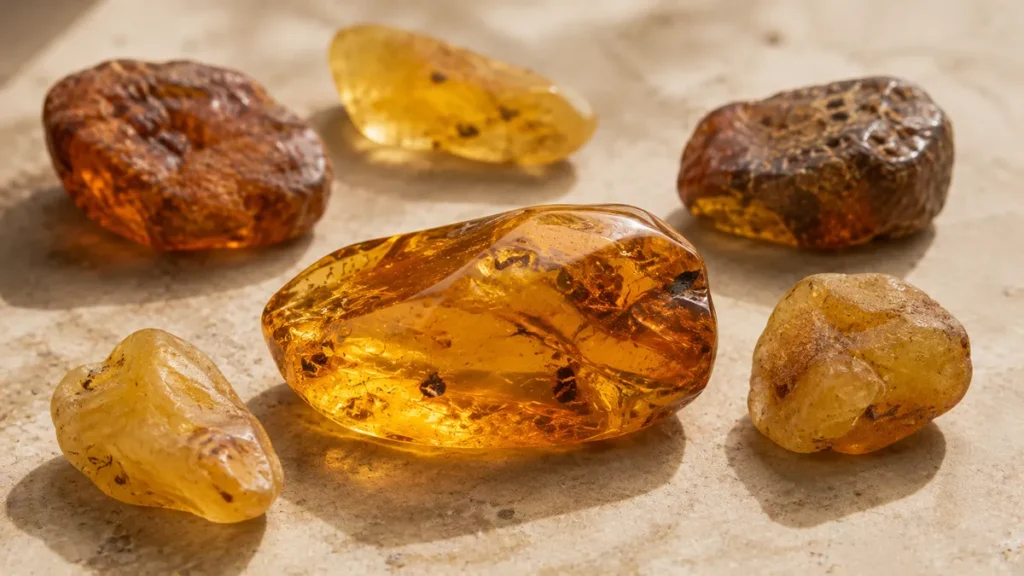
Buying Baltic amber online can be convenient, especially when you are looking for a particular color, a piece of amber jewelry, or a natural specimen that is difficult to find locally. The challenge is that you cannot hold the piece in your hand, examine its internal structure under magnification, or ask someone to inspect it in person before paying.
Instead, you have to rely on photographs, product descriptions, seller information, and whatever evidence is available to support the item’s authenticity.
That does not mean buying amber online is inherently risky. Many reputable sellers provide detailed descriptions, realistic photographs, clear treatment disclosures, and reasonable return policies. The key is knowing what to look for—and recognizing when a listing leaves too many questions unanswered.
The safest way to buy authentic Baltic amber online is to evaluate the material, the seller, and the evidence behind the product description together. No single photograph, certificate, or home test can answer every question.
This guide walks you through the process, from checking a seller’s claims to comparing prices and deciding when it is worth seeking independent verification.
What Does Authentic Baltic Amber Actually Mean?
Before choosing a seller, it helps to understand what you are trying to buy.
Baltic amber is fossilized tree resin associated with the Baltic region. Much of the material commonly traded as Baltic amber is succinite, a type of fossil resin with characteristic chemical properties. However, the name alone does not establish the exact identity, treatment history, or geographical origin of an individual piece.
When a seller describes an item as authentic Baltic amber, several separate questions are worth considering:
- Material: Is the piece genuine amber rather than plastic, glass, copal, or another imitation?
- Origin: Is there credible evidence supporting the claim that it comes from the Baltic region?
- Treatment: Has the amber been heated, clarified, dyed, or otherwise altered?
- Construction: Is it a single piece of amber, or is it pressed or reconstructed from smaller fragments?
These distinctions matter because a piece can be genuine amber without being untreated, and genuine amber does not automatically prove Baltic origin.
Likewise, a seller may offer a genuine amber pendant without having independent evidence of its precise geographical source.
A reliable listing should make these distinctions as clear as possible instead of relying on the word authentic to cover everything.
1. Choose a Seller Who Provides Specific Information
When shopping online, the seller’s product description is often your first source of evidence. Pay attention to how much useful information it contains.
A trustworthy seller should be able to describe the item beyond its color, size, and general appearance.
Look for details such as:
- The material being sold and whether it is described as natural amber
- The stated geographical origin and the basis for that claim
- Whether the piece has been treated or enhanced
- Whether it is a single piece or pressed/reconstructed material
- Its dimensions, weight, and condition
- The materials used in any metal setting or other jewelry components
- Available documentation and the terms of the return policy
Not every seller will have laboratory documentation for every item. That alone does not make a listing unreliable. What matters is whether the seller distinguishes confirmed information from assumptions and is willing to explain what is known.
Be more cautious when a listing makes strong claims about rarity, origin, or natural condition but provides little supporting information.
A polished website and professional-looking photographs can make a seller appear credible, but neither proves that the product is accurately described.
2. Examine the Product Photographs Carefully

Photographs are especially important when buying amber online. They allow you to evaluate visible characteristics, although they cannot establish everything about a specimen.
Start by looking for multiple views of the actual item rather than relying entirely on generic promotional images.
Useful photographs may show:
- The front and back of the piece
- Its side profile and thickness
- Surface condition and visible scratches
- Internal structures and inclusions
- The color in reasonably neutral lighting
- The size of the item relative to a familiar object or measuring scale
For jewelry, look closely at the setting, drilled holes, bead surfaces, clasps, and other construction details. For loose amber, examine the shape, polish, transparency, and visible internal features.
If the listing shows only one heavily edited image, it becomes harder to judge what you will receive.
Be Careful With Color and Lighting
Amber’s appearance can change considerably with lighting. A translucent honey-colored specimen may look deeper orange under warm light, while a cloudy piece may appear more transparent when strongly backlit.
Camera settings, white balance, reflections, and image editing can also influence the final photograph.
For that reason, do not judge authenticity by color alone. A vivid golden appearance does not prove that a piece is genuine, and an unusual color does not automatically mean it is fake.
If color is important to your purchase, ask whether the seller can provide additional photographs in neutral daylight or a short, unfiltered video.
Remember that photographs are useful for evaluating appearance and condition, not for independently confirming material identity or geographical origin.
3. Read the Description for More Than the Word “Genuine”
Words such as genuine, natural, authentic, and Baltic are common in amber listings. They can be useful, but only when the seller explains what they mean in the context of the item.
For example, “genuine amber” is a statement about the material. It does not necessarily mean that the amber is untreated, that it comes from a single continuous piece, or that its Baltic origin has been independently verified.
Similarly, “natural color” should not be confused with a guarantee that the material has never undergone any treatment.
Read the complete description and look for information about processing, construction, and origin. If the wording is ambiguous, ask the seller to clarify it before purchasing.
Watch for Unclear or Contradictory Claims
A listing deserves closer scrutiny if it simultaneously describes a piece as completely untreated and emphasizes an appearance produced through an undisclosed enhancement process.
Other warning signs include conflicting descriptions across different parts of the listing, photographs that appear to show different items, or claims of exceptional rarity without a clear explanation.
These signs do not automatically prove fraud. They do, however, give you a good reason to ask more questions or choose another listing.
The goal is not to reject every imperfect description. It is to avoid paying for claims that the seller cannot adequately explain.
4. Check Whether the Amber Is Natural, Treated, or Pressed
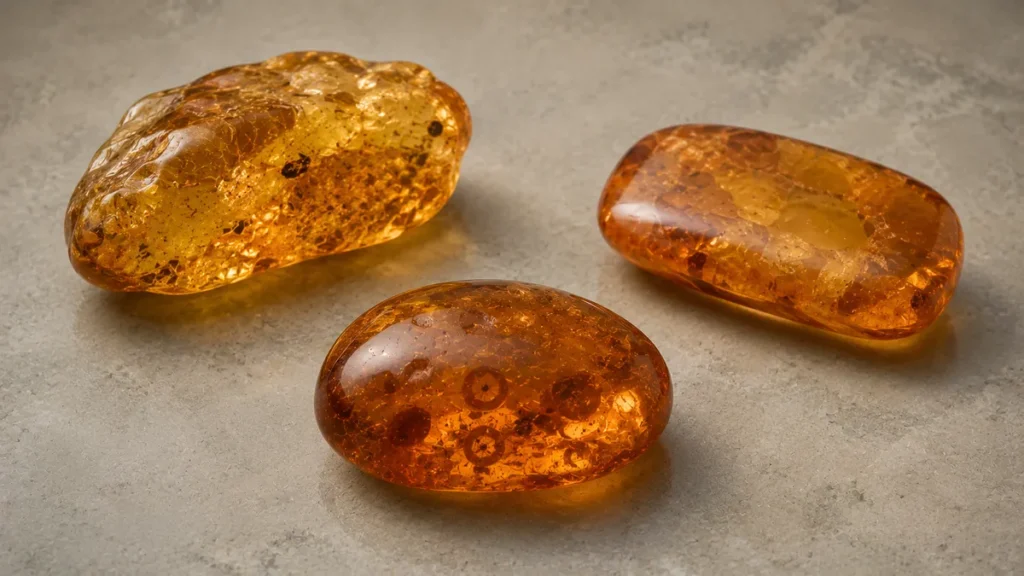
The distinction between natural, treated, and pressed amber is particularly important when buying online because the processing history may not be obvious in photographs.
Untreated amber has not undergone artificial enhancement intended to change its appearance, although it may still have been cut, shaped, drilled, or polished.
Treated amber begins as amber but has undergone a process intended to alter characteristics such as color, clarity, or internal appearance.
Pressed or reconstructed amber is made by consolidating smaller amber fragments into a larger piece. It is therefore different from a single continuous piece of amber, even when the starting material is genuine.
None of these categories should be confused automatically with plastic or other imitation materials. The important issue is whether the item is described accurately.
Before buying, ask:
- Is the piece untreated, or has it undergone any enhancement?
- If it has been treated, what process is known to have been used?
- Is it a single piece of amber or pressed/reconstructed material?
- Does the seller have evidence supporting any claims about its treatment history?
If you want untreated amber specifically, make that requirement clear before paying.
Our guide to natural vs. treated amber explains these categories in more detail, including why a piece can be genuine amber without being untreated.
5. Understand What a Certificate Can—and Cannot—Prove
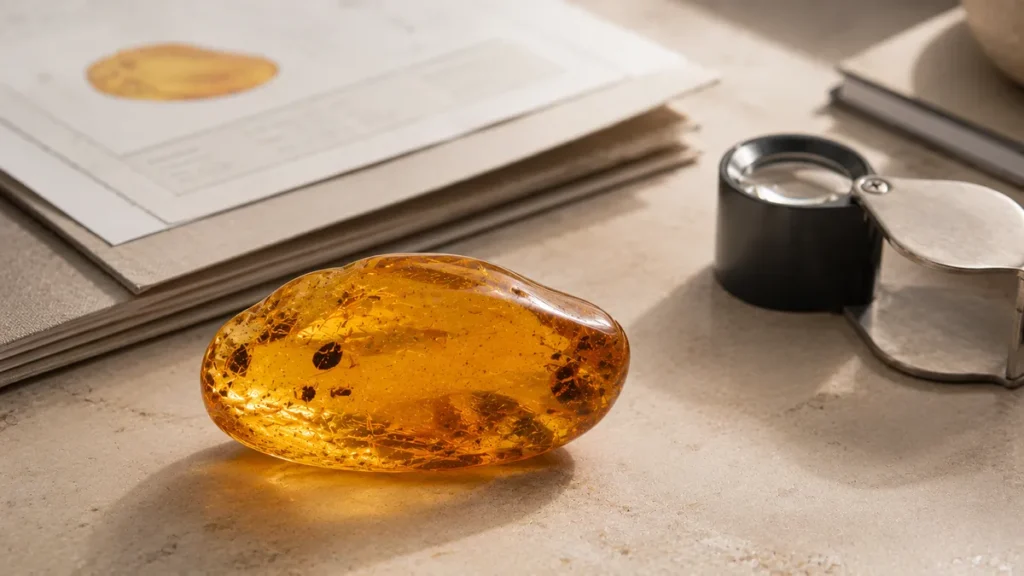
Certificates and gemological reports can provide useful evidence, but it is important to understand exactly what a document covers.
Some documents are seller-issued product cards or certificates of authenticity. Others are reports from independent gemological laboratories. These are not equivalent, and neither should be evaluated by appearance alone.
When a seller provides documentation, check the following:
- Who issued the document?
- Is the issuer independent of the seller?
- Does the document identify the material as amber?
- Does it discuss treatment, if that is important to you?
- Does it support the claimed geographical origin?
- Can the report be linked to the exact item being sold?
- Are there limitations or qualifications in the findings?
A report that identifies a specimen as amber does not necessarily establish that it is untreated. Likewise, a material identification does not automatically confirm that the piece originated in the Baltic region.
Not every laboratory offers the same tests, and not every report addresses every question.
For a higher-value purchase, look for a report whose stated scope matches the claim you want to verify. If you are unsure, ask the issuing laboratory what the report establishes and what remains unconfirmed.
Be cautious of vague claims such as “certified authentic” when the seller does not identify the issuer or explain what was examined.
6. Check the Seller’s Reputation Beyond the Product Page
A detailed listing is useful, but it is only one part of evaluating an online seller.
Look for signs that the business is established and accountable. Depending on the platform, useful information may include:
- A consistent seller name and business identity
- Clear contact information
- A stated return and refund policy
- Reviews from buyers who describe specific products and experiences
- A history of selling similar items
- Responses to customer questions and complaints
- Consistent descriptions and photographs across the seller’s listings
Reviews are worth reading carefully rather than judging only by the average star rating.
Detailed reviews that discuss product accuracy, packaging, communication, and how the seller handled a problem can be more informative than short comments that simply say an item was beautiful.
However, reviews are not proof of authenticity. A buyer may be satisfied with the appearance of a pendant without knowing whether the amber was treated or whether its stated origin is correct.
Look for a pattern of reliable service and accurate descriptions, not just positive feedback.
Be Cautious of Pressure Tactics
Be wary when a seller pressures you to purchase immediately, refuses to answer reasonable questions, or asks you to complete payment through an unfamiliar channel outside the platform’s normal protections.
Claims that a piece is uniquely rare or that the opportunity will disappear within minutes should not replace evidence.
A genuine opportunity should still withstand a few sensible questions.
7. Compare Prices Before You Buy
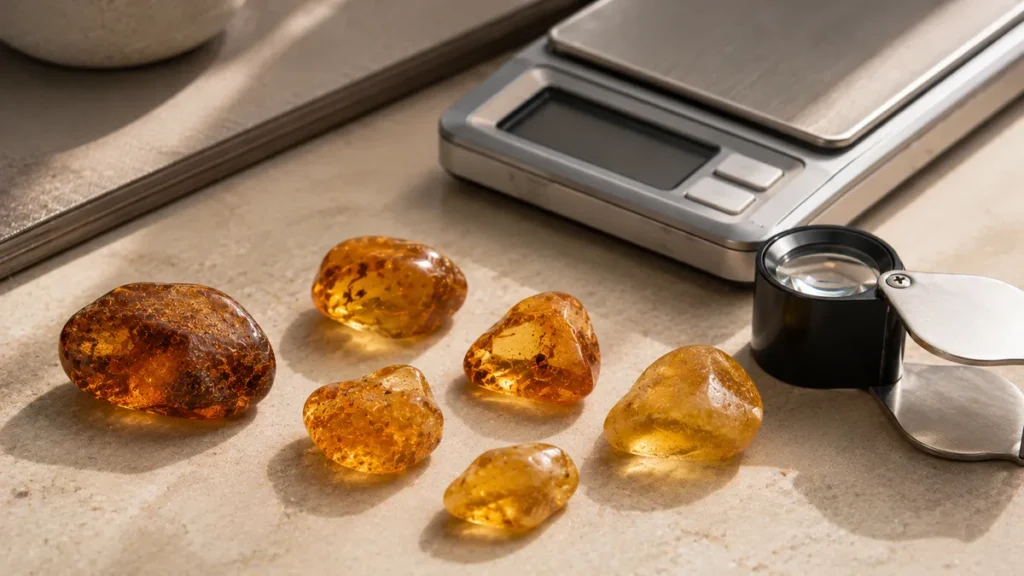
Price can help you identify listings that deserve a closer look, but it cannot establish authenticity by itself.
Amber prices vary according to material, size, color, clarity, inclusions, condition, treatment, craftsmanship, and the seller’s market. Jewelry also includes the cost of metal settings, design, and labor.
Two pieces that look similar in photographs may differ substantially in weight, construction, treatment history, or quality.
Likewise, a higher price does not guarantee that the amber is untreated or that its geographical origin is verified.
Before purchasing, compare several reasonably similar items. Try to match the product type, approximate size, material description, treatment status, and quality rather than comparing unrelated pieces simply because they share a color.
Our guide to how much amber costs explains common price differences and the factors that influence value.
If you are deciding between several pieces, also consider the criteria in our guide to what makes amber valuable.
Be Careful With “Investment-Grade” and “Rare”
Terms such as investment-grade, museum quality, and exceptionally rare can sound persuasive, but they need context.
Ask what makes the specimen unusual and whether the claim is supported by specific characteristics or independent documentation.
A large inclusion, a deep color, or a visually striking shape may make a piece attractive. None of these features automatically guarantees future appreciation or resale demand.
Unless you have a clear reason to buy a collectible specimen, it is usually more practical to focus on material identity, condition, workmanship, and whether the price makes sense for the item you actually want.
8. Understand the Limits of Home Authenticity Tests
You may encounter advice suggesting that amber can be verified using salt water, static electricity, UV light, or other simple tests.
These methods can sometimes provide clues, but they have limitations. A result may be influenced by the item’s composition, shape, surface, setting, or other factors. Some tests can also damage jewelry or leave residues.
For example, a salt-water test does not establish Baltic origin, and a UV response alone does not prove that a piece is genuine amber. Different materials can behave in overlapping ways.
Online buyers should be especially cautious about using a seller’s demonstration video as definitive proof. It may show a real test result without establishing every relevant fact about the item.
Avoid destructive tests on a newly purchased piece, particularly if you may need to return it.
For a more detailed explanation of common identification clues and their limitations, read our guide on how to tell if amber is real.
For expensive purchases or cases where authenticity materially affects the value, independent gemological examination is a more appropriate option than relying on a single home test.
9. Read the Return Policy Before Paying
A return policy is particularly important when you cannot inspect an item in person.
Before completing the purchase, find out:
- How long you have to request a return
- Whether returns are accepted if the item differs from its description
- Who pays return shipping
- Whether the seller offers a refund or only an exchange
- Whether the item must remain unused and in its original packaging
- How disputes are handled if the item is materially misrepresented
Check the policy on the actual marketplace or seller website rather than assuming that all sellers offer the same protection.
If the seller advertises a return window, save a copy of the terms in effect when you place the order.
When the item arrives, inspect it promptly and compare it with the listing. Keep the packaging, order confirmation, product description, and correspondence until you are satisfied with the purchase.
If the item differs materially from what was promised, contact the seller through the platform’s official process and follow the applicable return or dispute procedure.
10. Use a Payment Method With Appropriate Protection
Payment security is another part of buying amber online.
Where available, use the marketplace’s normal checkout or a reputable payment service that provides clear dispute procedures. Read the applicable terms before relying on any buyer-protection benefit.
Be cautious if a seller insists on an irreversible payment method, requests payment to an unrelated personal account, or offers a discount only if you bypass the platform.
Keep your order confirmation and payment records. These may be useful if the item never arrives or does not match the description.
A secure payment method cannot establish that amber is authentic, but it can reduce some of the financial risks associated with an online transaction.
11. What to Do When Your Amber Arrives
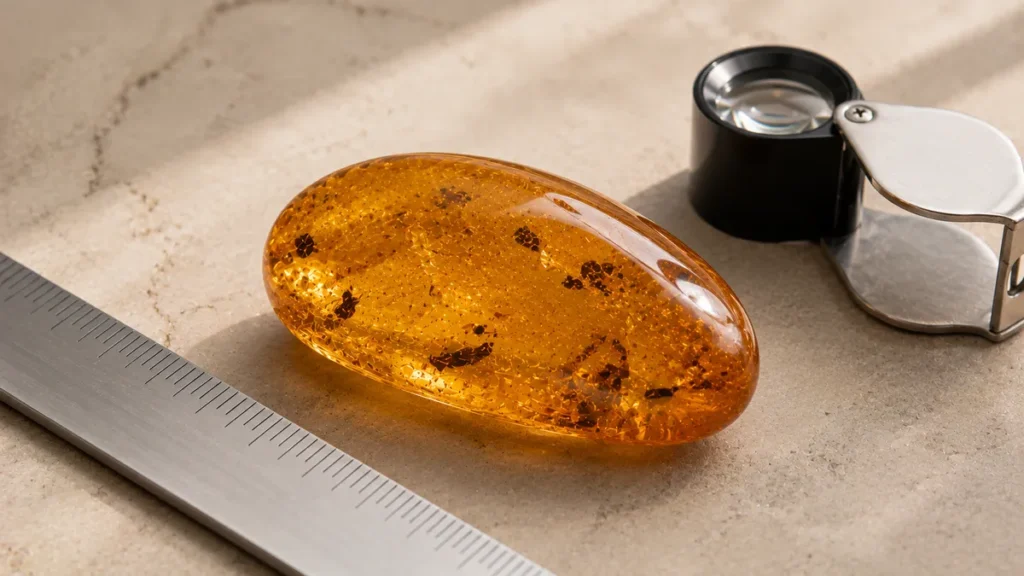
The final check begins when the parcel arrives.
Before discarding the packaging, compare the item with the original listing and order confirmation.
Check its dimensions, color, surface condition, craftsmanship, and any visible features that were specifically described. For jewelry, examine the clasp, setting, drilled holes, and overall finish. For a loose specimen, compare its shape and internal structures with the seller’s photographs.
Remember that ordinary differences in lighting can make amber look different from the listing. A color variation alone does not necessarily mean the product is misrepresented.
Focus on meaningful discrepancies, such as a different item being delivered, undisclosed damage, a substantial mismatch in size, or a material description that conflicts with what you received.
If authenticity or treatment status was a specific condition of the sale and you have reasonable grounds for concern, document the issue before altering or testing the piece. Contact the seller promptly and consider independent examination when the purchase justifies the cost.
Do not perform destructive tests while the return option is still relevant.
A Practical Checklist for Buying Baltic Amber Online
Before placing an order, use this checklist to make sure you have considered the most important points.
- The seller provides a specific description of the material.
- The listing explains what is known about the amber’s origin.
- Treatment status is disclosed or the seller has answered your questions.
- Pressed or reconstructed material is identified accurately.
- Photographs show the actual item from useful angles.
- The dimensions, weight, and condition are clear.
- Any certificate or report has an identifiable issuer and a relevant scope.
- The seller has a credible history and clear contact information.
- The price is reasonable compared with similar items.
- The return policy and payment terms are acceptable.
- You have saved the listing and order details.
You do not need every item to come with a laboratory report. The appropriate level of verification depends on the purchase. A modestly priced pendant and a valuable collector’s specimen do not necessarily justify the same level of investigation.
The important thing is to match the evidence to the claims and the amount you are spending.
Frequently Asked Questions
How can I tell if Baltic amber sold online is authentic?
Start by examining the product description, photographs, seller reputation, and any available documentation. Ask about material identity, geographical origin, treatment, and construction. For a valuable purchase, consider an independent gemological report. No single photograph or home test can establish every aspect of authenticity.
Is all genuine amber from the Baltic region?
No. Genuine amber occurs in several regions around the world. A claim that an item is genuine amber is different from a claim that it originates in the Baltic region. Geographical origin requires separate supporting evidence.
Is Baltic amber sold online always untreated?
No. Baltic amber can be sold in untreated, treated, or pressed/reconstructed forms. Read the description carefully and ask the seller about processing if untreated material is important to you.
Does a certificate guarantee that Baltic amber is authentic?
Not necessarily. The value of a certificate depends on who issued it, what was examined, and what conclusions the document supports. A report may identify amber without confirming that it is untreated or establishing its precise geographical origin.
Is it safe to buy Baltic amber from an online marketplace?
It can be, provided you evaluate the seller, listing, payment process, and return policy carefully. Marketplace protections vary, so read the applicable terms. Do not assume that a high rating or a large number of sales proves authenticity.
Why is one Baltic amber necklace much cheaper than another?
Differences may reflect the size and weight of the beads, material quality, color, clarity, treatment, construction, craftsmanship, metal components, and seller pricing. Compare similar items and check whether the descriptions refer to the same type of material.
Can UV light prove that amber is genuine?
No. UV fluorescence can provide a useful observation, but responses vary and are not exclusive to genuine amber. It should be considered alongside other evidence rather than used as a definitive test.
What should I do if the amber I receive does not match the listing?
Keep the packaging, order records, and original listing. Photograph the discrepancy, contact the seller through the official platform, and follow the applicable return or dispute procedure. If the disagreement concerns material identity or treatment, independent examination may help clarify the issue.
Final Thoughts
Buying authentic Baltic amber online does not require you to become a gemologist. It does require you to look beyond attractive photographs and reassuring product descriptions.
Start with the material itself, then examine the seller’s claims about origin, treatment, and construction. Compare prices fairly, understand the limits of certificates and home tests, and make sure the return policy gives you a reasonable way to address a problem.
Most importantly, do not treat authenticity as a single yes-or-no question. A piece may be genuine amber but treated, or made from pressed fragments rather than one continuous specimen. Its Baltic origin may also be less certain than the listing suggests.
A good online purchase is one in which the item, the evidence, and the seller’s description agree with one another. When those details are clear, you can make your decision with greater confidence—and know what you are paying for before the parcel arrives.