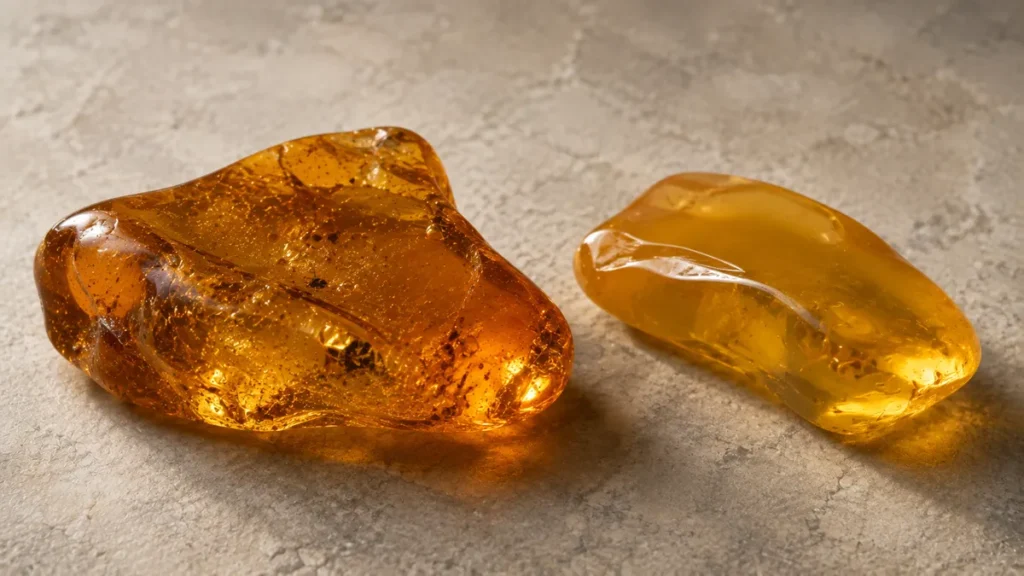
Amber has an unusual appeal. It is warm to the touch, surprisingly light in the hand, and often contains tiny traces of a world that disappeared millions of years ago. But its natural beauty also makes it easy to imitate.
Modern plastics, synthetic resins, copal, pressed amber, and other materials can sometimes look remarkably similar to genuine amber. For someone buying a piece of amber jewelry or a loose specimen, telling the difference is not always as simple as it first appears.
The good news is that you do not need a laboratory to make a useful first assessment.
By looking carefully at the material, examining its internal features, and using a few simple tests, you can often identify signs that support or contradict the possibility that a piece is genuine amber.
The important thing is to understand the limits of these tests.
No single home test can reliably prove that a piece of amber is genuine. The best approach is to combine several observations and, for valuable pieces, use professional gemological testing.
If you are completely new to amber, you may also want to start with our guide to what amber is and how it forms.
What Does “Real Amber” Actually Mean?
Before testing a piece of amber, it helps to clarify what you are trying to identify.
Amber is a natural organic material formed when ancient plant resin underwent chemical and geological changes over long periods of time. It is commonly described as fossilized tree resin, although the exact botanical sources of different ambers can be more complicated.
This makes amber very different from most familiar gemstones.
It is not a mineral such as quartz, sapphire, or diamond. Instead, it belongs to the group of organic gem materials, alongside substances such as pearl, coral, and jet.
There are also several materials that can be confused with amber:
- Copal — younger natural resin that has not undergone the same degree of geological maturation as amber
- Synthetic resin — man-made material designed to resemble natural amber
- Plastic — various plastics can imitate amber’s color and transparency
- Pressed or reconstructed amber — genuine amber fragments that have been combined under heat and pressure
- Treated amber — natural amber that has been altered to change its appearance
This distinction matters because “real” does not always mean “completely untreated and natural-looking.”
A piece can contain genuine amber and still have been modified or reconstructed.
If you want to understand one of the most common natural materials confused with amber, see our guide to Amber vs. Copal: What’s the Difference?
1.Start With the Appearance
The first step is also the simplest: look closely at the piece.
Natural amber can occur in a surprisingly wide range of colors and appearances. Golden yellow is probably the most familiar, but amber can also appear honey-colored, orange, reddish-brown, dark brown, milky or nearly opaque. Some varieties can even display unusual optical effects.
So color alone is not a reliable authenticity test.
A piece being very bright, very clear, or an unusual shade does not automatically mean it is fake.
Instead, pay attention to the overall character of the material.
Natural amber often has subtle irregularities inside it. You may see:
- tiny bubbles
- flowing internal structures
- cloudy areas
- fine cracks
- natural color variation
- small particles or inclusions
- irregular transparency
- subtle changes in tone from one area to another
These features are not proof by themselves, but they can provide useful clues.
Be cautious with pieces that look too perfect
A perfectly uniform color and completely flawless transparency can sometimes be a warning sign, especially when the piece is unusually large and inexpensive.
But this should not be interpreted too literally.
Some natural amber can be exceptionally clear, while some imitations are deliberately made with bubbles or other internal features to look natural.
The goal is not to find one “magic” feature. It is to look at the material as a whole.
2.Look for Natural Inclusions
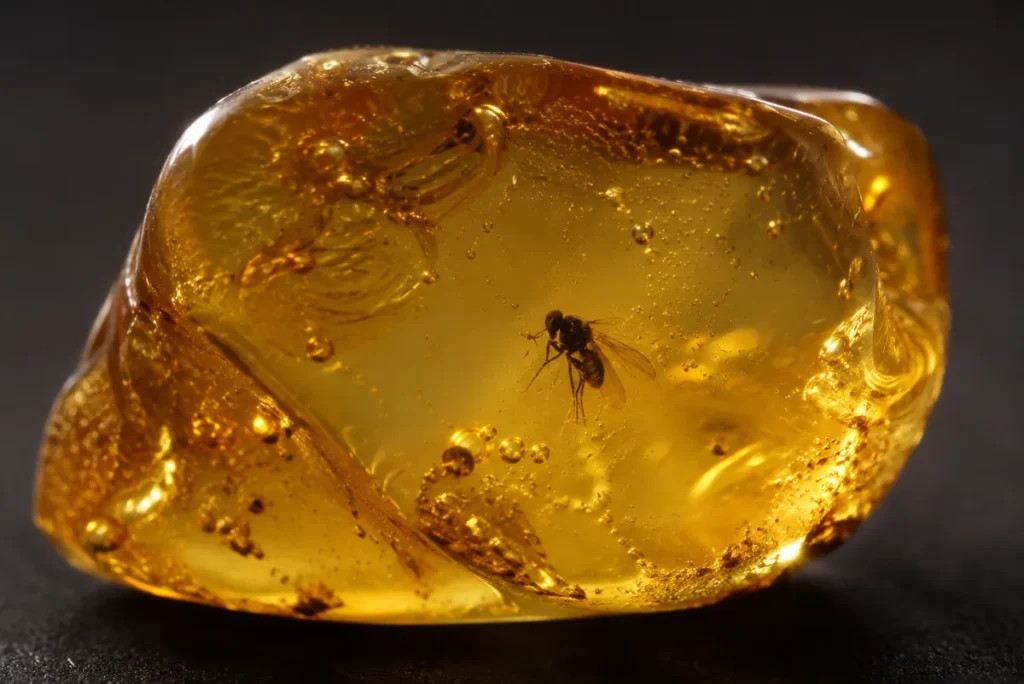
One of amber’s most fascinating characteristics is its ability to preserve material from the environment in which the original resin formed.
Insects, plant fragments, pollen, seeds, feathers, and other organic or mineral particles have all been found in amber.
A genuine fossil inclusion can be extremely valuable scientifically and commercially.
However, there is an important catch.
An inclusion does not automatically prove that amber is genuine.
Artificial inclusions can be placed inside synthetic resin, and modern insects or plant material can be embedded in imitation materials.
What matters is how the inclusion interacts with the surrounding amber.
A natural inclusion may show signs of being trapped while the resin was still fluid. It can appear partly obscured by flowing resin, surrounded by tiny bubbles, or positioned in a way that makes geological sense.
An artificial inclusion may look unnaturally clean or deliberately positioned.
If an insect appears perfectly preserved in a suspiciously pristine position inside a cheap piece of material, it deserves closer examination.
3.Examine the Inside, Not Just the Surface
One of the easiest mistakes beginners make is judging amber entirely from its surface.
A polished piece can hide many of the characteristics that would otherwise help you understand the material.
If possible, examine it under a strong light.
Hold the piece at different angles and look through it rather than simply looking at its surface.
You may notice:
- internal flow lines
- tiny bubbles
- cloudy zones
- natural fractures
- changes in transparency
- subtle variations in color
- inclusions or particles
Natural amber formed under changing environmental and geological conditions, so its interior does not always look perfectly uniform.
Again, none of these features should be treated as a definitive test.
Some synthetic materials are deliberately manufactured to reproduce the internal appearance of natural amber.
But when several natural-looking characteristics appear together, they can provide useful evidence.
4.Check How Light Passes Through the Amber
Transparency is another useful clue.
Natural amber can range from transparent to translucent and opaque.
Transparent amber allows light to pass through relatively clearly, while cloudy or milky amber scatters the light because of its internal structure.
Try placing the piece near a strong light source.
Do not focus only on whether it “glows.” Instead, observe how the light moves through the material.
Does the color change gradually?
Are there cloudy areas?
Can you see internal structures?
Are there irregular boundaries between transparent and opaque areas?
These observations can tell you more than simply asking whether the amber is clear.
5.Try the UV Light Test
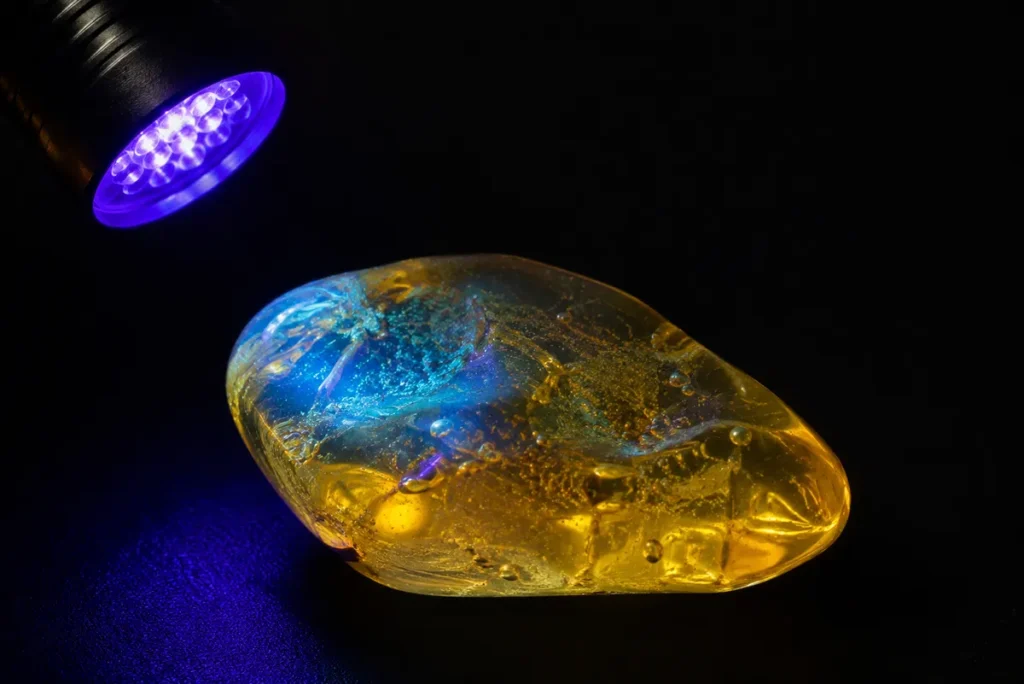
Ultraviolet light can be useful when examining amber.
Many natural ambers show fluorescence under UV light, although the exact appearance can vary considerably depending on the type and origin of the material.
Depending on the material, amber may show yellowish, bluish, greenish, or other fluorescent effects.
This can be an interesting clue, but it is important not to turn it into a yes-or-no test.
Not every genuine amber sample will produce the same UV reaction, and other materials can fluoresce as well.
So if a piece fluoresces, that does not automatically prove that it is amber.
Likewise, an unexpected UV reaction does not necessarily mean that it is fake.
UV examination is most useful when combined with other observations.
6.The Saltwater Test: Useful, but Not Definitive
The saltwater test is probably one of the most commonly recommended home tests for amber.
The basic idea is simple.
Amber has a relatively low density compared with many common stones and glass. In sufficiently concentrated saltwater, some genuine amber pieces can float.
This has made the test popular among collectors and buyers.
However, there are several reasons not to treat it as a definitive authenticity test.
The result can depend on:
- the concentration of the salt solution
- the shape and size of the piece
- whether the amber is attached to metal or other materials
- the density of the imitation
- trapped air
- the composition of the material being tested
Some plastics and other lightweight materials may also behave similarly.
In addition, a piece of amber jewelry cannot always be tested in the same way as a loose amber specimen because metal findings and other components affect its overall density.
So the correct conclusion is:
If amber floats in concentrated saltwater, it may support the identification, but it does not prove that the material is genuine amber.
This is an important distinction that is often lost in simplified online guides.
7.The Static Electricity Test
You may also hear about the static electricity test.
Amber has been known since antiquity for its ability to become electrically charged when rubbed. In fact, the ancient Greek word associated with amber, elektron, is related to the origin of the word “electricity.”
When amber is rubbed with a suitable material, it can develop static charge and attract very light particles such as small pieces of paper or dust.
This is a genuine physical property of amber.
But it is not a reliable authenticity test.
Many plastics and synthetic materials can also become statically charged.
So if a piece attracts tiny pieces of paper after rubbing, that tells you something about its electrical behavior—not necessarily its geological origin.
It can be an interesting demonstration, but it should never be used as the deciding test.
8.Be Very Careful With the Hot Needle Test
One of the most widely repeated amber tests involves heating a needle and touching the material.
We do not recommend this as a casual home test.
Heating an unknown material can:
- permanently damage the specimen
- leave a visible mark
- produce unpleasant or potentially harmful fumes
- make interpretation difficult
- damage jewelry settings or other components
Different resins, plastics, copal, and amber can produce different odors or reactions when heated, but identifying an unknown material by smell is not a safe or dependable beginner method.
If the piece has meaningful monetary or scientific value, deliberately damaging it makes little sense when non-destructive professional testing is available.
9.Does Amber Feel Warm to the Touch?
Amber often feels warmer to the touch than materials such as glass or many metals.
This is partly related to its relatively low thermal conductivity.
That can make genuine amber feel noticeably different when you hold it.
But once again, this is not an authentication test.
Some plastics and other organic materials can feel similarly warm.
Think of touch as an observation rather than evidence of authenticity.
If someone tells you that “real amber is warm and fake amber is cold,” the claim is simply too absolute.
10.Look at the Weight
Amber is unusually light compared with many traditional gemstones.
This is one reason large amber jewelry pieces can be surprisingly comfortable to wear.
If you have handled amber before, you may notice the difference immediately.
But weight by itself does not tell you whether a piece is genuine.
Several imitation materials can also be lightweight.
For a more useful assessment, density or specific gravity can be measured under controlled conditions. This is one reason professional gemological examination can provide information that simple home tests cannot.
11.Watch Out for Perfectly Round Bubbles
Bubbles inside amber deserve special attention.
Natural amber can contain bubbles, so seeing bubbles does not mean that the piece is fake.
The more useful question is what those bubbles look like and how they are distributed.
Some natural amber contains irregularly positioned bubbles and internal structures formed as resin moved and hardened.
Manufactured resin can sometimes contain large numbers of very regular, perfectly spherical bubbles.
That pattern may raise suspicion.
But even this is not conclusive.
Modern imitation materials can be manufactured specifically to mimic the internal appearance of natural amber.
This is why visual inspection works best as a process of collecting clues rather than searching for a single giveaway.
12.Check for Signs of Pressed or Reconstructed Amber
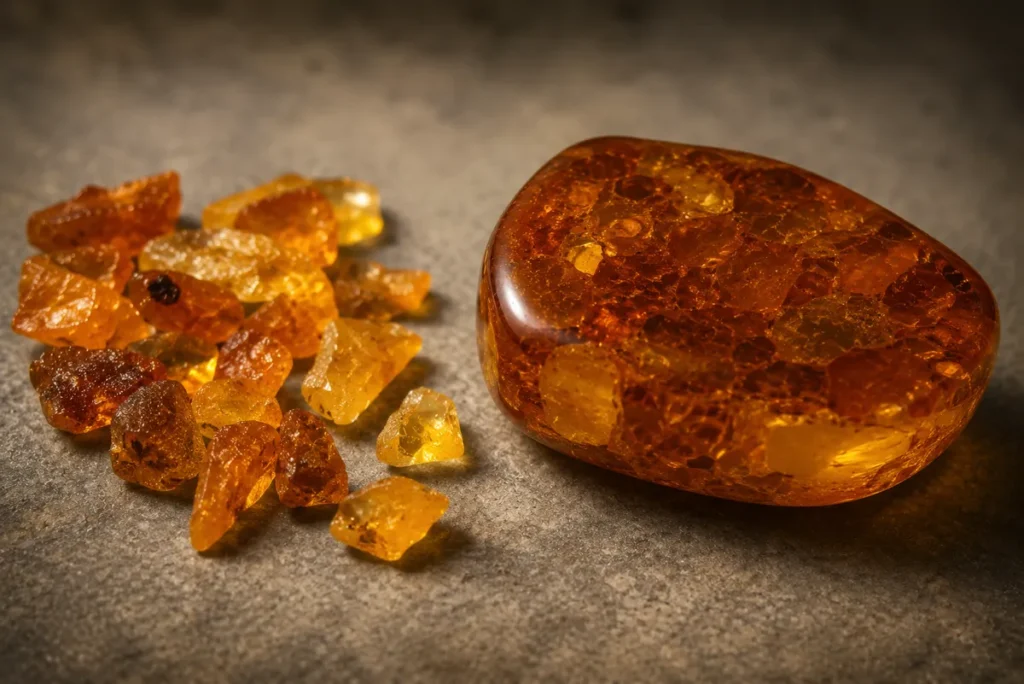
Not every piece containing genuine amber is necessarily a single, untreated piece of natural amber.
Small amber fragments can sometimes be combined using heat and pressure to create larger pieces. This material is commonly known as pressed amber or reconstructed amber.
Pressed amber can still contain genuine amber material.
The issue is therefore not simply:
real or fake?
A better set of questions is:
- Is it natural amber?
- Is it pressed or reconstructed?
- Has it been treated?
- Is it a different natural resin such as copal?
- Is it synthetic resin or plastic?
This distinction becomes especially important when buying expensive amber.
A seller should clearly describe what the material actually is.
13.Natural Amber Can Also Be Treated
Another point beginners often overlook is that genuine amber can be treated.
Treatment does not necessarily mean that the material is fake.
For example, amber may be modified to alter its color, clarity, or appearance.
Some treatments are relatively common in the jewelry trade, and certain appearances can be difficult to interpret correctly without experience.
This means that authenticity and treatment are two different questions.
A piece can be:
genuine natural amber + untreated
or:
genuine amber + treated
or:
genuine amber material + reconstructed
or:
copal
or:
synthetic resin
Those categories should not be treated as interchangeable.
For collectors and buyers, knowing exactly what you are purchasing is more useful than simply hearing the word “real.”
14.Amber vs. Plastic: What Should You Look For?
Plastic is one of the most common materials used to imitate amber.
At first glance, some pieces can be surprisingly convincing.
When comparing an unknown piece with known amber, look for differences in:
Internal appearance
Plastic may have a more uniform appearance, although some manufactured materials are designed to imitate natural inclusions and internal structures.
Surface behavior
Natural amber has a relatively low hardness and can be scratched more easily than many gemstones. However, intentionally scratching a valuable specimen is not recommended.
Weight
Amber is relatively lightweight, but some plastics are also lightweight.
UV reaction
UV fluorescence can provide useful clues, but plastics can also fluoresce.
Inclusions
A natural-looking inclusion may support an amber identification, but artificial inclusions exist.
In other words, no single difference between amber and plastic is foolproof.
The strongest approach is to combine several observations.
For a dedicated comparison, see our guide:
Amber vs. Plastic: Key Differences Explained
15.Amber vs. Copal: Don’t Confuse the Two
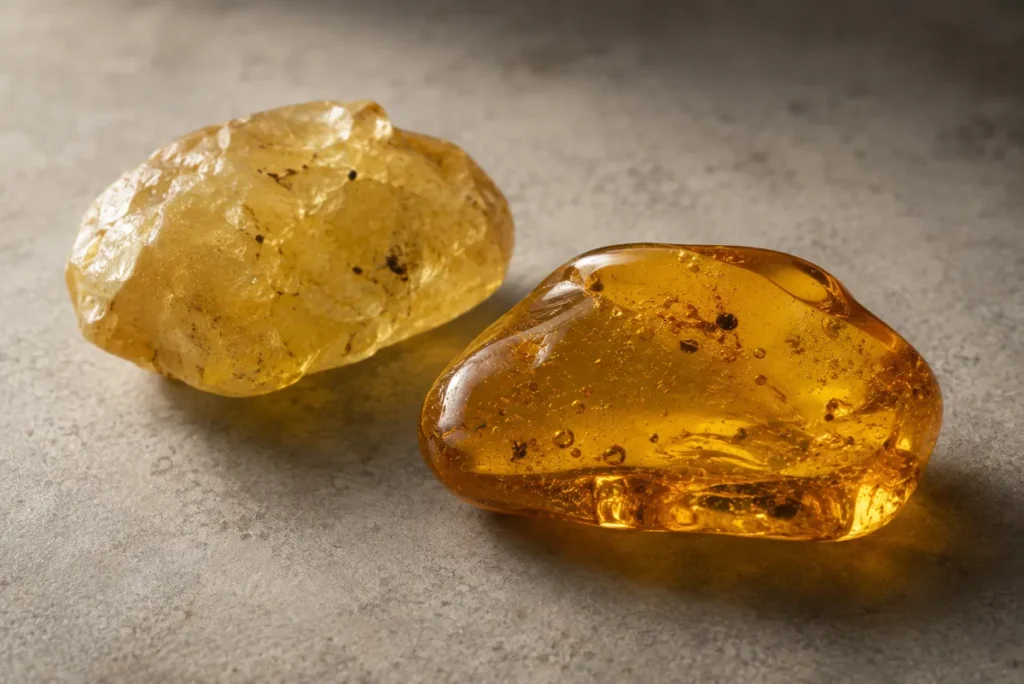
Copal deserves special attention because it is a natural resin material rather than a simple plastic imitation.
Copal is younger and less geologically mature than amber. Because of this, some copal can look remarkably similar to amber.
In fact, distinguishing between the two can be difficult, particularly when the material has been polished or treated.
This is one situation where simple home tests become particularly unreliable.
If you are dealing with a valuable piece and the distinction between amber and copal matters, professional analysis is a much better option.
You can read more in our detailed comparison of amber and copal
16.Why No Home Test Can Guarantee Authenticity
This is perhaps the most important lesson for beginners.
Many websites present one particular test as if it provides a definitive answer:
- saltwater
- UV light
- static electricity
- smell
- warmth
- bubbles
- weight
In reality, each method has limitations.
A lightweight imitation may float.
A plastic may become electrically charged.
A synthetic resin may contain bubbles.
A genuine amber sample may show an unusual UV reaction.
A treated or reconstructed material may behave differently from untreated natural amber.
That is why professional identification does not depend on one observation.
Instead, gemologists and laboratories can combine physical examination with analytical techniques such as infrared spectroscopy, microscopy, and other material-analysis methods.
These techniques can reveal information about the chemical and structural characteristics of the material that cannot be reliably determined just by looking at it.
17.When Should You Get Amber Professionally Tested?
For an inexpensive piece of amber jewelry, a basic visual inspection may be all you need.
But professional testing becomes much more worthwhile when:
- the piece is expensive
- it contains a claimed rare fossil inclusion
- the seller describes it as exceptional or investment-grade
- the origin is important
- you suspect copal or synthetic resin
- the material may be pressed or reconstructed
- the piece is being sold as rare Baltic amber
- you are buying a large specimen
- you plan to resell it
For a significant purchase, an independent gemological report can provide much more confidence than a collection of home tests.
And if the seller strongly discourages independent testing, that is worth treating as a warning sign.
18.A Simple Beginner’s Amber Checklist
If you are examining a piece of amber for the first time, don’t make the process more complicated than it needs to be.
Work through these questions:
Step 1 — Look at the color
Is the color natural-looking and varied, or unnaturally uniform?
Step 2 — Examine the interior
Look for bubbles, flow structures, cloudy areas, fractures, and other internal features.
Step 3 — Look for inclusions
If there is an insect or plant inclusion, examine how naturally it appears to sit within the material.
Step 4 — Check the weight
Amber is relatively lightweight compared with many gemstones.
Step 5 — Examine it under UV
Use UV fluorescence as supporting evidence, not proof.
Step 6 — Consider the saltwater test
If appropriate, a saltwater test can provide another clue, but it should not be treated as definitive.
Step 7 — Ask about treatment
Find out whether the material is natural, treated, pressed, reconstructed, or otherwise modified.
Step 8 — Consider the price
An unusually low price for a supposedly rare or exceptional specimen deserves closer scrutiny.
Step 9 — Check the seller’s description
A trustworthy seller should be able to explain what the material is and whether it has been treated.
Step 10 — Get professional testing when the stakes are high
If significant money is involved, laboratory identification is the safest approach.
Common Mistakes Beginners Make
Mistake 1: “It floats, so it must be real.”
Not necessarily.
Floating can support an identification, but other lightweight materials can behave similarly.
Mistake 2: “It attracts paper, so it is definitely amber.”
Again, no.
Static electricity is not unique to amber.
Mistake 3: “It glows under UV, so it must be natural Baltic amber.”
UV fluorescence can be useful, but it does not establish either authenticity or geographic origin by itself.
Mistake 4: “There is an insect inside, so it must be ancient amber.”
Artificial inclusions exist.
The inclusion itself needs to be examined, as does the surrounding material.
Mistake 5: “All transparent amber is valuable.”
Transparency can affect appearance and value, but amber value depends on much more than clarity.
Color, size, condition, inclusions, rarity, origin, craftsmanship, and market demand can all play a role.
Mistake 6: “Anything unusual must be fake.”
Natural amber is highly variable.
Unusual colors, cloudy areas, internal structures, and fluorescence do not automatically mean that a piece is synthetic.
Mistake 7: Using destructive tests on valuable amber
There is rarely a good reason to damage an expensive specimen simply to satisfy curiosity.
If the material matters financially, scientific or professional testing is the better route.
Can You Tell If Amber Is Real Just by Looking at It?
Sometimes an experienced collector can make a surprisingly accurate preliminary assessment simply by examining a piece.
But there is an important difference between recognizing likely amber and proving authenticity.
A trained eye can notice combinations of characteristics that a beginner might overlook.
Still, visual examination has limits.
A sophisticated imitation may be convincing, while a genuine but unusual piece may look suspicious to someone unfamiliar with natural amber.
That is why professional identification becomes important when the value or rarity of the material is high.
Final Thoughts: The Best Way to Identify Real Amber
Learning how to tell if amber is real is less about finding a single perfect test and more about learning how natural amber behaves and looks.
Start with the simplest observations.
Look carefully at the color and transparency. Examine the interior. Pay attention to bubbles, flow structures, and inclusions. Consider the weight and feel of the material. UV light and a carefully performed saltwater test can provide additional clues.
But don’t stop there.
Saltwater, static electricity, UV fluorescence, warmth, and appearance can all be useful pieces of evidence, yet none should be treated as absolute proof.
And when a piece is expensive, unusually rare, or claimed to contain an important fossil inclusion, professional testing is worth the extra effort.
Perhaps the most useful habit you can develop as an amber buyer is simply this:
Don’t ask only, “Does this look like amber?” Ask, “What evidence supports that identification?”
That small change in thinking can help you avoid many of the most common mistakes when buying or collecting amber.
Frequently Asked Questions
How can I tell if amber is real at home?
Start with visual examination. Look at the color, transparency, internal structures, bubbles, and inclusions. You can also use UV light or a carefully prepared saltwater test as supporting methods. However, no home test can guarantee authenticity.
Does real amber float in saltwater?
Some genuine amber can float in sufficiently concentrated saltwater because of its relatively low density. However, some imitation materials can behave similarly, so floating should not be considered definitive proof.
Does real amber glow under UV light?
Many types of amber fluoresce under ultraviolet light, but the color and intensity can vary. Other materials can also fluoresce, so UV testing is best used as supporting evidence.
Does real amber attract paper?
Amber can develop static electricity when rubbed and may attract very light objects. However, plastics can do the same, so the static test cannot prove that a piece is genuine amber.
Can fake amber contain insects?
Yes. Artificial inclusions can be placed inside synthetic resin and other imitation materials. The presence of an insect does not automatically prove that the surrounding material is natural amber.
What is the difference between amber and copal?
Both are natural resin materials, but amber has undergone much greater geological maturation. Copal is generally younger and less mature. Some specimens can be difficult to distinguish without professional analysis.
Is pressed amber real amber?
Pressed amber is made from genuine amber fragments that have been combined, typically using heat and pressure. It is different from a single piece of naturally formed amber and should be described accurately when sold.
What is the most reliable way to identify amber?
For valuable or uncertain specimens, professional gemological examination is the most reliable approach. Laboratories can use microscopy and analytical techniques such as infrared spectroscopy to examine the material more closely.
Sources & Further Reading
For readers who want to go beyond simple home tests, useful references include gemological research and educational material on amber’s physical properties, inclusions, treatments, and analytical identification.
You can also continue exploring the subject through our amber guides: