If you’re completely new to amber, you may want to start with our [complete beginner’s guide to amber].
Amber is often displayed alongside gemstones.
You will find it in jewelry stores, mineral collections, museums, and gem shops. It is polished, graded, carved, and sometimes described as a gemstone.
But there is something unusual about amber.
Unlike quartz, sapphire, or diamond, amber was never a mineral crystal formed deep inside the Earth.
So what exactly is it?
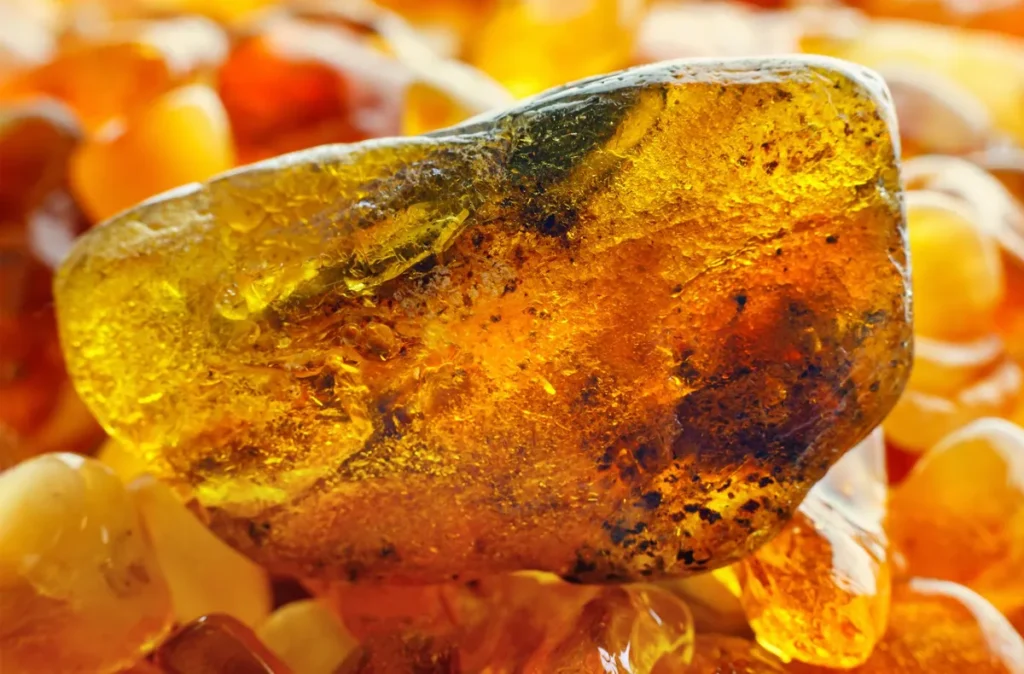
Amber is fossilized natural plant resin.
It is an organic material that began as resin produced by ancient plants and was gradually transformed and preserved through geological time.
That makes amber very different from most materials we casually call “stones.”
It may look like a stone, feel somewhat like a stone, and be sold as a gemstone—but scientifically, amber belongs to a different category.
In this guide, we’ll look at what amber really is, whether it can technically be called a stone, how it differs from minerals, and why it is still considered a gemstone by the jewelry industry.
The Short Answer: Is Amber a Stone or Resin?
Amber is fossilized plant resin, not a mineral.
The original material was resin produced by plants millions of years ago. After being buried and preserved, the resin underwent chemical and physical changes over geological time.
So, if you want the most scientifically accurate description:
Amber is a fossilized organic resin.
It is not a mineral in the same sense as quartz, feldspar, or diamond.
However, amber is commonly classified and sold as an organic gemstone.
This is why you may hear both descriptions:
- Natural resin
- Fossil resin
- Fossilized resin
- Organic gemstone
They are describing different aspects of the same material.
What Is Amber Made Of?
Amber is made primarily from organic compounds derived from plant resin.
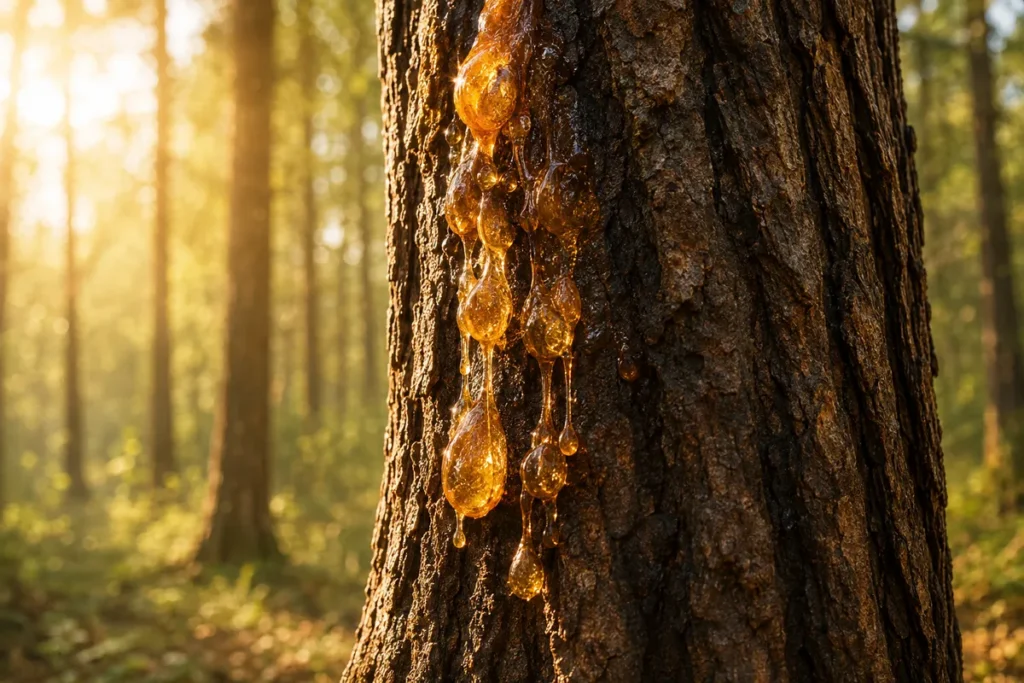
Fresh resin is produced by living plants as part of their natural defense system. When a tree is injured, for example, resin may flow from the damaged area and help protect the exposed tissue.
That fresh resin contains a complex mixture of organic compounds.
If the resin survives long enough to become buried and preserved, its chemical composition gradually changes.
Volatile components can be lost, molecules can react with one another, and the structure of the resin can become increasingly stable.
Over millions of years, these processes can produce amber.
The result is a material that still carries the chemical legacy of the original plant resin, but is very different from the sticky substance that first came out of the tree.
Is Amber a Mineral?
No.
This is one of the most important distinctions to understand.
A mineral is generally defined as a naturally occurring, inorganic solid with an ordered internal structure and a characteristic chemical composition.
Amber does not fit that definition.
It is:
- Organic rather than inorganic
- Derived from biological material
- Non-crystalline
- Formed from plant resin rather than geological mineral crystallization
Quartz, for example, is a mineral with a crystalline structure.
Diamond is also a mineral.
Amber is not.
Instead, amber belongs to the broader world of organic gem materials.
Why Is Amber Called a Gemstone?
This is where everyday language and scientific classification can overlap.
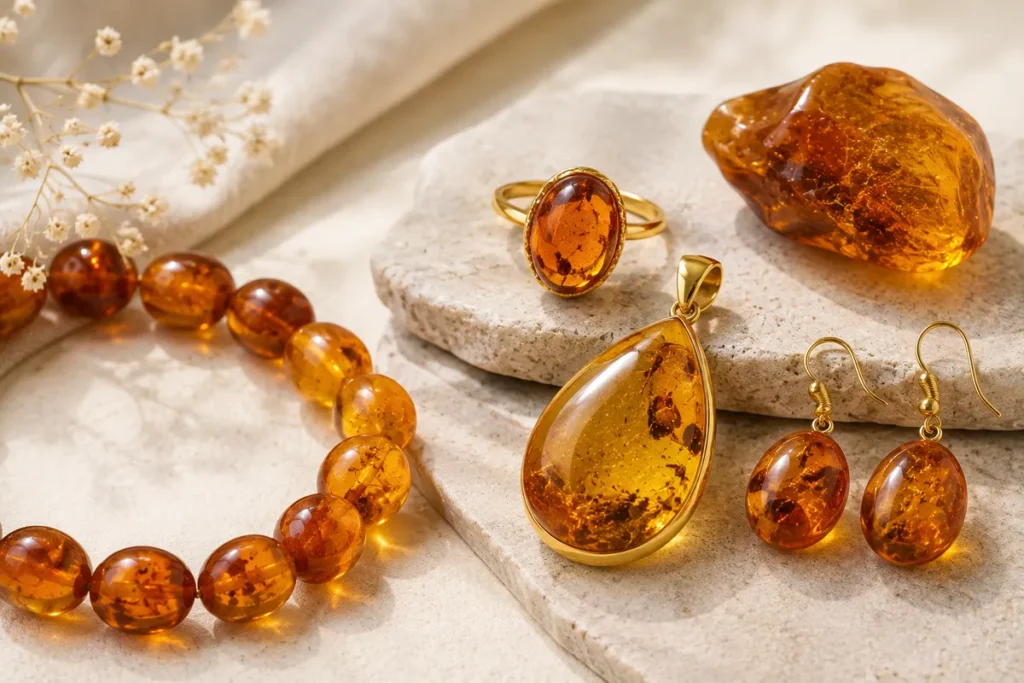
In jewelry, the word gemstone is used more broadly than the word “mineral.”
A gemstone is generally a natural material that can be cut, polished, or otherwise worked for decorative use.
That includes some materials that are not minerals.
Examples of organic gem materials include:
- Amber
- Pearl
- Coral
- Jet
- Shell
These materials have different origins, but they can all be used in jewelry and decorative objects.
So calling amber a gemstone is perfectly normal in the jewelry world.
The important distinction is that amber is an organic gemstone, not a mineral gemstone.
How Does Amber Form?
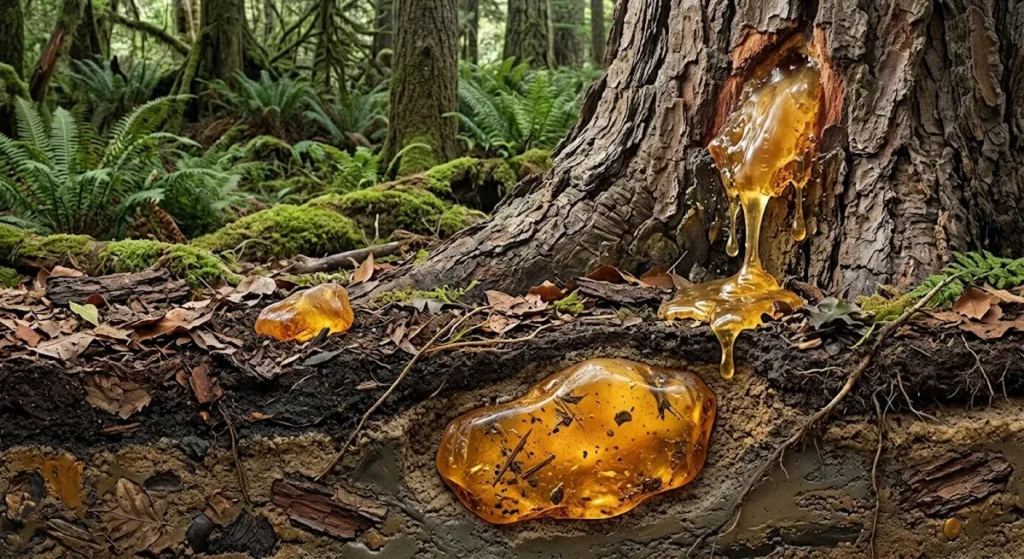
Amber begins with resin.
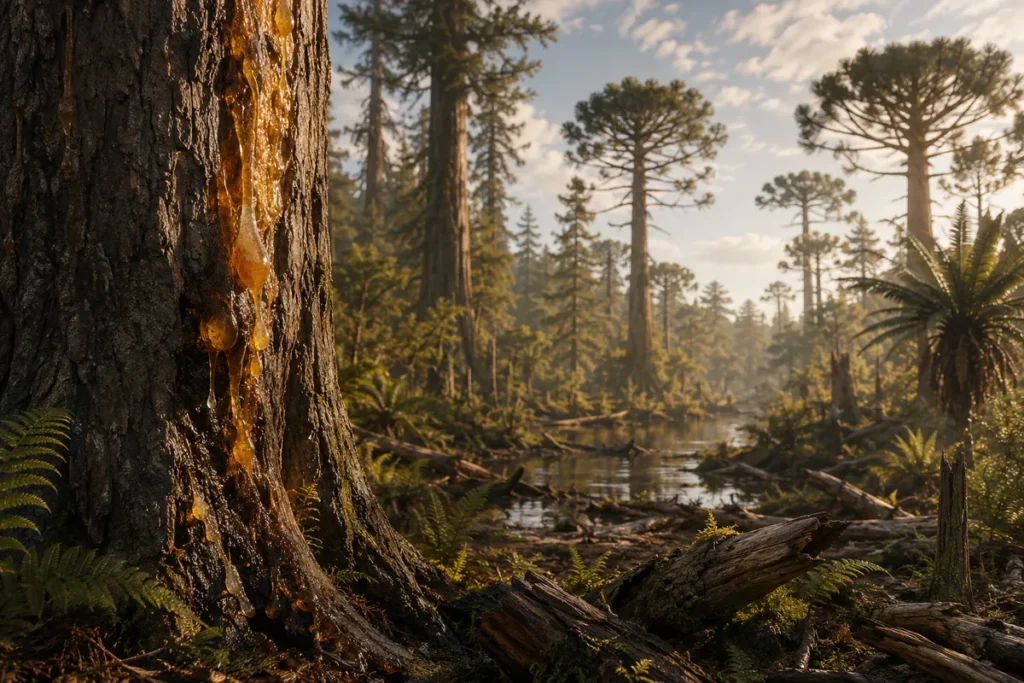
Millions of years ago, plants produced resin in ancient forests. Some of that resin accumulated in environments where it could survive instead of decomposing completely.
The resin was eventually buried beneath sediment.
Burial protected portions of the material from the surface environment and allowed geological and chemical processes to take place.
Over very long periods, the resin changed.
The transformation involved much more than simply drying out. Its chemical structure evolved as it was subjected to geological conditions over time.
Eventually, some of these ancient resins became the stable fossil material we recognize as amber.
If you’d like to explore this process in more detail, see our guide to [How Is Amber Formed?].
Is Amber Made From Tree Sap?
This is a common misconception.
Amber is not simply fossilized tree sap.
People often use “tree sap” as a general term, but sap and resin are not the same thing.
Sap
Sap transports water, minerals, sugars, and other substances through a plant.
Resin
Resin is a different substance. Plants produce resin as part of their defense and protective systems.
Amber originates from resin, not ordinary tree sap.
This distinction may sound small, but it is important if you want to understand where amber actually comes from.
A more accurate phrase is:
Amber is fossilized ancient plant resin.
Is Amber Fossilized Tree Resin?
Yes, although the full story is slightly more complicated.
Amber is generally understood as fossilized or geologically matured plant resin.
The original resin came from ancient plants, but the exact botanical sources varied depending on the deposit and geological period.
For example, Baltic amber is strongly associated with ancient forests that existed in northern Europe during the Eocene Epoch.
The resin from these forests eventually became part of the geological deposits that are now famous for producing Baltic amber.
So when you look at a piece of Baltic amber, you’re looking at material that began its history as ancient plant resin.
Is Amber a Fossil?
Amber is commonly described as a fossil resin.
But it is different from fossils such as dinosaur bones or fossilized shells.
A dinosaur bone becomes preserved through mineralization and replacement processes.
Amber follows a different path.
The original organic resin itself is preserved and chemically transformed.
This is why amber is sometimes described as an organic fossil or fossil resin.
It is also one of the rare fossil materials that can preserve organisms in three dimensions.
An insect trapped in amber may retain remarkably detailed structures, including wings, legs, antennae, and body segments.
Why Are Insects Found Inside Amber?
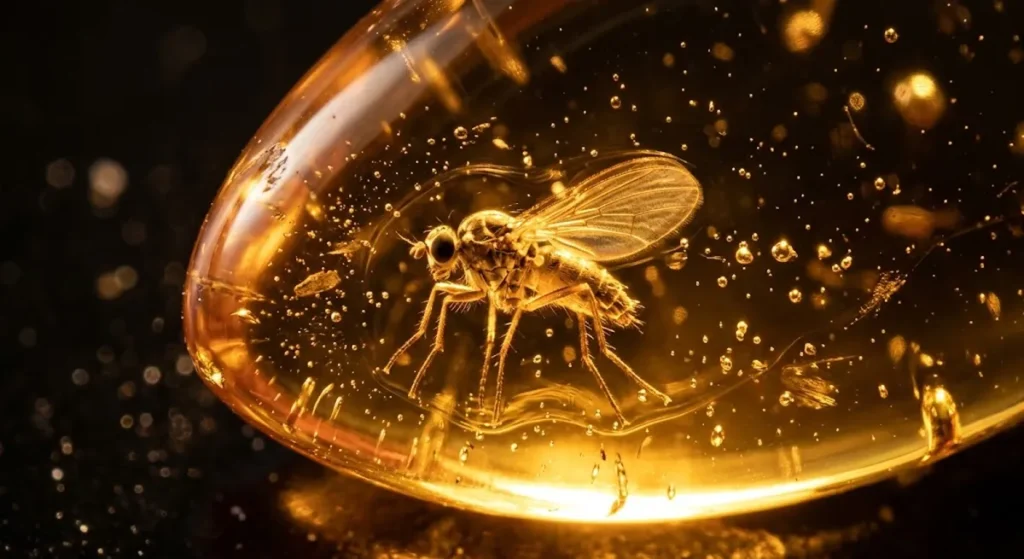
The answer begins with the sticky nature of fresh resin.
Imagine a small insect walking across the bark of a tree millions of years ago.
If it encounters fresh resin, it may become trapped.
More resin can flow over the insect, enclosing it within the material.
If the resin is subsequently preserved and buried, the insect may remain trapped as the resin undergoes geological transformation.
This is one reason amber is so valuable to paleontologists and other researchers.
It doesn’t merely preserve the hard parts of organisms.
Under favorable conditions, it can preserve incredibly detailed structures of ancient organisms.
However, remember what we discussed in the previous article:
An insect inside a resin specimen does not automatically prove that the material is amber.
Copal can also contain insects because it is younger natural resin.
For more on this distinction, see our guide to [Amber vs. Copal].
Is Baltic Amber a Mineral?
No.
Baltic amber is still fossilized plant resin rather than a mineral.
The word “Baltic” describes its geographic and geological association with the Baltic region.
Much Baltic amber is associated with Eocene-age deposits and is tens of millions of years old.
Its age and geological history are part of what makes it so interesting.
If you want to understand where Baltic amber comes from, see our guide to [Where Does Baltic Amber Come From?].
What Makes Amber Different From Ordinary Stones?
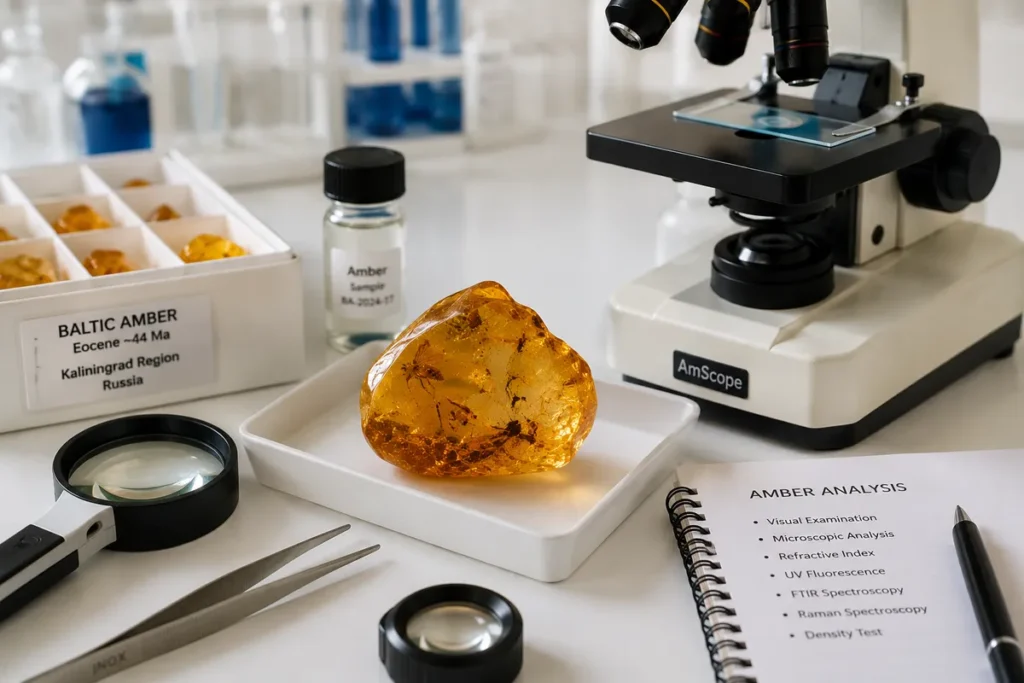
Amber has several properties that immediately distinguish it from many common rocks and minerals.
It is very light
Amber has a relatively low density compared with most common gemstones and rocks.
This is one reason it can feel surprisingly light when held.
It can be warm to the touch
Because amber does not conduct heat like many metals and stones, it can quickly feel warm in the hand.
This is not proof of authenticity, but it is one of its familiar physical characteristics.
It can develop static electricity
When amber is rubbed with certain materials, it can become electrically charged and attract lightweight objects.
The ancient Greeks noticed this unusual behavior.
In fact, the English word electricity ultimately has a connection to the Greek word elektron, which referred to amber.
It is relatively soft
Amber is considerably softer than many traditional gemstones.
This makes it relatively easy to carve and polish, but it also means that amber jewelry needs appropriate care.
Amber vs. Quartz: What’s the Difference?
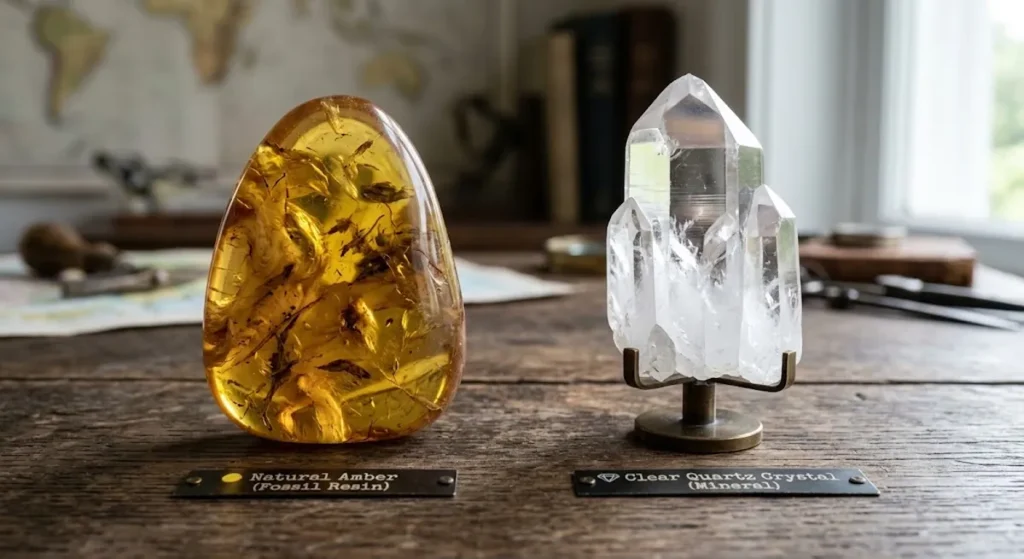
Quartz is a mineral.
Amber is an organic fossil resin.
The differences are fundamental.
| Property | Amber | Quartz |
| Origin | Ancient plant resin | Geological mineral formation |
| Classification | Organic gemstone | Mineral |
| Structure | Non-crystalline | Crystalline |
| Composition | Complex organic compounds | Silicon dioxide |
| Hardness | Relatively soft | Much harder |
| Typical appearance | Golden, yellow, orange, brown, cloudy, etc. | Wide range of colors and varieties |
| Organic inclusions | Can preserve insects and plants | Generally not preserved in the same way |
The two may both be polished and used in jewelry, but scientifically they belong to very different categories.
Amber vs. Glass: Are They Similar?
Amber can sometimes look surprisingly similar to colored glass.
Both can be:
- Transparent
- Golden
- Highly polished
- Smooth
- Visually glossy
But their origins are completely different.
Glass is manufactured by humans from inorganic materials.
Amber is a naturally occurring fossil organic material.
This is one reason identification matters when purchasing expensive amber jewelry.
A beautiful golden appearance by itself does not establish what a material actually is.
Is Amber a Precious Stone?
Amber is generally not classified as a precious stone in the traditional sense.
The traditional precious gemstones are:
- Diamond
- Ruby
- Sapphire
- Emerald
Amber is usually grouped with organic gemstones or other gem materials.
That doesn’t mean amber is unimportant or inexpensive.
Rare amber specimens, unusual colors, large pieces, and exceptional inclusions can command significant prices.
Its value comes from characteristics that are very different from those used to evaluate diamonds or other traditional precious gemstones.
What Determines the Value of Amber?
Amber value depends on several factors.
Color
Golden yellow, honey, orange, cognac, creamy white, and other natural colors can have different levels of demand.
Transparency
Some buyers prefer clear amber, while others appreciate cloudy or opaque material.
Inclusions
Insects, plants, and other inclusions can make certain specimens particularly interesting to collectors.
Size
Large natural pieces can be considerably more unusual than small fragments.
Condition
Cracks, chips, weathering, polishing quality, and surface condition all affect value.
Origin
Geographic origin can matter, particularly for collectors interested in Baltic amber or other well-known deposits.
Craftsmanship
For jewelry, the quality of cutting, polishing, setting, and overall design also contributes to the final price.
So there is no single price per gram that applies to all amber.
Does Amber Count as a Gemstone in Jewelry?
Yes.
Amber has been used in jewelry for thousands of years.
It can be cut into:
- Beads
- Pendants
- Rings
- Earrings
- Bracelets
- Necklaces
- Carvings
- Decorative objects
Its relatively low density also makes large amber jewelry surprisingly comfortable to wear.
This combination of beauty, light weight, and ancient origin has helped amber remain popular across generations.
Is Amber Considered a Rock?
Strictly speaking, amber is not a rock.
Rocks are naturally occurring solid aggregates of one or more minerals or mineraloid materials.
Amber is an organic material derived from plant resin.
In everyday conversation, someone might casually call amber a “stone” because it is a hard natural material used in jewelry.
That is understandable.
But scientifically, fossil resin or organic gemstone is more accurate.
Why Does Amber Feel Different From Other Gemstones?
Pick up a piece of amber and you may notice that it doesn’t feel quite like quartz or glass.
It is unusually light.
It can warm quickly in your hand.
Its surface often has a softer, more organic appearance.
And when illuminated, amber can glow rather than simply reflect light.
These qualities are part of what makes amber distinctive.
Its appearance also reflects its biological origin.
Even highly polished amber often retains subtle internal features—tiny bubbles, flow lines, clouds, particles, and inclusions—that hint at the resin from which it originated.
Can Amber Be Considered a Natural Material?
Absolutely.
Natural amber forms through geological processes without being manufactured by humans.
However, the commercial amber market includes other forms of material as well.
You may encounter:
- Natural amber
- Pressed or reconstructed amber
- Treated amber
- Amber composites
- Imitation amber
These materials should not automatically be treated as equivalent.
When buying amber, particularly higher-value material, it is important to understand exactly what the seller means by “natural amber.”
Is Pressed Amber Still Amber?
Pressed or reconstructed amber is made by combining smaller pieces of amber under controlled conditions.
The resulting material can be shaped into larger pieces.
It is different from a single natural piece of amber, but it is not necessarily the same thing as a completely synthetic imitation.
The key issue is accurate disclosure.
If a piece has been reconstructed, the buyer should be told.
This distinction becomes especially important when a product is being sold as a valuable natural specimen.
Why Amber Is More Than Just a Pretty Gemstone
Perhaps the most interesting thing about amber is that its value isn’t limited to appearance.
Amber can preserve evidence of ancient ecosystems.
An inclusion may contain:
- Insects
- Spiders
- Plant fragments
- Pollen
- Fungi
- Other organic material
These inclusions can provide researchers with information about environments that existed millions of years ago.
A small piece of amber can therefore function almost like a tiny time capsule.
It can preserve a moment from an ancient forest long after the forest itself has disappeared.
Is Amber “Alive” Because It Comes From Trees?
No.
The fact that amber originated from a living plant does not mean that it remains biologically active.
The resin has undergone geological transformation and is no longer living plant tissue.
However, its organic origin is still visible in its chemistry and, sometimes, in the inclusions preserved inside it.
This is what makes amber unusual among materials used in jewelry.
It carries a biological history rather than simply a mineralogical one.
So, Is Amber a Real Stone?
If by “real stone” you mean a naturally occurring material that can be cut and polished for jewelry, then people may casually use the term stone.
But if you’re asking from a scientific perspective, the answer is different.
Amber is not a mineral stone.
It is a natural fossilized plant resin and is generally classified as an organic gemstone.
That distinction doesn’t make amber less valuable.
If anything, its unusual origin is part of what makes it so fascinating.
A diamond tells the story of extreme pressure and geological conditions deep within the Earth.
Amber tells the story of ancient forests, living plants, resin, burial, geological time, and sometimes the organisms that became trapped inside it.
They are simply different kinds of natural treasures.
Frequently Asked Questions
Is amber a stone or resin?
Amber is fossilized natural plant resin. It is commonly used as an organic gemstone but is not a mineral stone.
Is amber a mineral?
No. Amber is organic and does not have the crystalline structure characteristic of minerals such as quartz.
Is amber made from tree sap?
No. Amber originates from plant resin, not ordinary tree sap.
Is amber a fossil?
Amber is commonly described as fossil resin or an organic fossil because it is ancient biological material preserved and transformed through geological time.
Is Baltic amber a real gemstone?
Yes. Baltic amber is a natural organic gemstone associated with amber-bearing deposits in the Baltic region.
Is amber considered a precious stone?
Amber is generally classified as an organic gemstone rather than one of the traditional precious stones such as diamond, ruby, sapphire, or emerald.
Why is amber so light?
Amber has a relatively low density compared with many rocks and gemstones, which gives it its characteristic light weight.
Can amber contain insects?
Yes. Insects and other organisms can become trapped in fresh resin and later be preserved as inclusions.
Is copal the same as amber?
No. Copal is generally younger and less geologically mature natural resin. Amber has undergone greater geological maturation.
Is amber natural?
Natural amber forms from ancient plant resin through geological processes. However, the market also contains reconstructed, treated, and imitation materials, so accurate identification and disclosure are important.
Final Thoughts
Amber doesn’t need to be a mineral to be a gemstone.
Its story simply follows a different path.
Long before it appeared in a necklace, pendant, or museum case, amber began as resin produced by an ancient plant. Some of that resin survived, became buried, and gradually changed through geological time.
Millions of years later, we recognize the result as amber.
So the next time someone asks whether amber is a stone or resin, the most accurate answer is simple:
Amber is fossilized plant resin—and an organic gemstone.
It may sit beside traditional gemstones in a jewelry case, but its origin is completely different.
And perhaps that is exactly what makes it worth knowing.