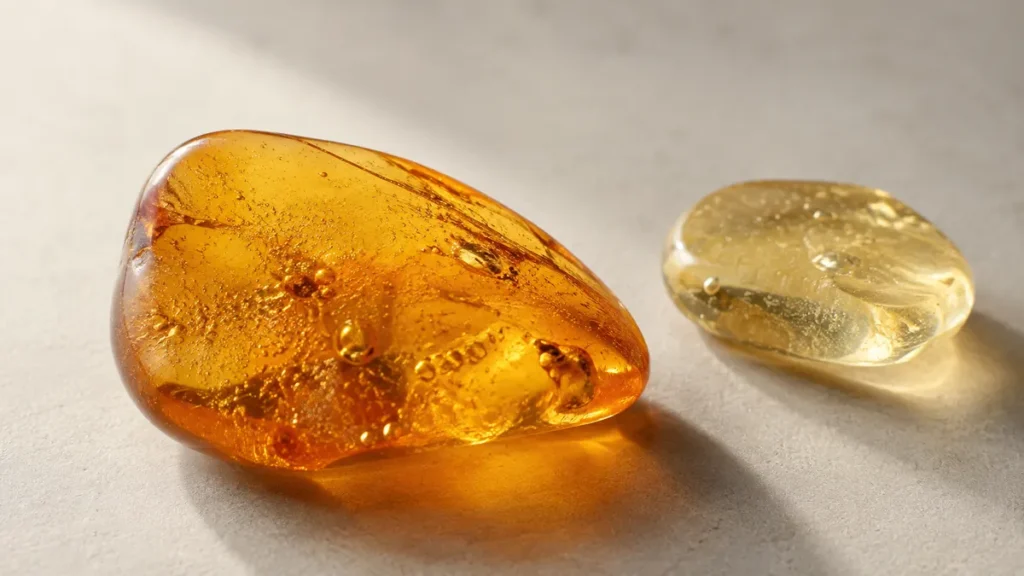
At first glance, amber and plastic can be surprisingly difficult to distinguish.
A piece of amber jewelry may have a smooth, polished surface, a warm golden color, and a perfectly ordinary appearance. A well-made plastic imitation can reproduce many of those same characteristics at a fraction of the cost.
That is why simply looking at the color is rarely enough.
Natural amber has a combination of physical and visual characteristics that can help distinguish it from plastic. Its internal structure, weight, texture, inclusions, fluorescence, and response to certain tests can all provide useful clues.
But there is an important point to keep in mind from the beginning:
No single home test can prove that a piece is genuine amber.
Some plastics are lightweight. Some can develop static electricity. Some contain bubbles. Some may even fluoresce under ultraviolet light.
The most reliable approach is to look at several characteristics together and, when the value of the piece justifies it, have the material professionally examined.
If you’re starting from the basics, our guide on [how to tell if amber is real] can help you understand the broader authentication process before comparing amber with a specific imitation material.
Amber vs. Plastic: What’s the Difference?
The fundamental difference is simple.
Amber is a natural fossil resin that formed over geological time. Plastic is a man-made synthetic material.
That difference affects their physical and internal characteristics, but it does not always produce an obvious visual difference.
Natural amber can contain:
- tiny bubbles
- natural flow structures
- cloudy areas
- internal fractures
- plant material
- insects and other inclusions
- subtle variations in color and transparency
Plastic can be manufactured to imitate some of these features.
For that reason, the question is not simply whether the piece “looks natural.”
To better understand what amber actually is and how it relates to resin, see our guide on whether amber is a real stone or resin.
Instead, you want to ask:
Does the material show a consistent combination of characteristics expected from natural amber?
That is a much more useful way to approach identification.
1.Look at the Color — But Don’t Rely on It
Color is usually the first thing people notice.
Natural amber is often associated with warm yellow, honey, orange, and reddish-brown tones. It can also occur in milky or opaque forms, darker shades, and some unusual varieties with distinctive optical effects.
Plastic imitations can reproduce almost any of these colors.
This means that color alone tells you very little.
A very bright yellow piece is not necessarily fake, and a muted brown piece is not necessarily genuine.
Instead of asking whether the color “looks like amber,” look for variation within the material.
Natural amber may show subtle changes in tone, transparency, and internal structure. The color can become lighter or darker in different areas, particularly around inclusions, cracks, or cloudy regions.
A highly uniform appearance can be worth investigating, especially when combined with other suspicious characteristics.
But it should never be treated as proof of imitation.
2.Examine the Internal Structure
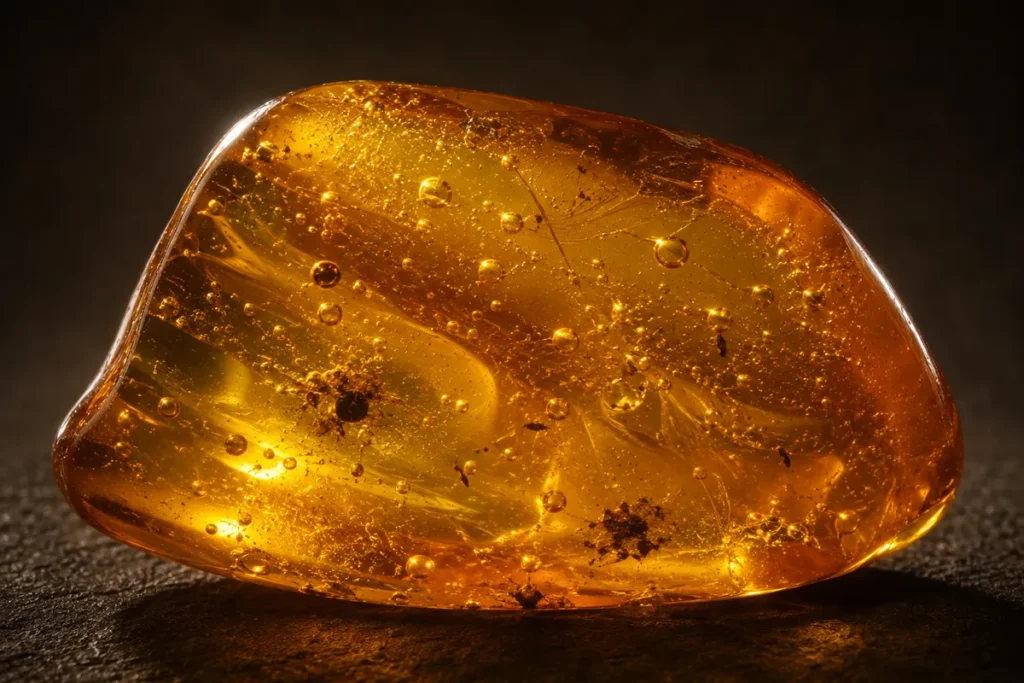
If you have access to a strong light, one of the most useful things you can do is look through the piece.
Natural amber is not necessarily perfectly uniform inside.
Depending on the specimen, you may see:
- small bubbles
- cloudy regions
- flow lines
- tiny particles
- internal fractures
- areas of different transparency
- natural inclusions
These features formed during the history of the resin and its subsequent geological transformation.
Plastic can also contain bubbles or internal patterns, however, especially when it has been manufactured specifically to imitate amber.
So don’t make the mistake of thinking:
“Bubbles = real amber.”
The more useful question is whether the overall internal structure looks consistent with a natural material.
A collection of perfectly uniform bubbles, for example, may be more suspicious than a varied distribution of irregular internal features.
3.Look for Natural Inclusions
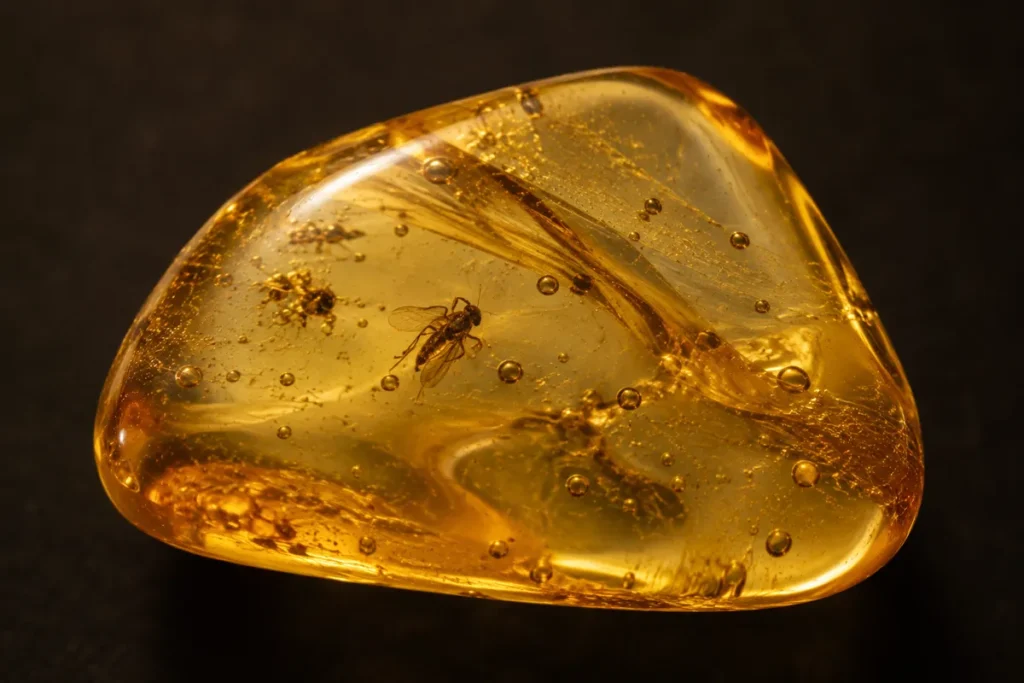
Natural inclusions are among the most fascinating features found in amber.
Insects, plant fragments, pollen, seeds, and other small particles can become trapped in resin before it hardens and eventually undergoes geological transformation.
If you see an inclusion inside a piece of amber, examine it carefully.
A natural inclusion may appear slightly distorted by the surrounding resin. It may be positioned at an unusual angle, surrounded by tiny bubbles, or partly obscured by internal flow structures.
However, an inclusion is not automatic proof of authenticity.
Artificial inclusions can be placed inside synthetic resin, including modern insects and plant material.
A perfectly preserved insect inside an unusually inexpensive piece should therefore make you more curious, not automatically more confident.
The surrounding material needs to be examined as well.
4.Compare the Weight
Amber is relatively lightweight.
This is one reason a large amber necklace or pendant can feel surprisingly light compared with jewelry made from glass or many mineral gemstones.
Plastic can also be lightweight, so weight is useful only as part of a broader assessment.
If you are comparing two visually similar pieces, however, the difference can sometimes be noticeable.
For a more scientific comparison, density or specific gravity can be measured rather than relying on how heavy something feels in your hand.
This is one reason professional testing can provide much more useful information than informal home experiments.
5.Pay Attention to How It Feels in Your Hand
Natural amber often feels relatively warm and light compared with glass or metal.
This is related in part to amber’s low thermal conductivity.
Plastic can behave similarly.
So if somebody tells you:
“Real amber feels warm, while plastic feels cold.”
that is an oversimplification.
The sensation can provide a small clue, but it cannot identify the material.
Think of touch as a way of noticing a difference, not as a test that produces a definitive answer.
6.Try the UV Light Test
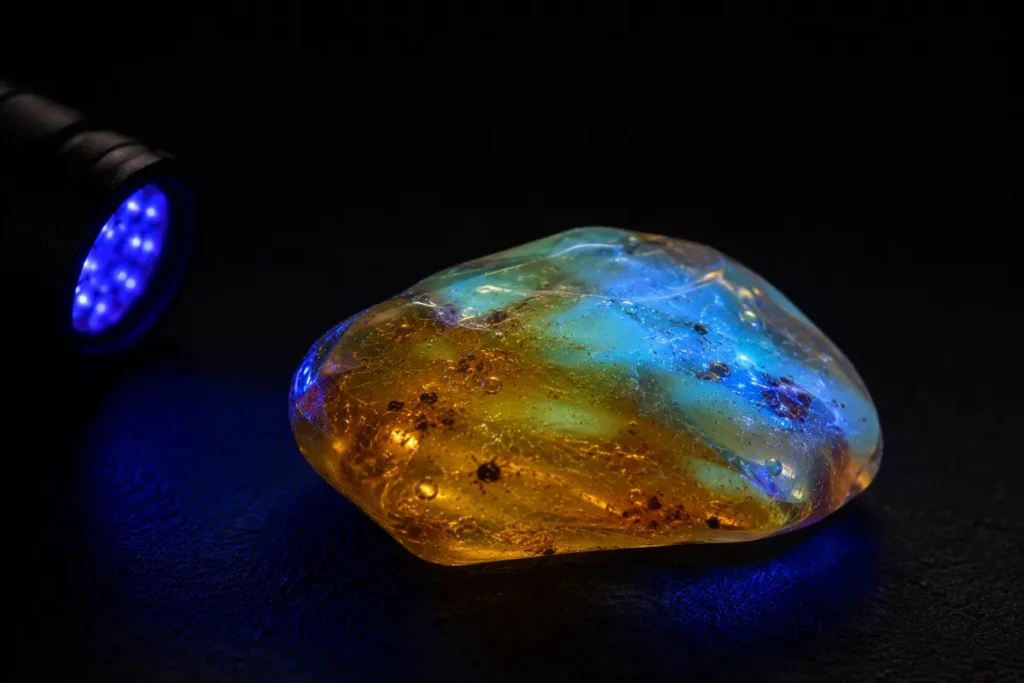
Ultraviolet light is one of the more interesting tools available to amber collectors.
Many natural ambers show fluorescence under UV light, although the exact appearance varies depending on the material.
Depending on the type of amber and the lighting conditions, fluorescence may appear yellowish, bluish, greenish, or in other tones.
This can be useful when comparing an unknown sample with known amber.
But there is an important limitation:
Plastic can also fluoresce.
The absence, presence, or color of fluorescence should therefore not be treated as a simple “real or fake” answer.
UV light works best when used alongside visual examination and other physical observations.
7.What About the Saltwater Test?
The saltwater test is probably the most famous home test associated with amber.
The principle is based on density.
Amber is relatively low in density, and some genuine amber pieces can float in sufficiently concentrated saltwater.
That sounds straightforward, but the test has limitations.
The result can be affected by:
- the concentration of the solution
- the size and shape of the piece
- whether it is loose amber or finished jewelry
- the presence of metal components
- the density of the imitation material
Some lightweight plastics may also float.
For that reason:
Floating in saltwater can support an amber identification, but it does not prove that the material is genuine amber.
This distinction is important.
A simple test can be useful without being definitive.
8.Static Electricity Is Not a Reliable Amber Test
Amber is famous for its ability to become electrically charged when rubbed.
This property has been known for thousands of years and is closely connected to the historical origin of the word “electricity.”
Rubbed amber can attract very lightweight objects such as small pieces of paper.
It is a fascinating property.
But it is not unique to amber.
Many plastics can also build up static electricity.
So if a piece attracts paper after being rubbed, you have learned something about its electrical behavior, but not necessarily its geological origin.
For identification purposes, static electricity is therefore a supporting observation at best.
9.Be Careful With Scratch Tests
You may find advice online suggesting that you should scratch amber with a needle, knife, fingernail, or another object to see how easily it marks.
This is not something I recommend for valuable amber.
Amber is relatively soft compared with many gemstones, but deliberately scratching a piece can permanently damage the surface.
The same applies to aggressive cutting, scraping, or other destructive experiments.
If the piece is inexpensive and you are simply experimenting with an unknown material, the consequences may be minor.
If it is an expensive specimen, however, damaging it in the name of authentication makes little sense.
There are better ways to investigate the material.
10.Avoid the Hot Needle Test
Another commonly mentioned method involves heating a needle and touching it to the material.
This test has been repeated in amber identification guides for years, but it is not a good choice for most beginners.
The problem is not only that it is destructive.
Heating an unknown plastic or resin can produce unpleasant fumes, and the resulting smell or surface reaction can be difficult to interpret accurately.
You may also leave a permanent mark on the specimen.
If you’re dealing with valuable amber, it is much better to use non-destructive examination or professional testing.
11.Don’t Judge by Transparency Alone
Transparent amber can be especially beautiful, and clear material is often highly sought after.
But transparency does not determine authenticity.
Natural amber can be:
- transparent
- translucent
- cloudy
- milky
- partially opaque
Plastic can be manufactured to imitate all of these appearances.
In fact, some natural amber specimens are so clear that a beginner may assume they must be synthetic simply because they look unusually perfect.
The opposite can also happen.
A manufacturer can deliberately introduce cloudiness or bubbles into plastic to make it look more natural.
So transparency is a characteristic—not a verdict.
12.Look Closely at the Bubbles
Bubbles can be useful clues when examining an unknown piece.
Natural amber can contain bubbles trapped during the formation and movement of the original resin.
These bubbles may vary in size, shape, and position.
Manufactured materials can also contain bubbles, but their distribution may sometimes look noticeably different.
For example, a suspicious piece may contain large numbers of extremely regular spherical bubbles arranged throughout the material.
That can raise questions.
But again, modern synthetic materials can be surprisingly sophisticated.
A convincing imitation may deliberately reproduce internal features that once would have been considered obvious signs of natural amber.
This is why bubble examination should never be used alone.
13.Check the Surface
The surface can provide another small piece of evidence.
Natural amber is relatively soft compared with materials such as quartz or glass. Polished amber can therefore develop small scratches or signs of wear over time.
Plastic varies considerably in hardness and composition, so there is no single surface behavior shared by every plastic imitation.
A heavily worn piece of amber may have a different visual character from a newly polished synthetic imitation.
But surface condition is strongly influenced by how the object has been used.
A necklace worn every day will naturally look different from a specimen kept in a display case.
So once again, context matters.
14.Consider Whether the Piece Could Be Pressed Amber
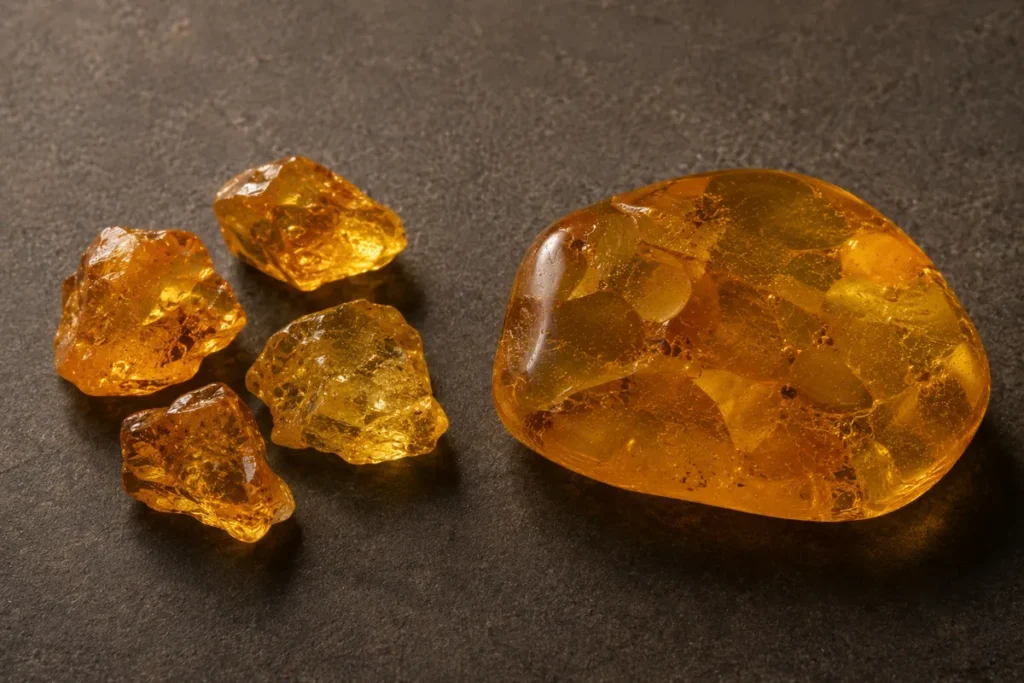
There is another possibility that is easy to overlook.
A piece may contain genuine amber material without being a single piece of naturally formed amber.
Small amber fragments can be combined under heat and pressure to produce a larger reconstructed material, commonly called pressed or reconstructed amber.
This is different from a piece made entirely from plastic.
The distinction matters because a buyer asking “Is this real amber?” may actually be asking several different questions:
- Is it natural amber?
- Is it pressed amber?
- Is it treated?
- Is it copal?
- Is it synthetic resin?
- Is it plastic?
Those are different categories.
A reputable seller should describe the material accurately rather than relying on a vague claim that something is simply “real amber.”
Amber vs. Plastic: Quick Comparison
| Characteristic | Natural Amber | Plastic Imitation |
| Origin | Natural fossil resin | Man-made synthetic material |
| Weight | Relatively lightweight | Varies widely |
| Color | Naturally variable | Can be manufactured to mimic amber |
| Internal structure | Often irregular and varied | Can be uniform or deliberately manufactured |
| Bubbles | May occur naturally | May be artificially introduced |
| Inclusions | Natural inclusions may occur | Artificial inclusions are possible |
| UV reaction | Often fluoresces, depending on material | Some plastics also fluoresce |
| Static electricity | Can develop static charge | Can also develop static charge |
| Saltwater | Some pieces may float | Some lightweight plastics may also float |
| Warmth to touch | Often feels relatively warm | Some plastics feel similar |
| Professional identification | Can be analyzed using gemological methods | Can often be distinguished through material analysis |
The important word in this table is “may.”
There are exceptions to almost every simple home test.
That is why identification becomes much more reliable when several characteristics point in the same direction.
What Is the Most Reliable Way to Tell Amber From Plastic?
If you only have a few minutes, start with a visual examination.
Look at the color
Does it have natural variation rather than a completely uniform appearance?
Examine the interior
Look for flow structures, bubbles, cloudy areas, fractures, and inclusions.
Check the weight
Does the piece feel unusually light compared with materials of a similar size?
Examine it under UV light
Look for fluorescence, but don’t treat it as proof.
Consider the saltwater test
If appropriate, use it as supporting evidence rather than a final answer.
Ask how the piece was made
Could it be pressed amber, treated amber, copal, or synthetic resin?
Consider the price and seller
An unusually low price for a supposedly rare specimen deserves more questions.
Use professional testing when necessary
If a significant amount of money is involved, professional identification is the safest option.
What Tests Should You Avoid?
Some traditional amber tests are more trouble than they are worth.
Avoid destructive scratching
You can permanently damage the piece.
Avoid the hot needle test
It damages the material and can produce unpleasant fumes.
Avoid burning or heating unknown materials
There is little reason to expose yourself or the specimen to unnecessary risk.
Don’t rely on smell alone
Different resins and plastics can produce different odors when heated, but smell is subjective and unreliable as a professional identification method.
Don’t trust a single test
This is the biggest mistake of all.
A piece that passes one home test has not necessarily passed an authenticity examination.
Can Plastic Look Exactly Like Amber?
Some modern plastic imitations can look remarkably convincing.
This is particularly true when the manufacturer deliberately reproduces:
- amber-like color
- transparency
- bubbles
- cloudy areas
- internal inclusions
- surface texture
That is why old rules such as “real amber has bubbles” or “fake amber looks too perfect” are no longer enough.
The better your imitation, the less useful a single visual clue becomes.
For expensive pieces, this is where laboratory analysis becomes valuable.
What About Synthetic Resin?
It is also worth distinguishing plastic from synthetic resin.
The two terms are sometimes used loosely in everyday conversation, but they do not necessarily refer to exactly the same materials.
Synthetic resins can be manufactured to resemble natural amber extremely closely.
Some may even be engineered with internal features intended to imitate natural amber.
This is one reason professional material identification can be more useful than trying to classify an unknown piece based solely on appearance.
If an Amber Has an Insect Inside, Is It Definitely Real?
No.
This is one of the most persistent misconceptions about amber.
Natural amber can contain extraordinary fossil inclusions, including insects and plant material.
But modern insects can also be deliberately placed into synthetic resin.
If you see an inclusion, examine the relationship between the inclusion and the surrounding material.
Does the insect appear naturally embedded?
Are there signs of resin flow?
Does the surrounding material have other characteristics consistent with natural amber?
Is the price and provenance reasonable?
A genuine-looking insect is interesting evidence, but it is not enough by itself.
How Can You Be More Confident When Buying Amber?
Authentication should begin before you make the purchase.
Ask the seller:
- What exactly is the material?
- Is it natural amber?
- Is it pressed or reconstructed?
- Has it been treated?
- Where is it said to originate?
- Does the seller provide documentation for valuable pieces?
- Is independent testing allowed?
A trustworthy seller should be comfortable answering reasonable questions.
Be particularly cautious when a seller makes dramatic claims such as:
“100% guaranteed authentic because it floats.”
or:
“The insect proves it is millions of years old.”
or:
“It glows under UV, so it must be Baltic amber.”
These statements oversimplify identification.
A professional seller should be able to explain the material without relying on a single home test.
Final Thoughts
Learning how to tell amber from plastic is less about memorizing a list of tricks and more about learning how to evaluate evidence.
Natural amber has a distinctive combination of characteristics: it is relatively lightweight, comparatively soft, often internally varied, and capable of displaying fascinating inclusions and fluorescence.
Plastic can imitate many of these features.
That is why the strongest approach is to combine observations rather than rely on one dramatic test.
Look closely at the material. Examine its interior. Consider its weight, inclusions, bubbles, and fluorescence. Use simple tests only as supporting evidence, and avoid methods that could damage the specimen.
And if the piece is valuable, rare, or being sold with an important claim about its origin or inclusions, don’t leave the decision to a kitchen-table experiment.
The more valuable the amber, the more valuable a proper identification becomes.
Frequently Asked Questions
How can I tell amber from plastic at home?
Start by examining the color, internal structure, bubbles, inclusions, weight, and overall appearance. UV light and a properly prepared saltwater test can provide additional clues, but no home method can guarantee authenticity.
Does real amber feel different from plastic?
Amber is relatively lightweight and often feels warm compared with materials such as glass or metal. However, some plastics can feel very similar, so touch alone cannot distinguish the two.
Does real amber float in saltwater?
Some genuine amber can float in sufficiently concentrated saltwater because of its relatively low density. However, some lightweight plastics can also float, so this is not a definitive test.
Does plastic glow under UV light?
Some plastics fluoresce under ultraviolet light. Genuine amber can also fluoresce, and the exact reaction varies. UV light should therefore be treated as a supporting identification method rather than proof.
Can fake amber have bubbles?
Yes. Manufacturers can introduce bubbles into synthetic materials to imitate the appearance of natural amber. The size, shape, distribution, and overall internal structure are more useful than simply looking for bubbles.
Can plastic contain insects?
Yes. Artificial insects or other inclusions can be embedded in synthetic resin. The presence of an insect does not by itself prove that a piece is natural amber.
Is pressed amber the same as fake amber?
Not exactly. Pressed amber can be made from genuine amber fragments that are combined under heat and pressure. It is different from a single naturally formed piece of amber, but it is also different from a completely synthetic plastic imitation.
What is the most reliable way to identify amber?
For valuable or uncertain specimens, professional gemological examination is the most reliable approach. Laboratory methods can examine the material’s physical, chemical, and structural characteristics in much greater detail than simple home tests.